

Principal's Message
Principal’s Message
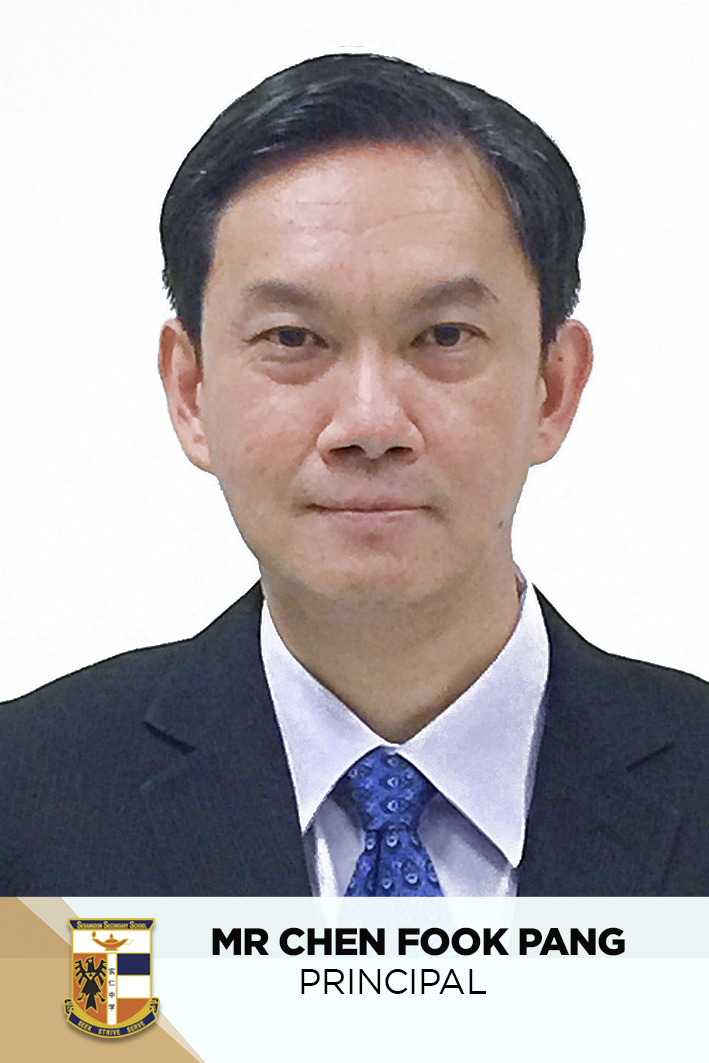
SPEECH BY MR CHEN FOOK PANG, PRINCIPAL, SERANGOON SECONDARY SCHOOL, AT THE 98TH PRIZE PRESENTATION DAY AT SERANGOON SECONDARY SCHOOL ON FRIDAY 30TH APRIL 2026, 9.00 AM
Good morning
Mr. Fu Chuan Chong, Director, School of Hospitality, Republic Polytechnic, former student of SSS
Fellow Members, School Advisory Committee
Distinguished partners, Alumni, representatives from CDAC, Mendaki, SINDA, MOE HQ, government and industry partners, Grassroot Leaders
Parents and guests of the school
Teachers, staff members and students
Ladies and gentlemen
A. Introduction and Welcome
1 - Welcome to our 98th Prize Presentation Day. We are honoured to have Mr Fu Chuan Chong with us as our Guest-of-Honour on this special occasion. As we come together this morning, we commemorate nearly a century of educational excellence and celebrating the outstanding accomplishments of our school community.
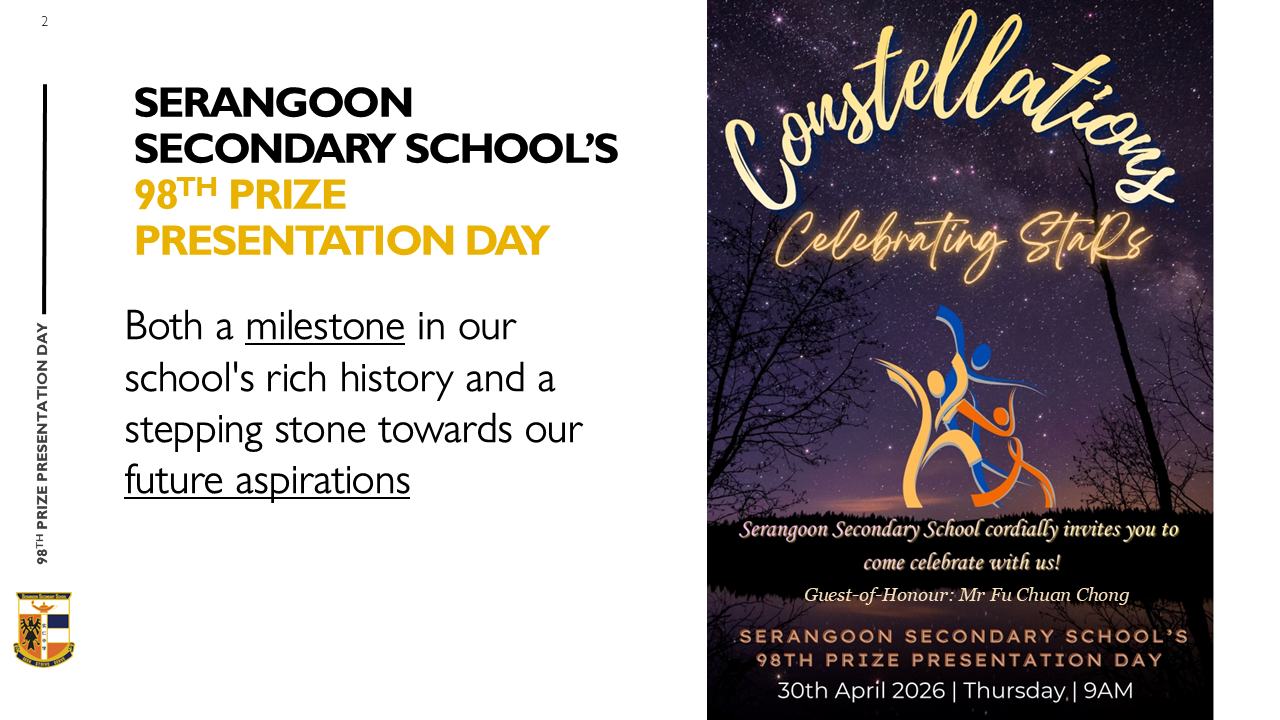
2 - Looking across this assembly fills me with immense humility. We are here not simply to hand out awards, but to celebrate a year of growth, resilience, and success — a milestone in our school’s history and a stepping stone towards our future. Today, we honour the outstanding achievements of our students and staff, a testament to their hard work and perseverance. And we recognise, too, the supportive environment that empowers every one of them to reach their fullest potential.
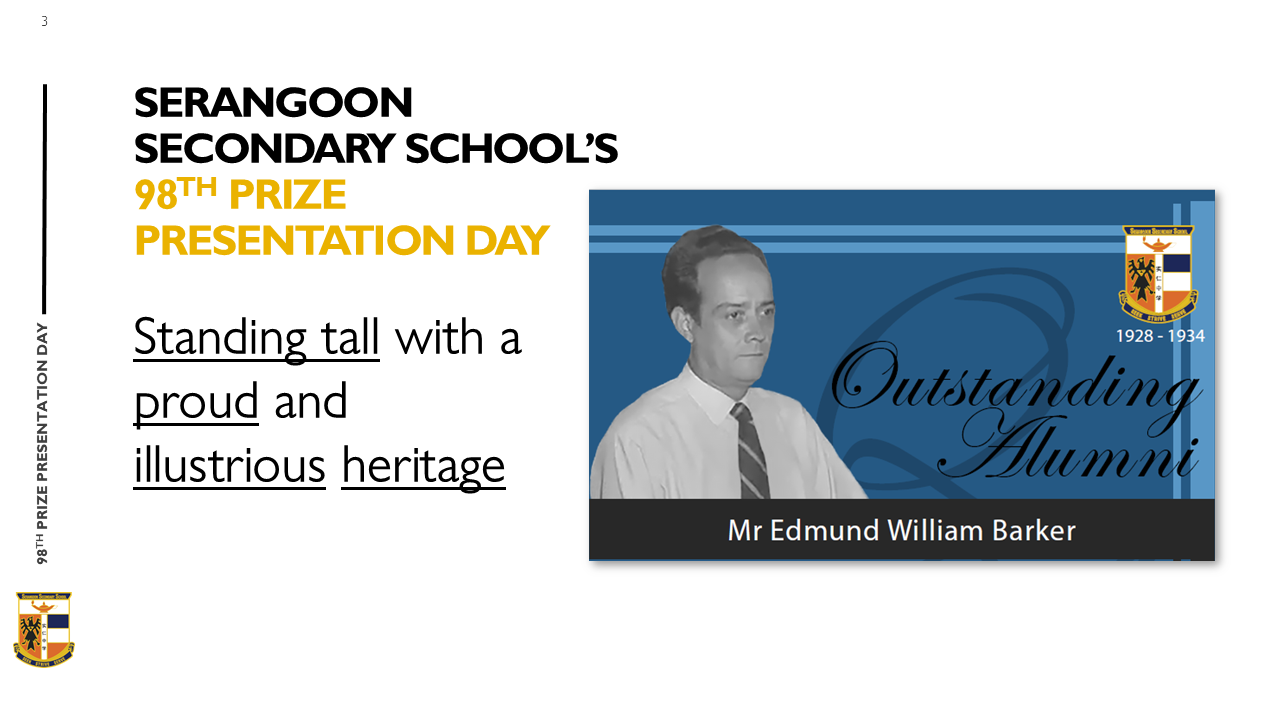
3 - This school carries a proud heritage, having nurtured generations of leaders who have shaped our nation — among them Mr Edmund William Barker, former Cabinet Minister;
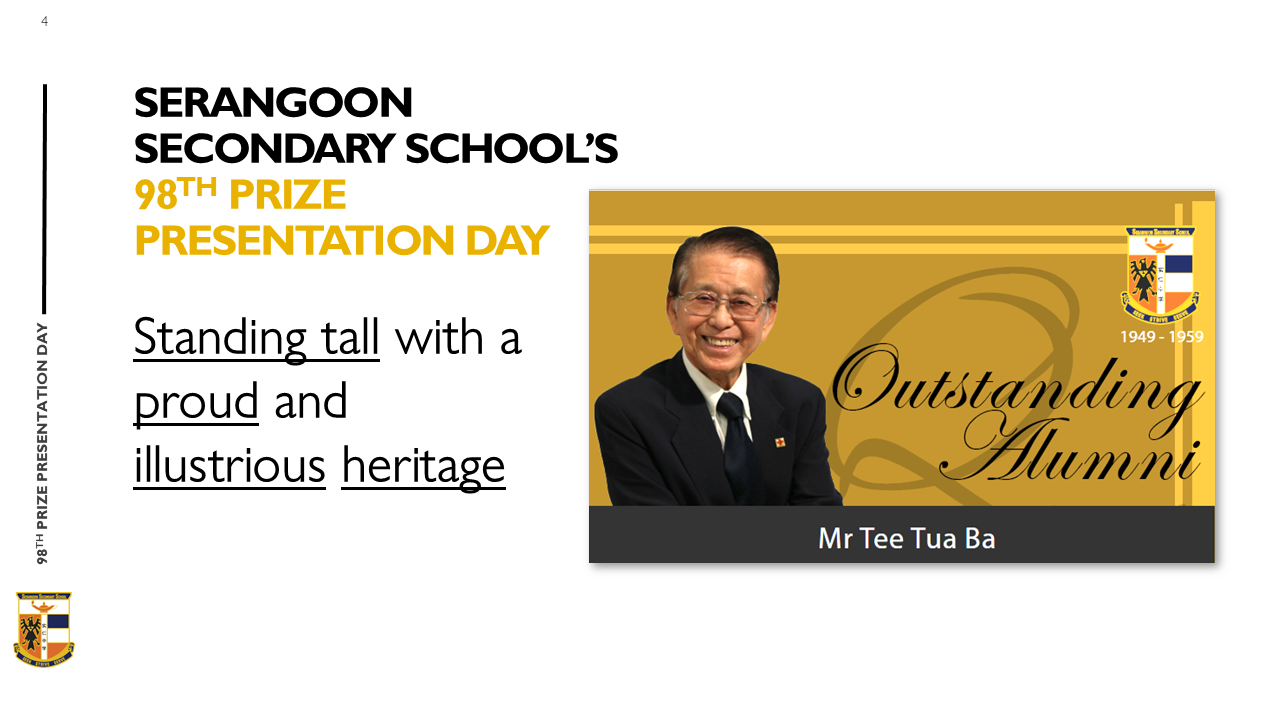
Mr Tee Tua Bah, former Commissioner of Police;
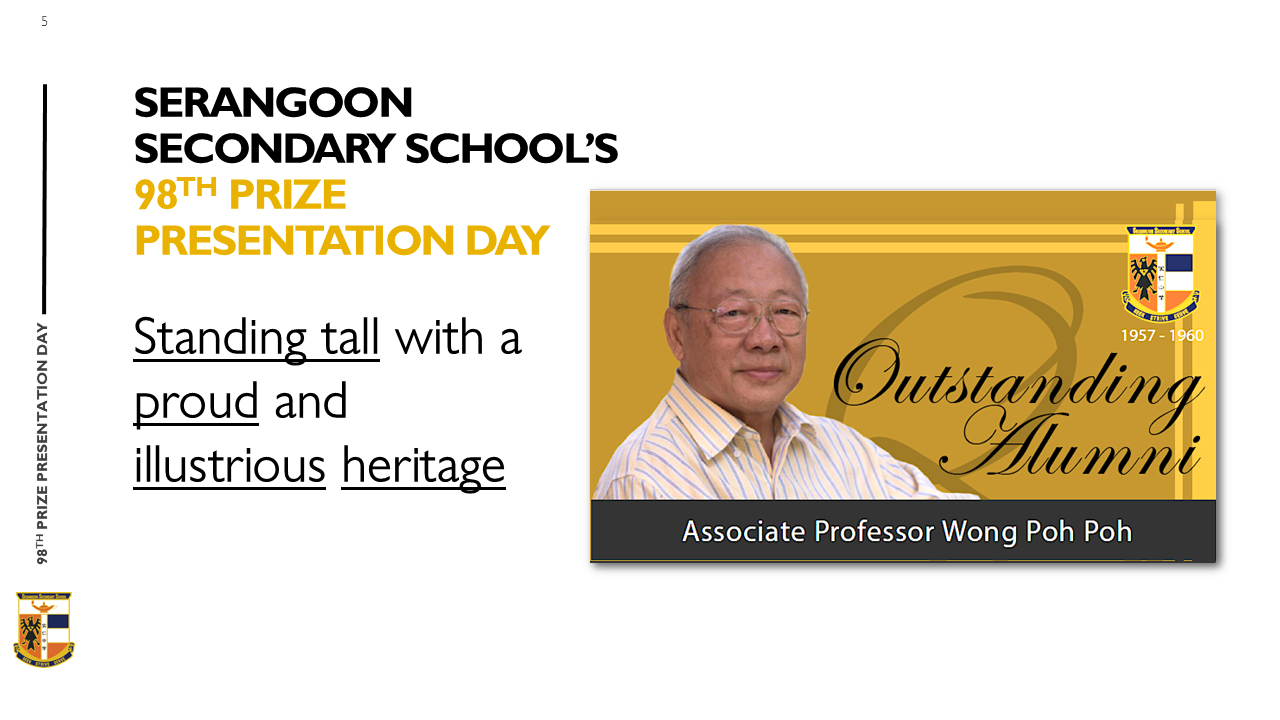
Dr Wong Poh Poh, internationally renowned climate change scholar and IPCC (Intergovernmental Panel on Climate Change) contributor; and
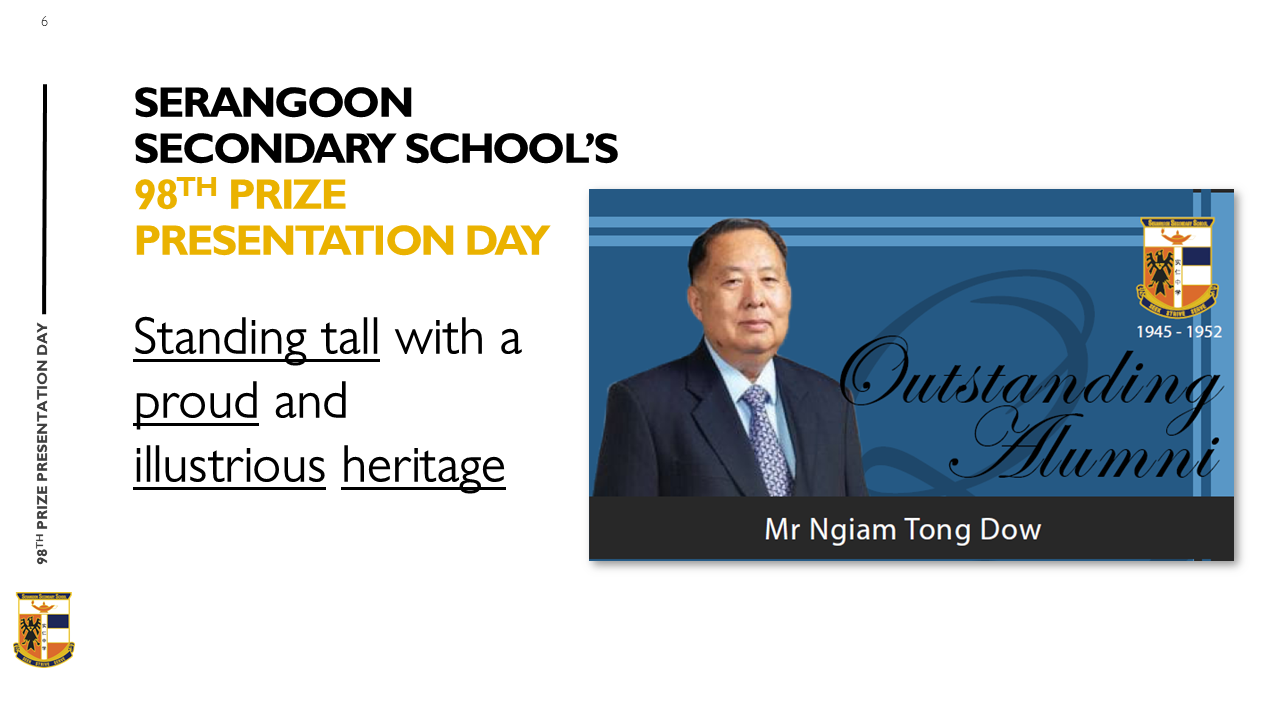
Mr Ngiam Tong Dow, one of Singapore’s most respected top Civil Service Permanent Secretaries.
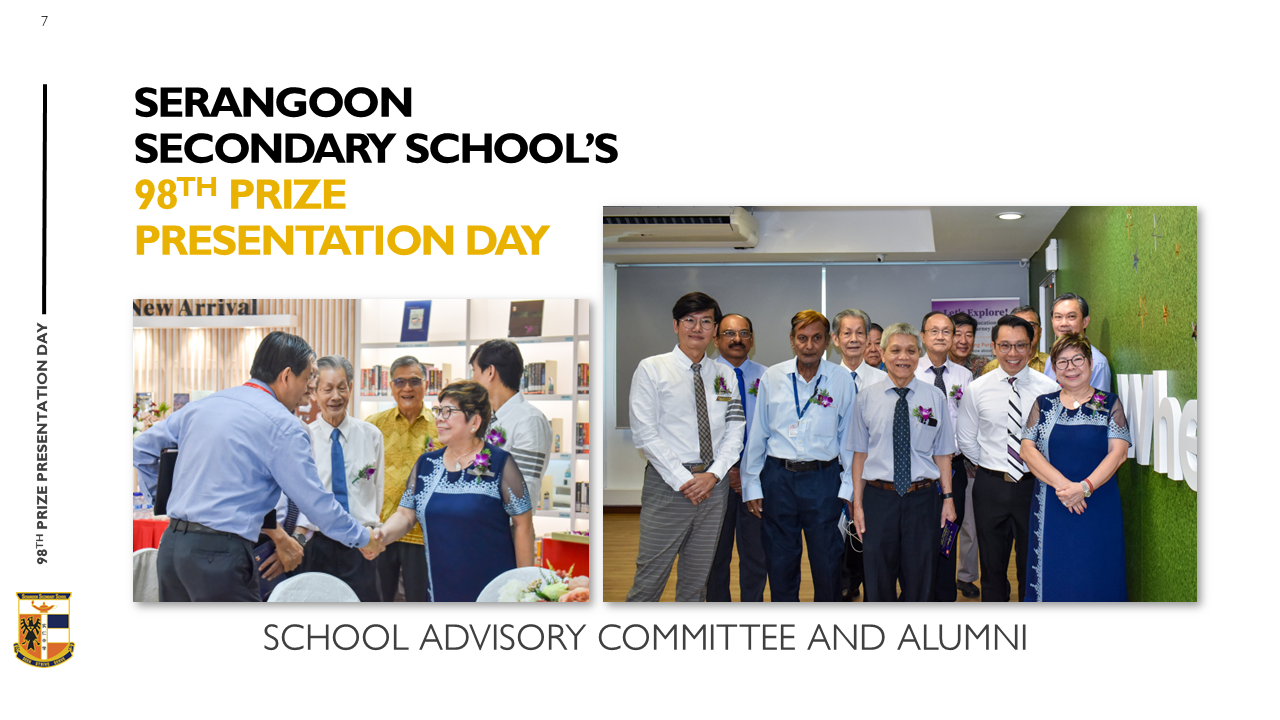
Our alumni embody integrity, resilience, and compassion — leaders in their fields and pillars of their communities. We pay tribute to the Serangoon Alumni, whose continued support keeps our school’s legacy vibrant and strong.
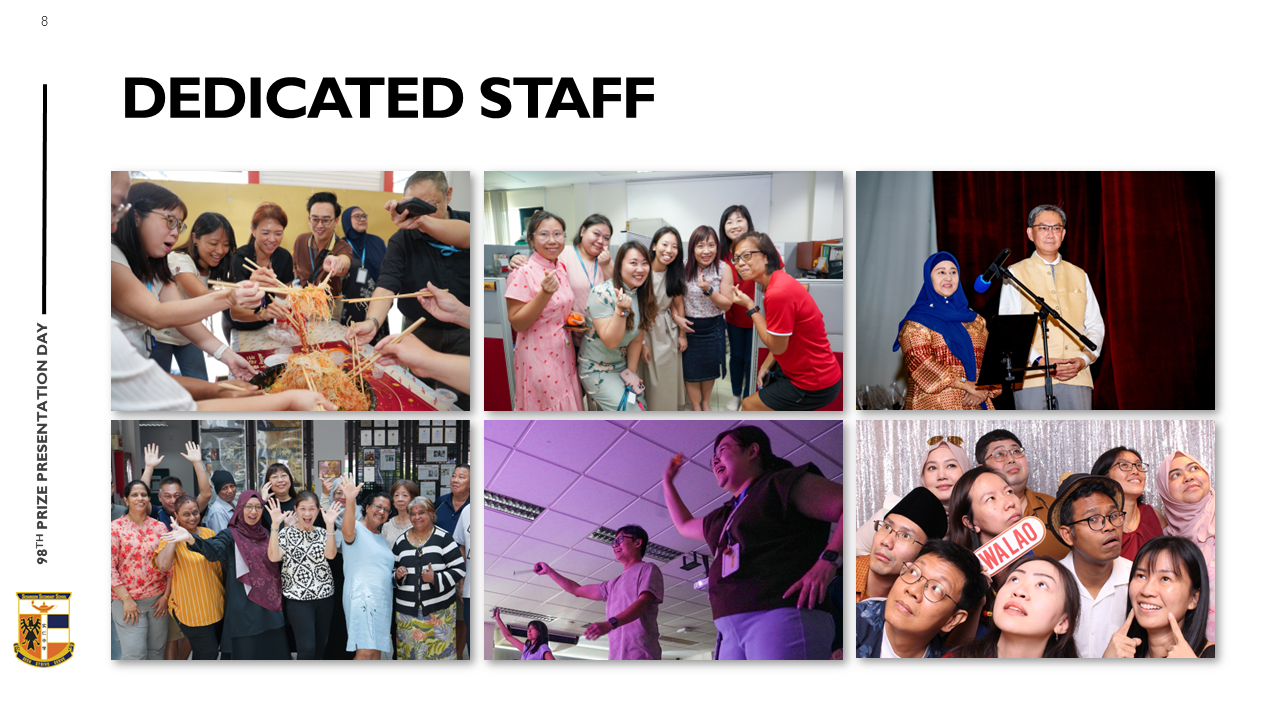
4 - At the heart of this legacy are our dedicated teachers, who shape minds, build character, and guide every student with care and conviction. To all our educators and staff—your tireless devotion lights the path forward for each Serangoon StaR, and we salute you with heartfelt gratitude.
B. P’s Directional Setting of 54321

5 - In 2024 – 2025, I have shared our school’s 5-4-3-2-1 framework, which guides us in our mission to equip, empower, and embolden every StaR to reach their fullest potential. We have continued to drive the school forward in this endeavour.
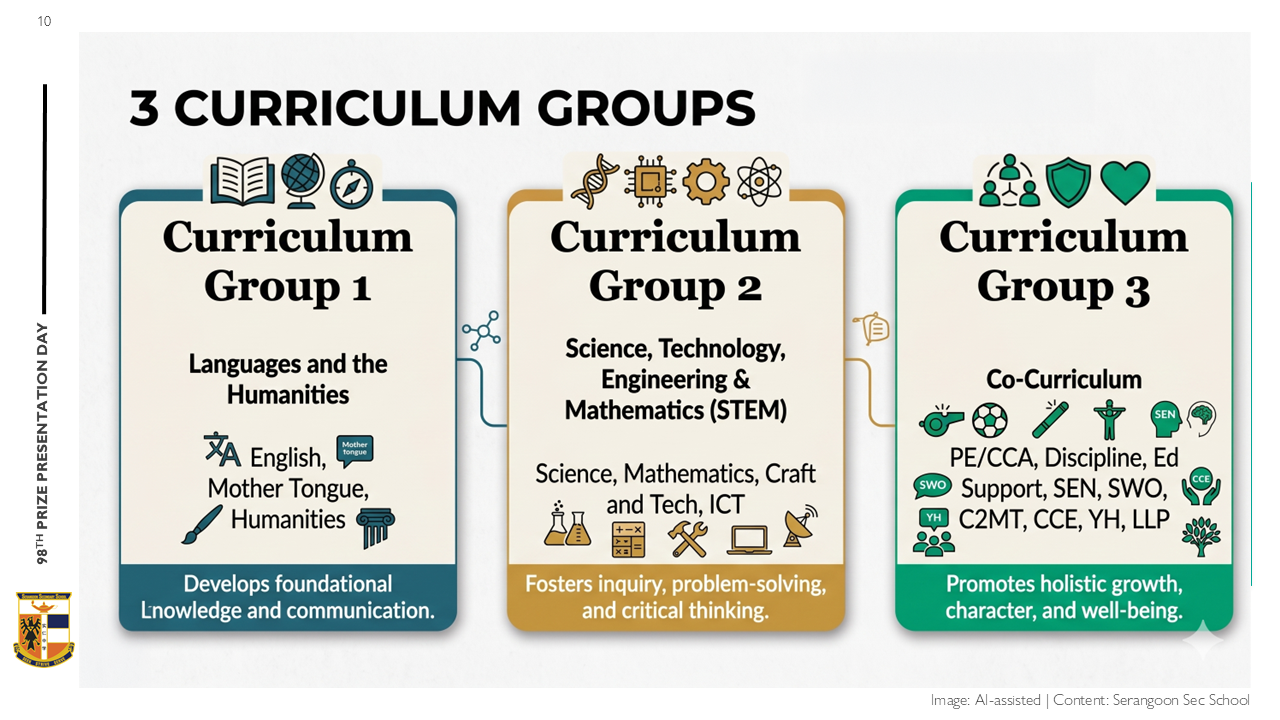
6 - Our IP subjects are organised into curriculum groups. Curriculum Group 1, or CG1, comprises Languages and Humanities, while Curriculum Group 2, or CG2, comprises STEM subjects. Together, CG1 and CG2 form the Academic Curriculum, overseen by an experienced team of Heads of Department and guided by our School Leaders. The Student Development Curriculum is organised under Curriculum Group 3, or CG3, and includes Physical Education, Co-Curricular Activities, Character and Citizenship Education, as well as the Year Head Curriculum. By balancing intellectual growth with character development, this structure embodies our commitment to a future-ready Total Curriculum.
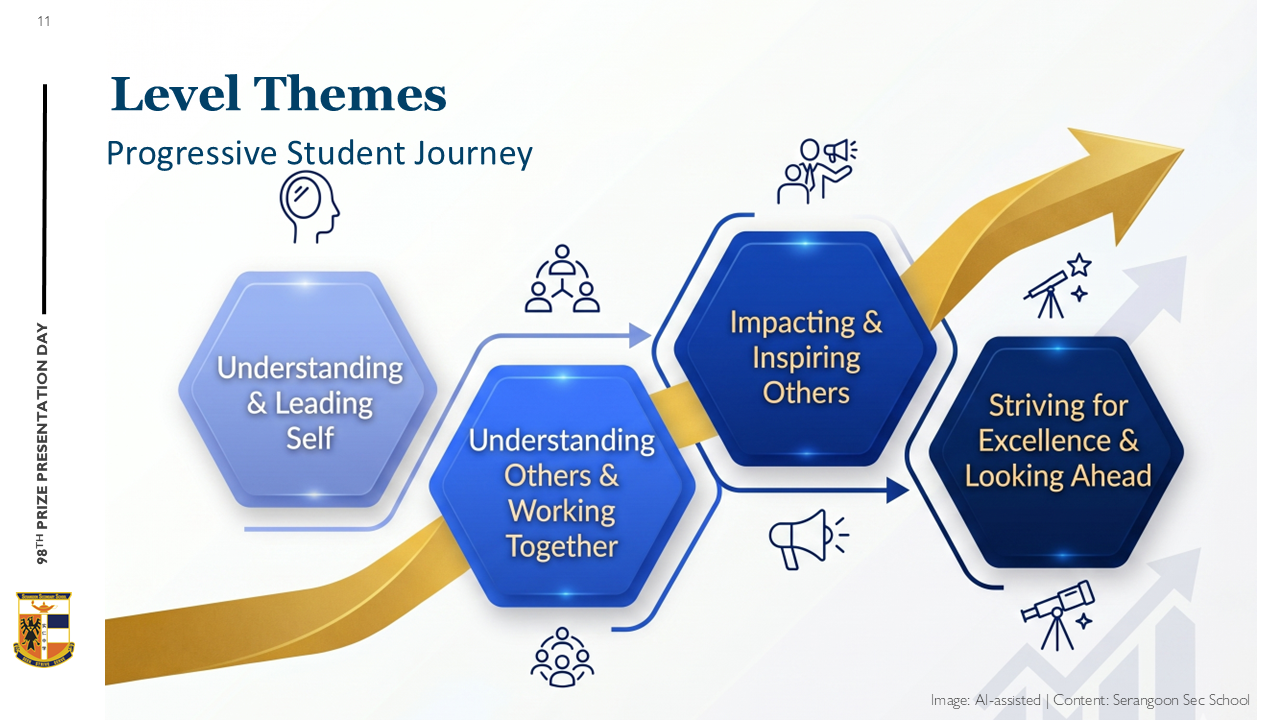
7 - Building on this structure, Level Themes provide clear focus and coherence, guiding students through a purposeful journey year by year. In Lower Secondary, the focus is on understanding self and working well with others harmoniously. In Upper Secondary, we guide our StaRs to step up their impact and influence.
8 - Academically, they move from ‘Transition’ in Secondary 1 to becoming ‘Future Ready Learners’ by Secondary 4. In parallel, their personal development grows from self-understanding to striving for excellence and looking ahead. Together, these pathways ensure holistic growth across every level.
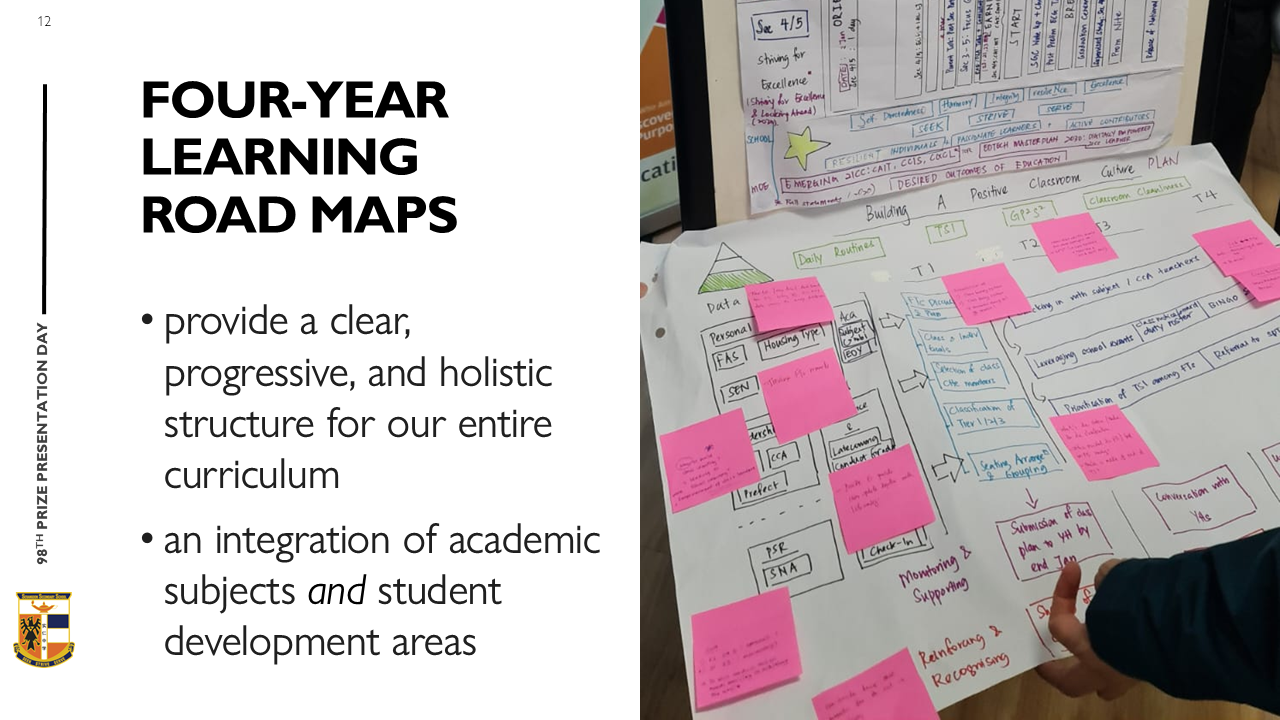
9 - Over the past two years, Serangoon Secondary has undertaken a curriculum review to enhance holistic learning. At its core are Four-Year Learning Road Maps, spanning Secondary 1 to 4. Aligned with MOE’s outcomes, these road maps integrate academic subjects with student development areas — CCE, VIA, and E21CC — systematically building the knowledge, skills, and values our students need.
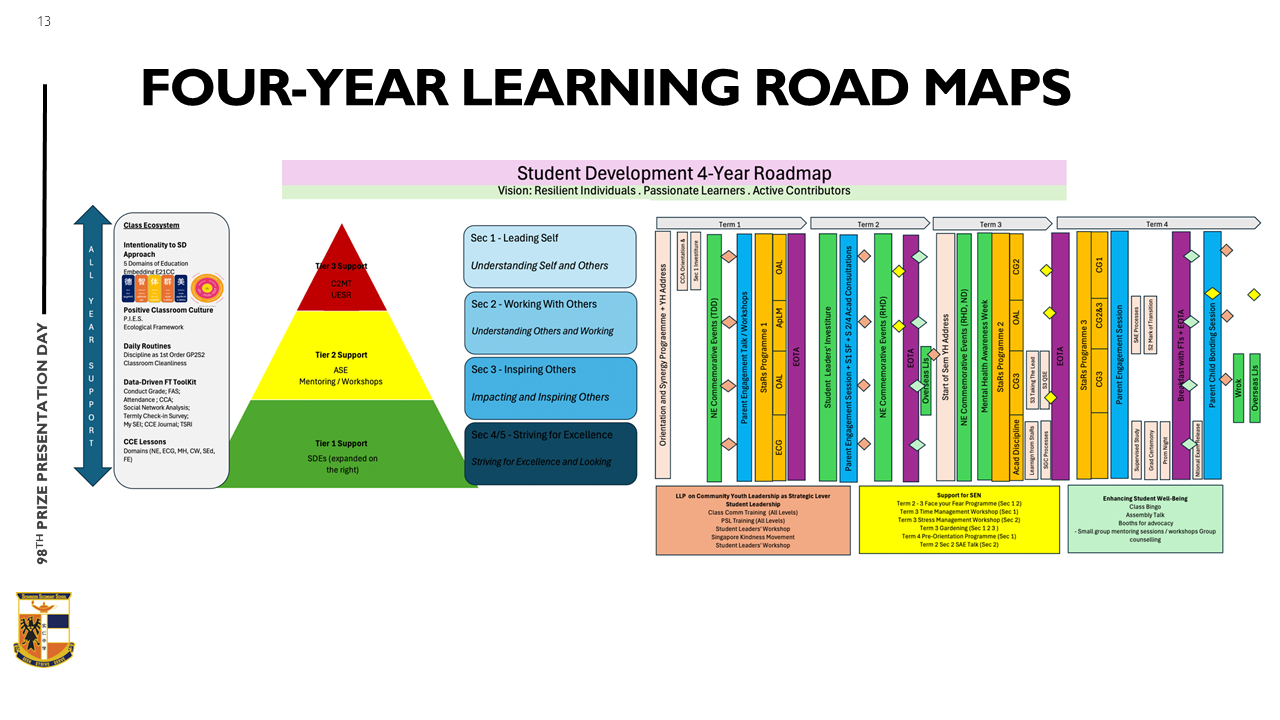
10 - Today, I am delighted to share how we are stepping up our efforts to empower our staff in building our StaRs across student development and instructional programmes.This is done through the Student Development Four-Year Learning Roadmap to grow our StaRs holistically and guide their development throughout their secondary school journey.
C. Enhancing the Culture of Care with Class Ecosystem
11 - Today, I am happy to share how we have made further enhancements to our class Ecosystem.
Section C1: StaRs Programme
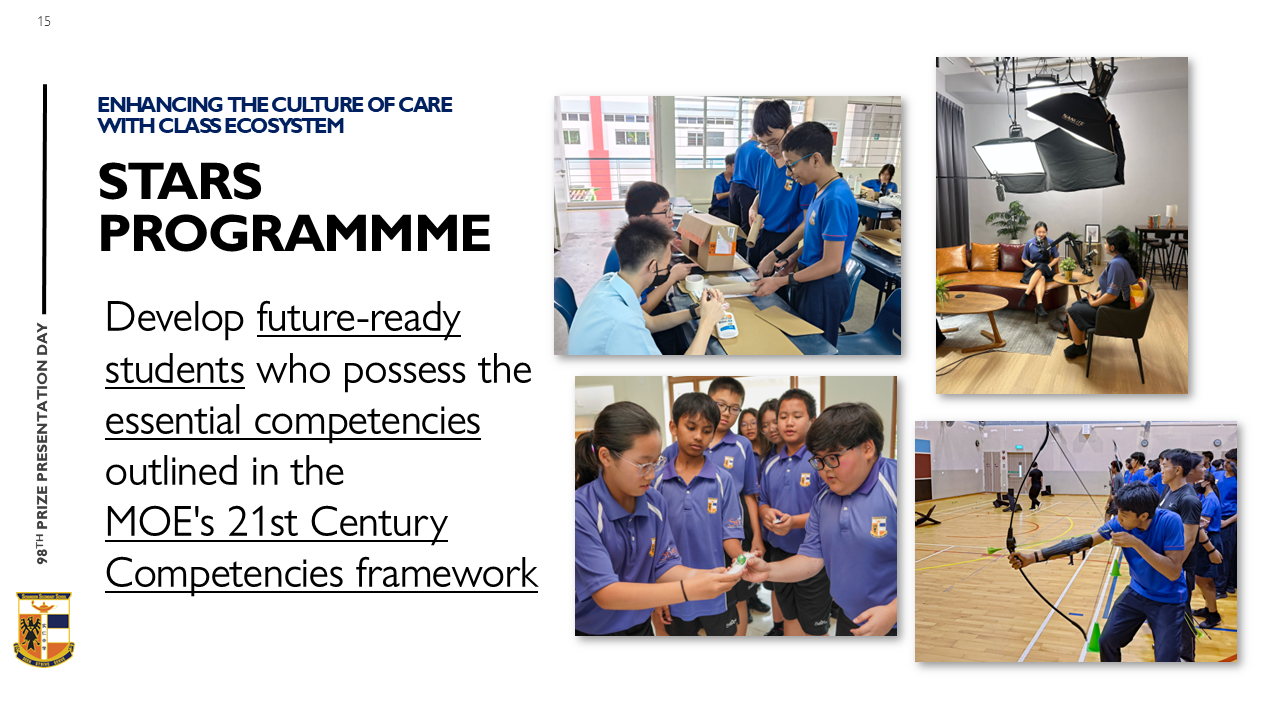
12 - Our signature StaRs Programme is a series of three engaging programmes that take place throughout the year, designed to enrich our students’ educational experience. The various StaRs Programme activities are aligned to our level themes for a coherent student experience. Allow me to share some of our StaRs’ learning in the StaRs Programme from Term 1 this year.
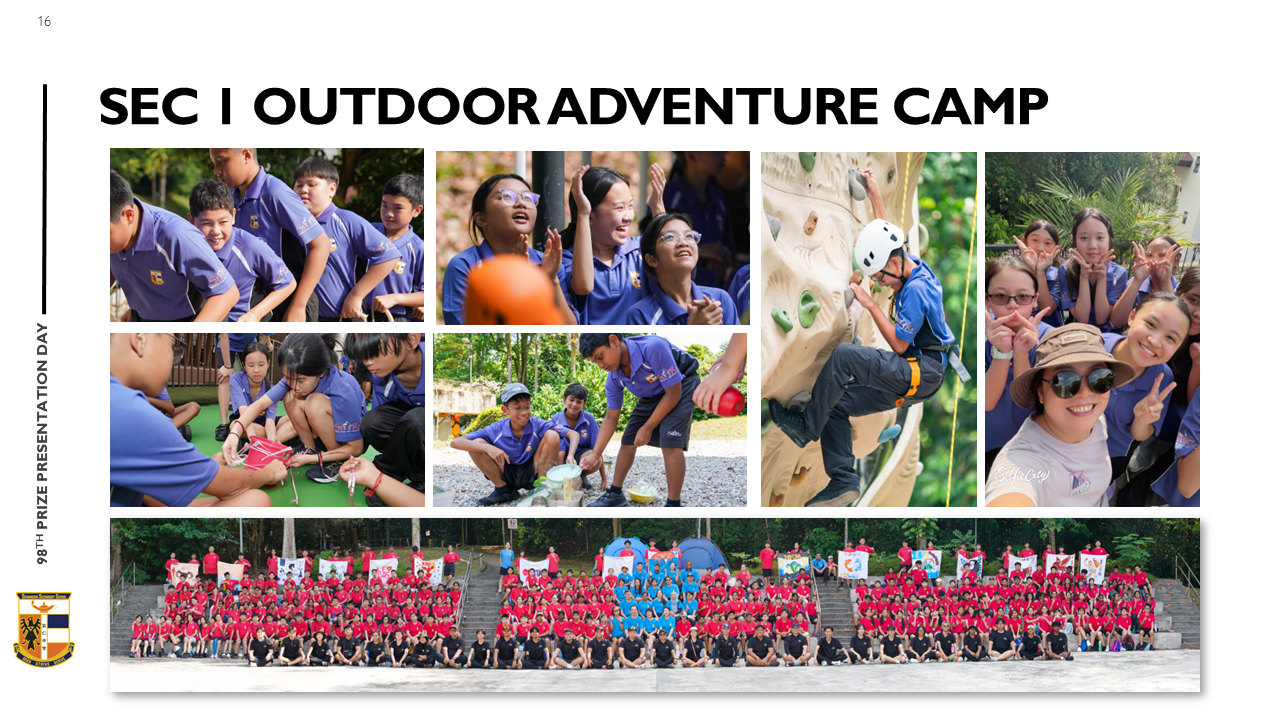
13 - Our Secondary 1 took part in the outdoor adventure camps in March. Various experiences here serve as powerful platforms for character development, where students cultivate essential life skills including resilience and collaborative teamwork. I particularly like the last photo with our Sec 1 StaRs coming together with their class flags, as one cohort.
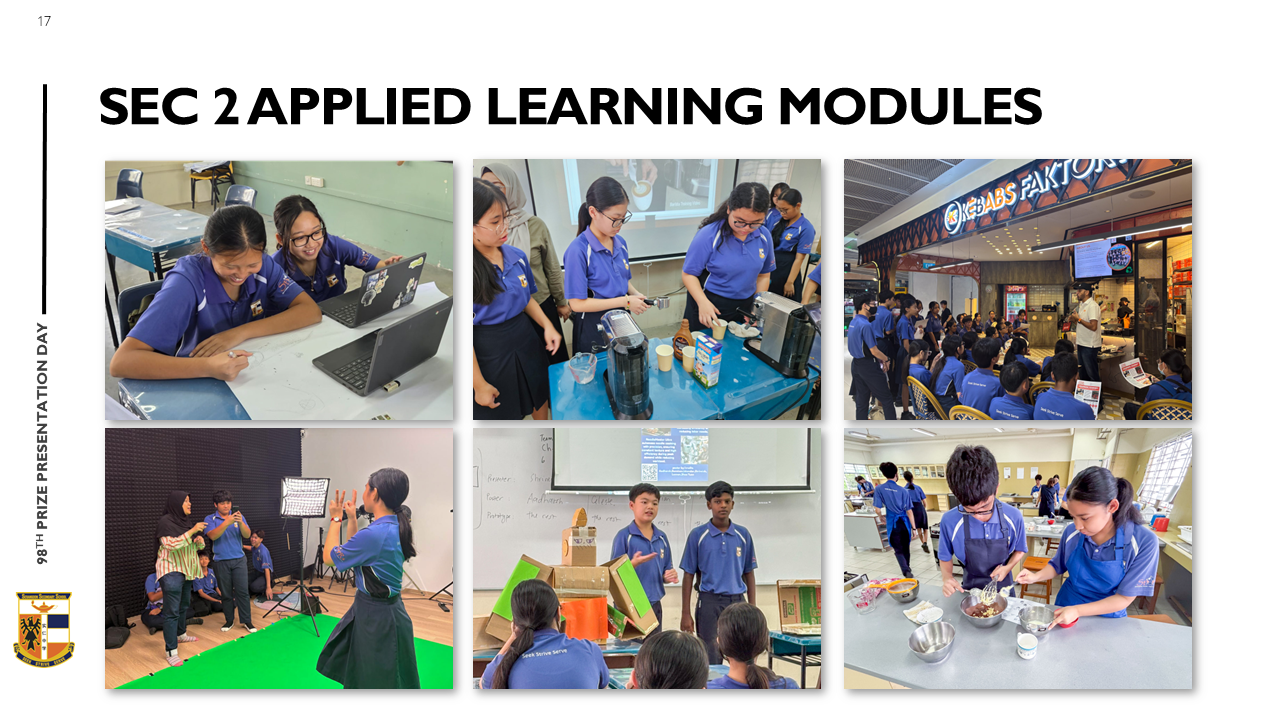
14 - The Secondary 2 Applied Learning Module represents another cornerstone of our programme, where students engage with authentic, real-world challenges that demand innovative solutions. Students had the chance to work in teams, develop their analytical thinking abilities and opportunities to demonstrate and present their learnings – perfectly embedding E21CC within.
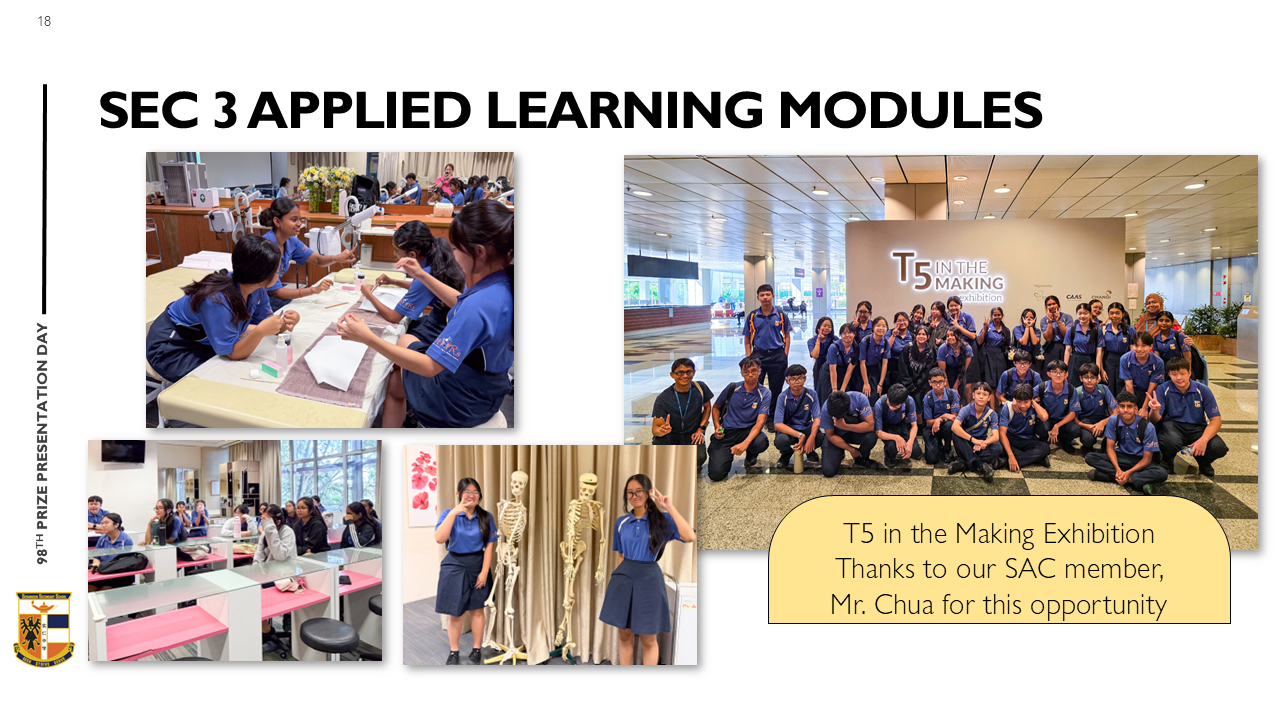
15 - Our Secondary 3 students benefit tremendously from structured visits to Institutes of Higher Learning, gaining invaluable exposure to diverse academic pathways and career possibilities. These experiences empower them to make well-informed decisions about their future educational and professional trajectories.
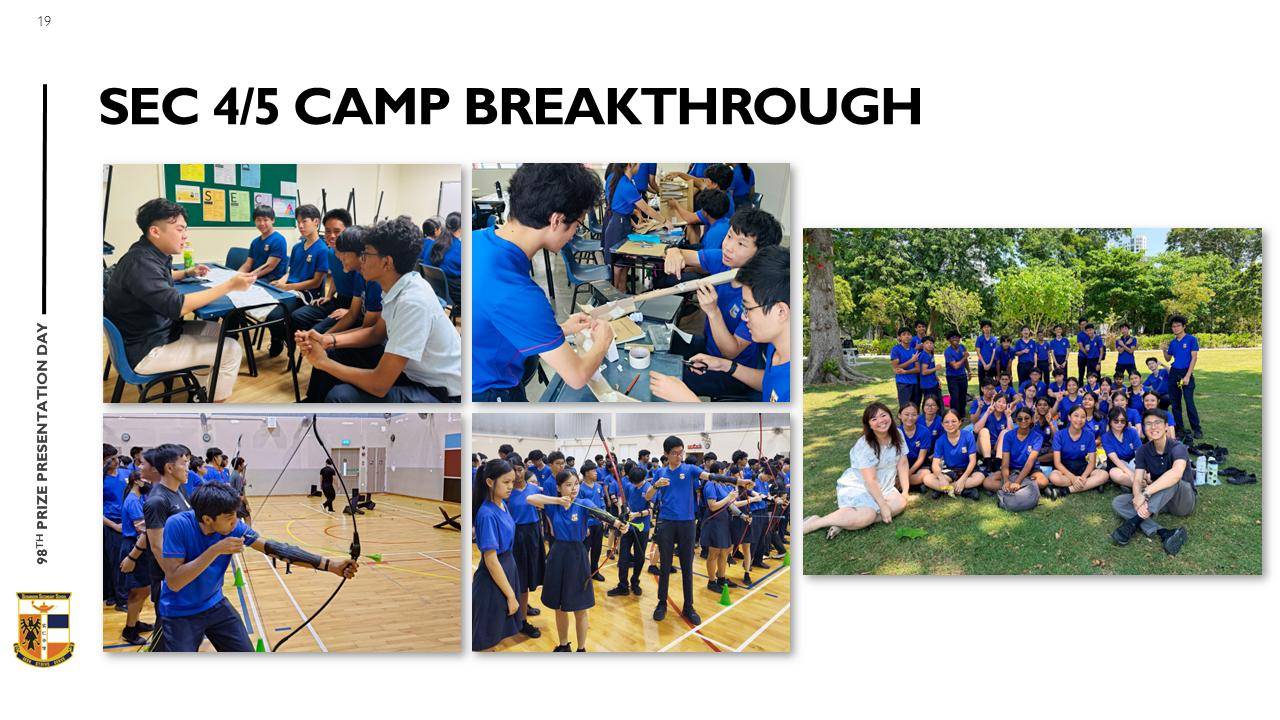
16 - Last but not least, our Secondary 4 and 5 students engage in comprehensive Education and Career Guidance portfolio development, where they refine their personal statements and enhance their interview competencies through mentorship and practice sessions.
Section C2: Overseas Learning Journeys
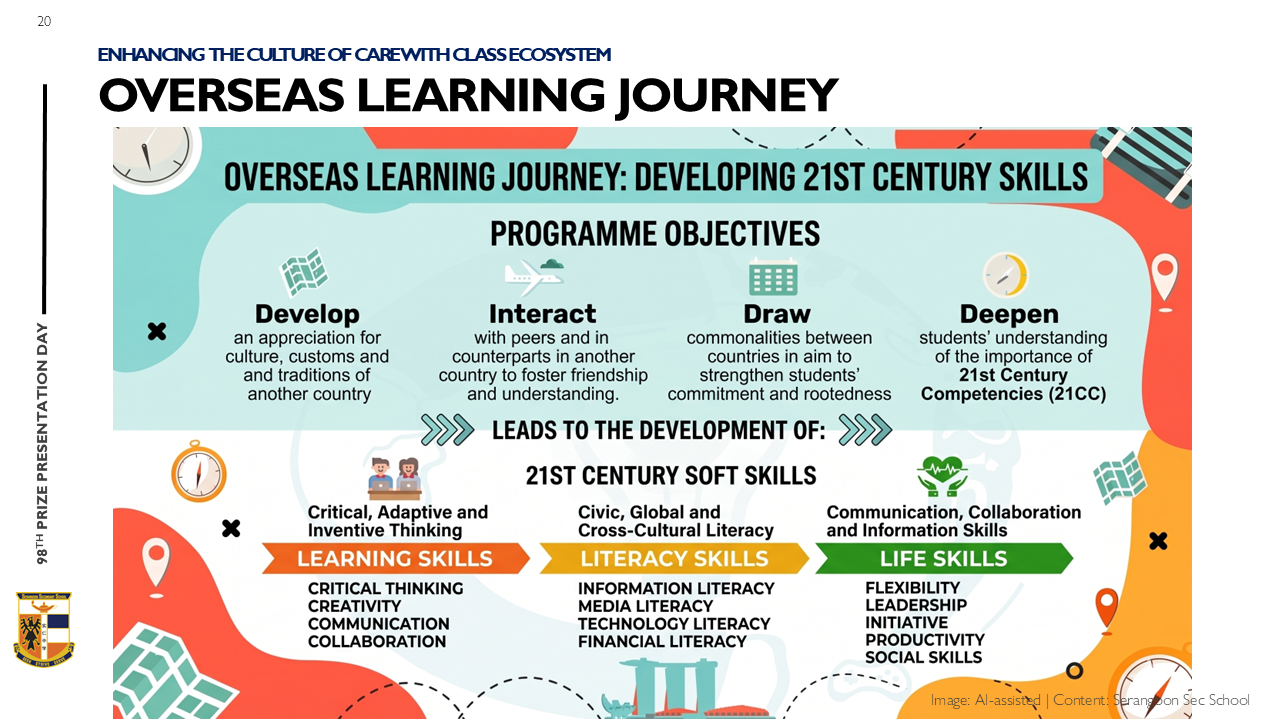
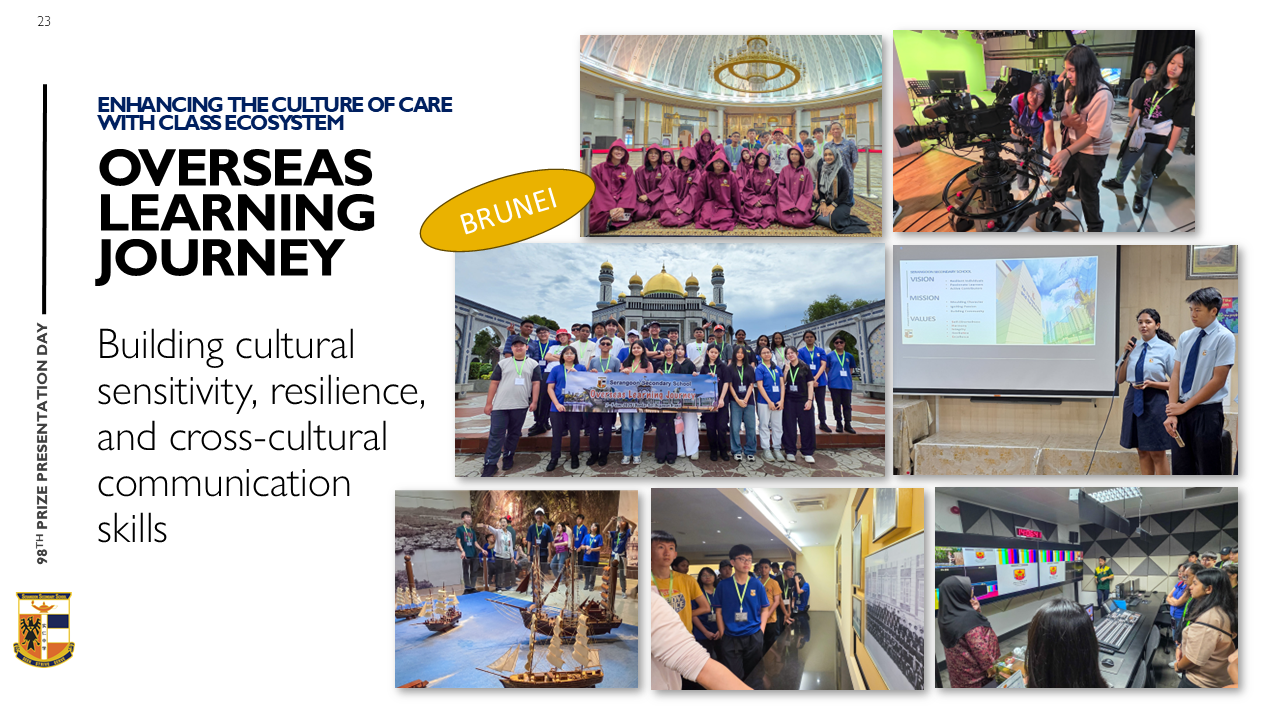
17 - Overseas learning journeys remain central to developing our students’ 21st Century Competencies. Building on recce trips to Brunei and Vietnam in 2023,
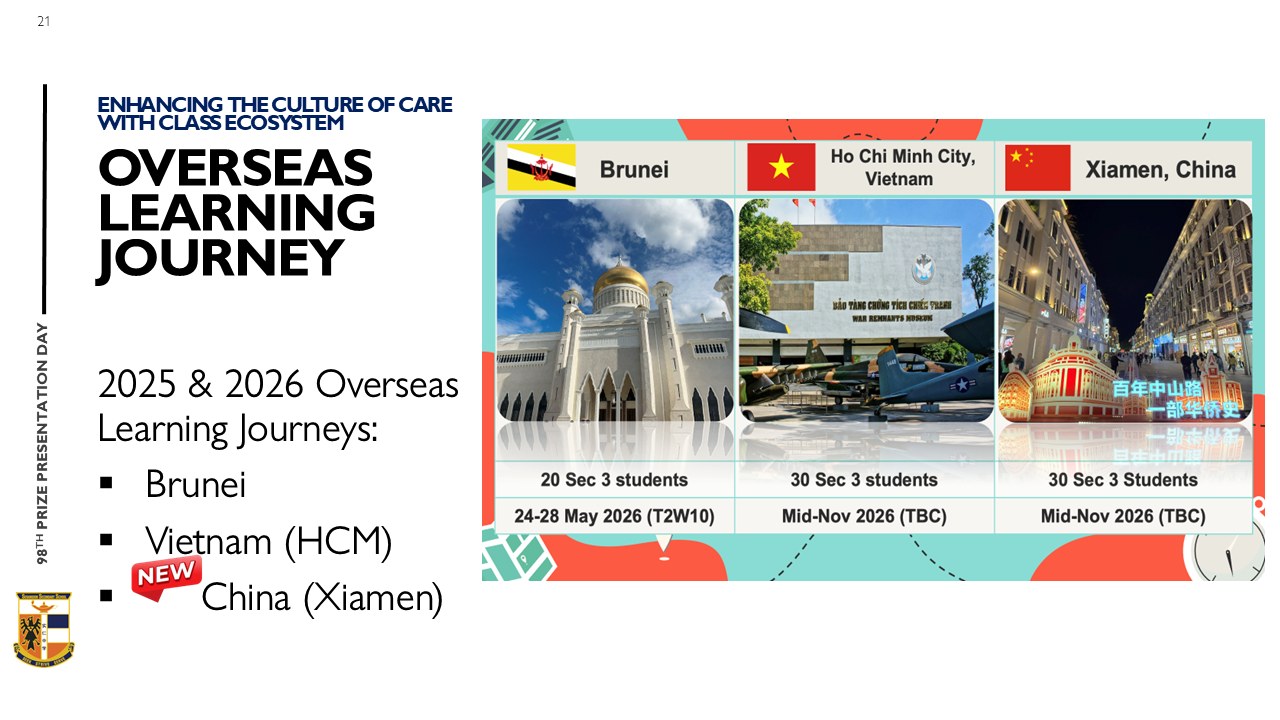
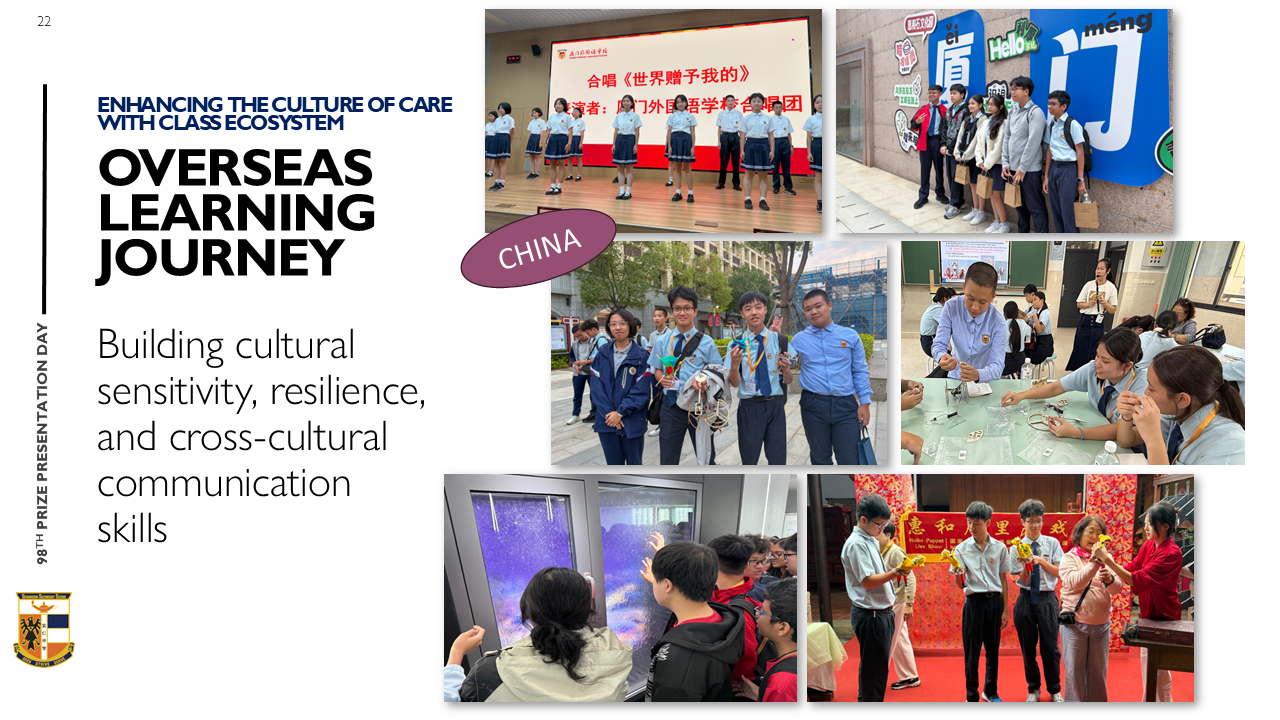
we expanded the programme in 2025 with a third destination — China —
reflecting our commitment to a structured,
progressive global learning experience in ASEAN and Asia. These journeys push students to step beyond their comfort zones,
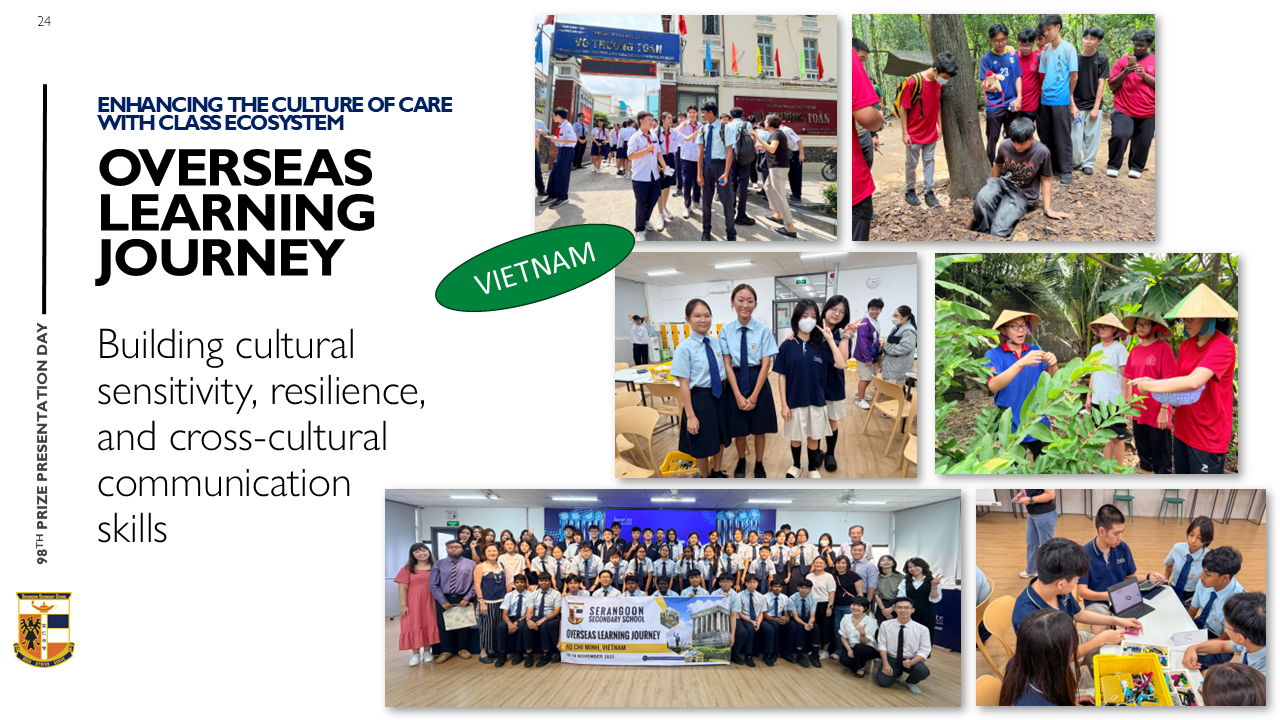
building cultural sensitivity, resilience, and cross-cultural communication skills.
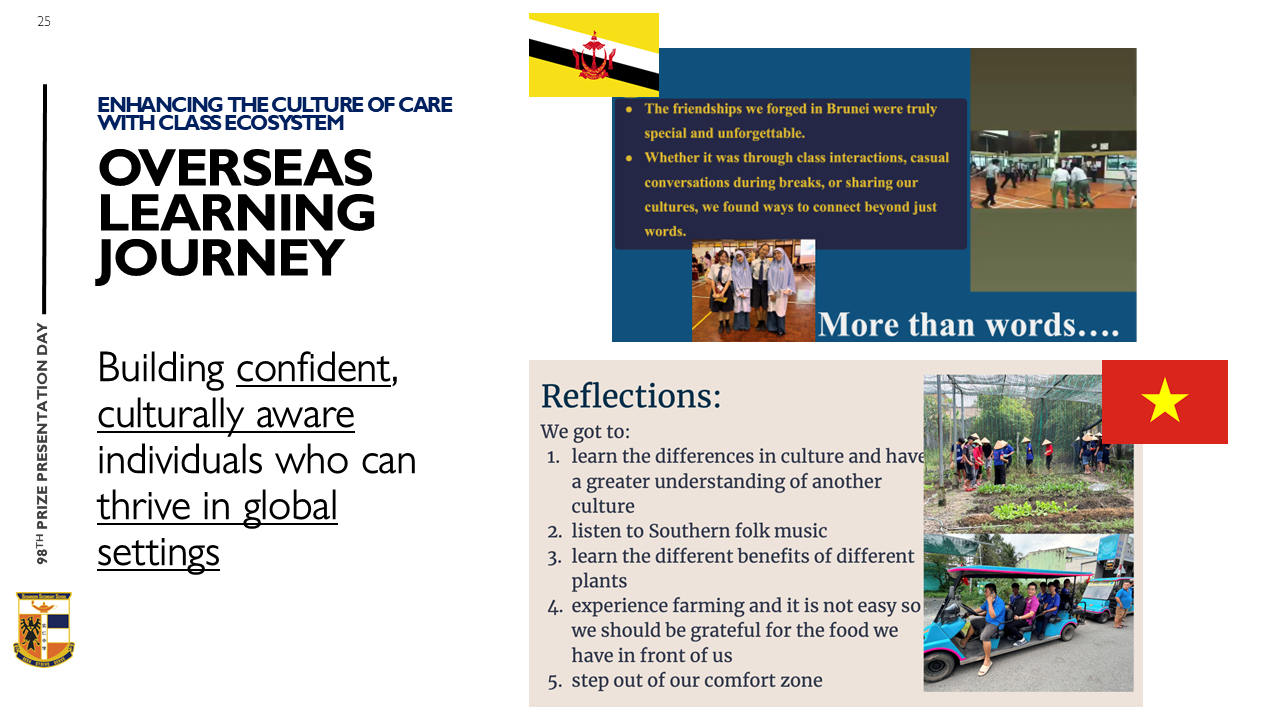
The learning continues beyond the trip itself, with post-trip sharing sessions at assembly where students reflect on their growth and inspire their peers.
Section C3: One Class, One Kampong, One Serangoon
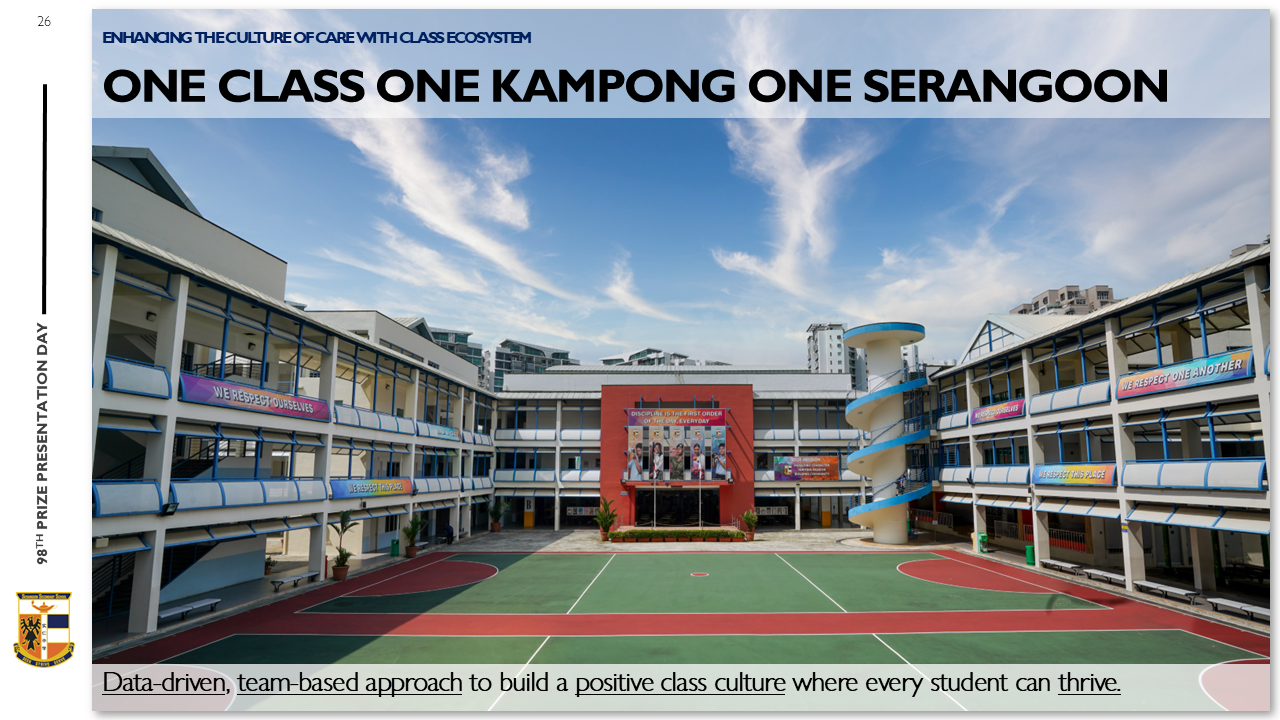
18 - SSS has consistently pride herself with a strong culture of care as a core strength. The Student Development Team (SDT) plays a critical role in the planning, implementing and monitoring to guide our Serangoon StaRs. Allow me to share broadly key directional shifts over the past few years:
19 - In 2023, the team noted the importance of care element in the work we do, and we renamed the Case Management Team to Care and Case Management Team (C2MT). We discussed roles and responsibilities within SDT, upstream and downstream measures, and looked into streamlining and integrating processes to help uplift our students with additional needs. This outlines the importance of inclusivity.
20 - In 2024, we started making shifts and embarked on ‘One Class, One Kampong, One Serangoon’. Firstly, having our Year Heads and School Counsellors follow up with their cohorts to ensure greater Teacher-Student Relationships, and reallocating Educational Support processes into Year Head and Student Management workflows. The C2MT triage workflow was also formulated and digitalized, and the SD road maps were drawn out. The class ecosystem data toolkit was introduced to consolidate key information through a data analytics dashboard, comprising check-in surveys, social network analysis and various class-based information parameters.
21 - In 2025, the School Staff Developer, HOD/Data Management and HOD/CCE joined the C2MT. This allowed us to better coordinate upstream measures, strengthened the use of data and looked into further building staff capacity. For the first time, the respective level FTs and subject teachers came together to discuss about the students during the conduct grade exercise. The sharing of good practices was also enhanced, with multiple sharing sessions at Staff Contact Time by FTs, for FTs. This allowed FTs to better provide more timely and targeted support at the class level.
22 - To further strengthen the class ecosystem this year, level themes have been translated into clear cohort goals and communicated to staff and students at the start of the year. These will guide class directions and individual targets, ensuring greater coherence in student development. To strengthen alignment between students’ developmental experiences and level themes, the following enhancements will be implemented in 2026.
23 - Learning and reflection from StaRs Programme will be aligned to level themes and cohort goals. The Emerging 21st Century Competencies framework will be systematically woven into the class ecosystem approach, with identified competencies embedded in reflection activities and students recording their development in the CCE journal.
24 - Secondly, with greater use of data and providing teachers with autonomy to build a positive classroom culture, time was set aside for individual class bonding activities, with class committee leaders actively involved in the planning and implementation of bonding sessions.
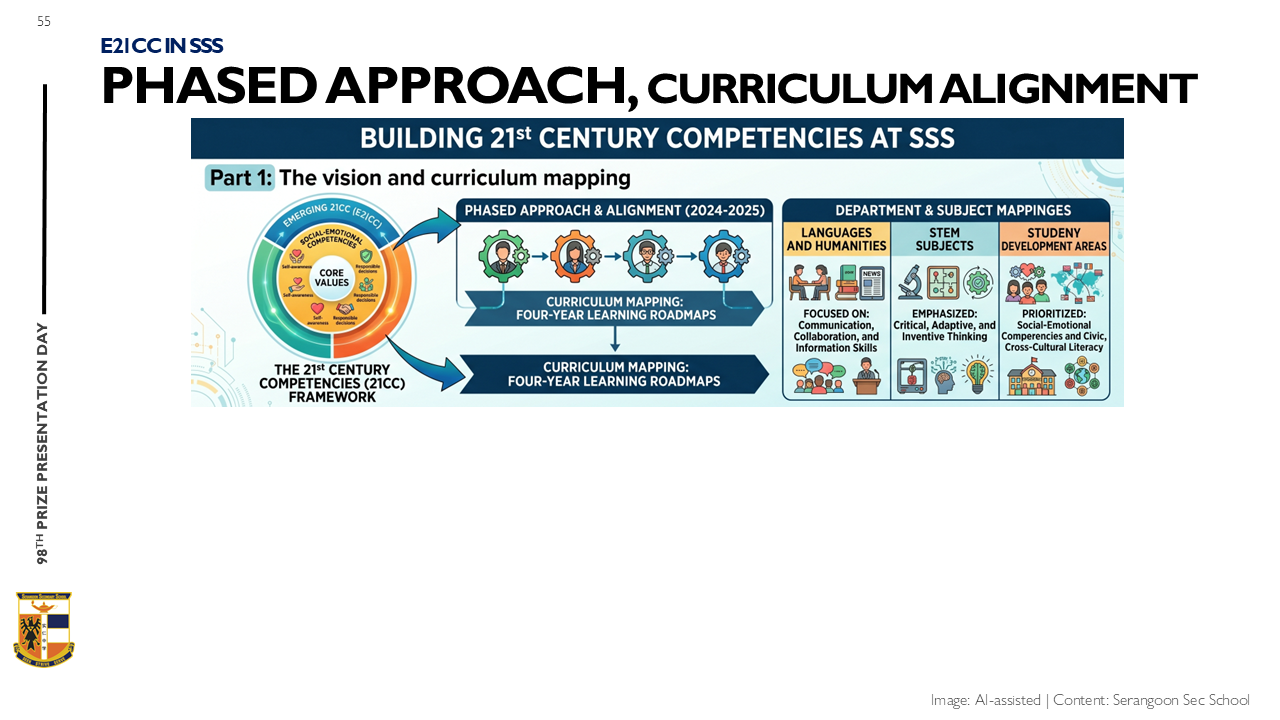
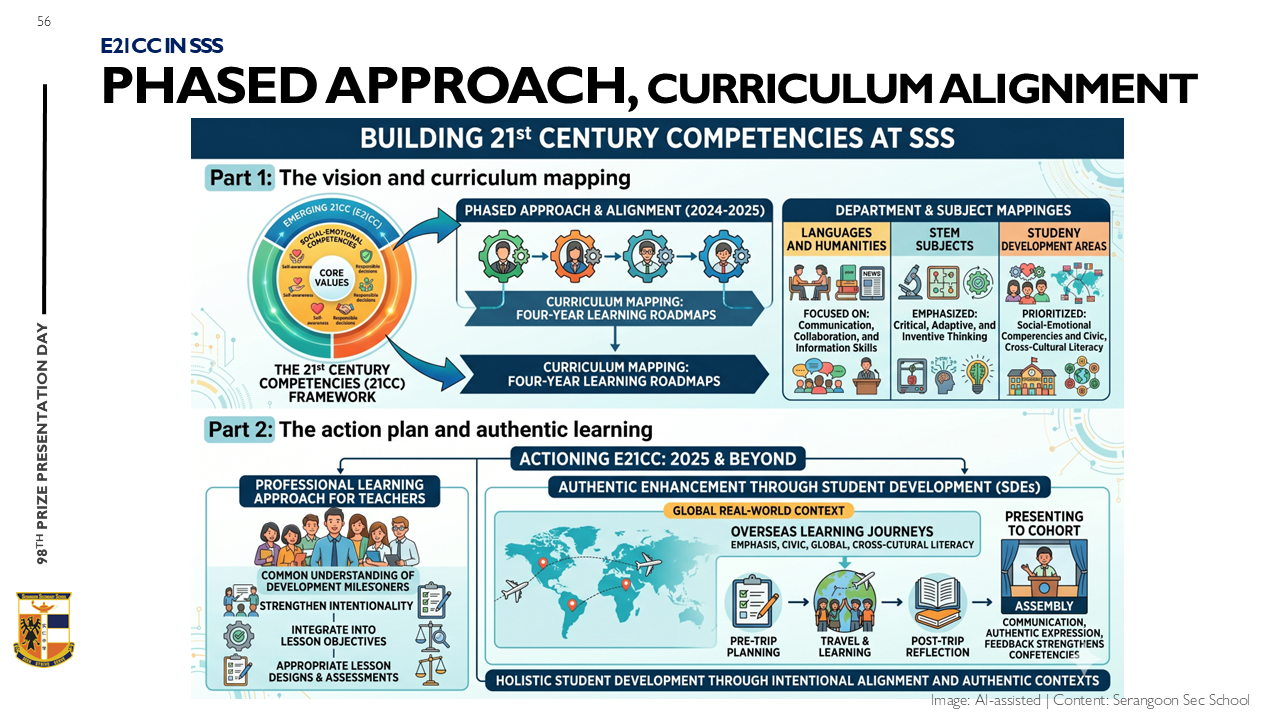
25 - We are also expanding our Form Teacher (FT) data toolkit: with SDCD’s Enhanced Social-Emotional Competency Rating Tool (My SEI) to help teachers better understand and support students’ social-emotional development. All insights and student development progress will then be documented in CCE journals to facilitate person-centred Parent Engagement Sessions.
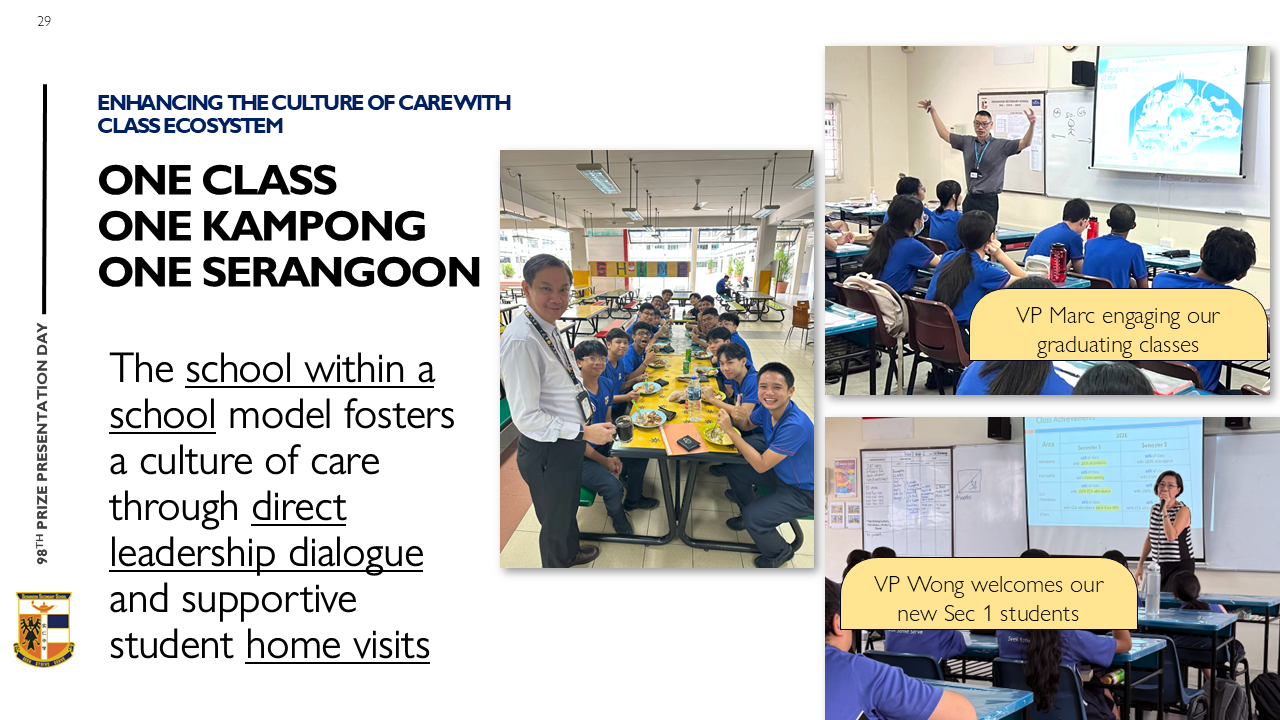
26 - The School Leaders will walk the talk in our efforts to grow our Serangoon StaRs. All students will continue to have direct access to the SLs to dialogue and provide their views and feedback. SLs will also do home visits to support our students with additional needs. We strongly believe that a strong culture of care is the foundation of effective learning. When our students feel supported and understood, they are then better positioned to excel.
D. Curriculum and Instruction
27 - In the last two years, I have shared how our academic departments have tailored learning experiences for our Serangoon StaRs that will equip them with the skills and attributes they need to thrive in today’s world.
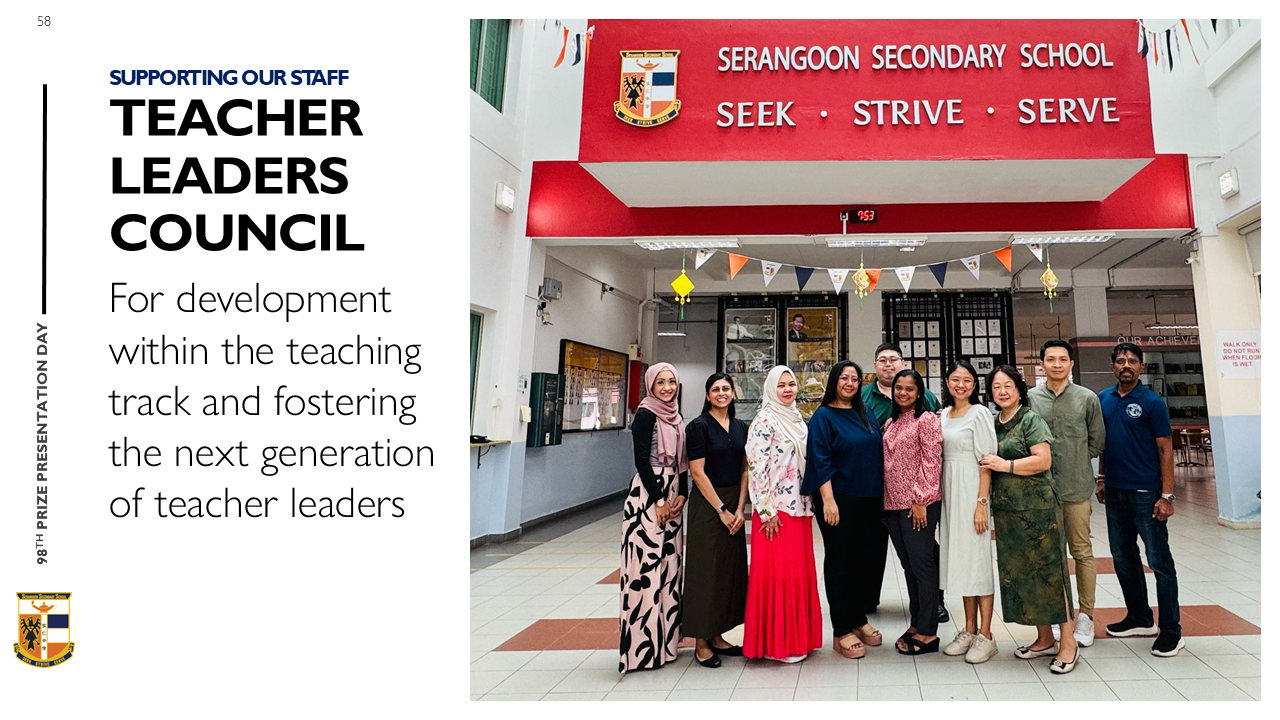
Section D1: Acknowledgement and Celebration of Success
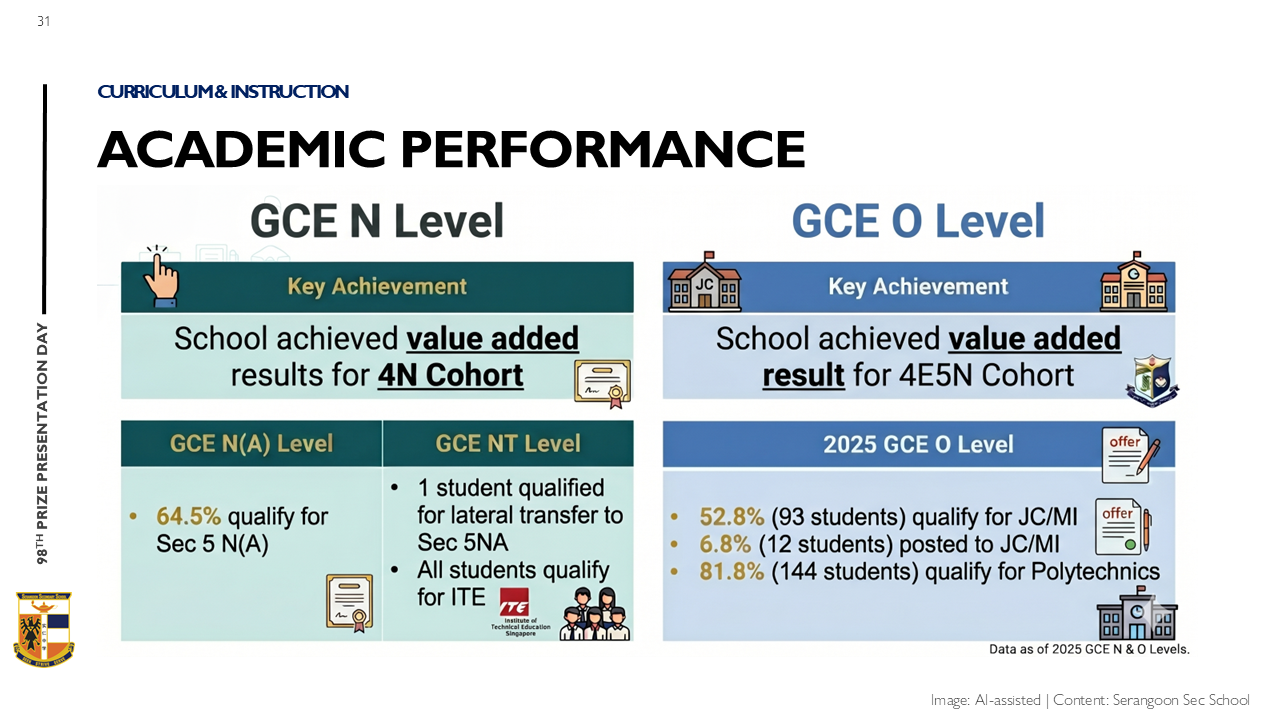
28 - Before I go further, let me acknowledge the Class of 2025’s National Examination results. Across both N and O Levels, we saw an encouraging upward trend — more students qualifying for polytechnic pathways and post-secondary options of their choice. The Early Admission Exercise also saw strong uptake, with a significant proportion securing placements ahead of results day. These results reflect our students’ resilience and the steadfast support of our teachers and families.
29 - Today, we celebrate not just results, but the character and perseverance that made them possible.
Section D2: Department signature programmes
Section D2A: CG1
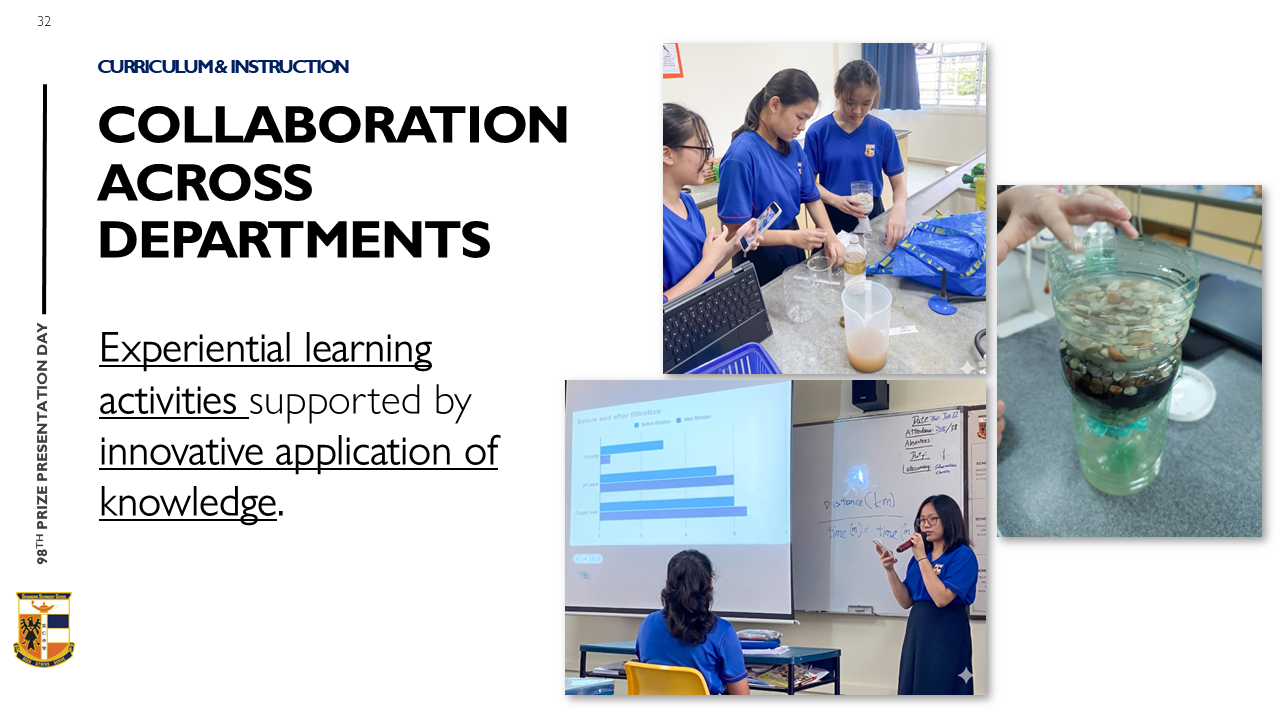
30 - At the heart of our learning culture is collaboration — the belief that learning is most powerful when connections are made across disciplines, mirroring the real world. Learning comes alive when subjects connect. Our Secondary 1 Inter-departmental Project Work brings together English Language, Science, and Humanities, guiding students through real-world experimentation, research, and presentation — breaking down subject silos and building holistic problem-solving skills. Students work together to construct a water filtration system, learn about soil composition from Geography lesson and finally presenting the project in front of their peers.
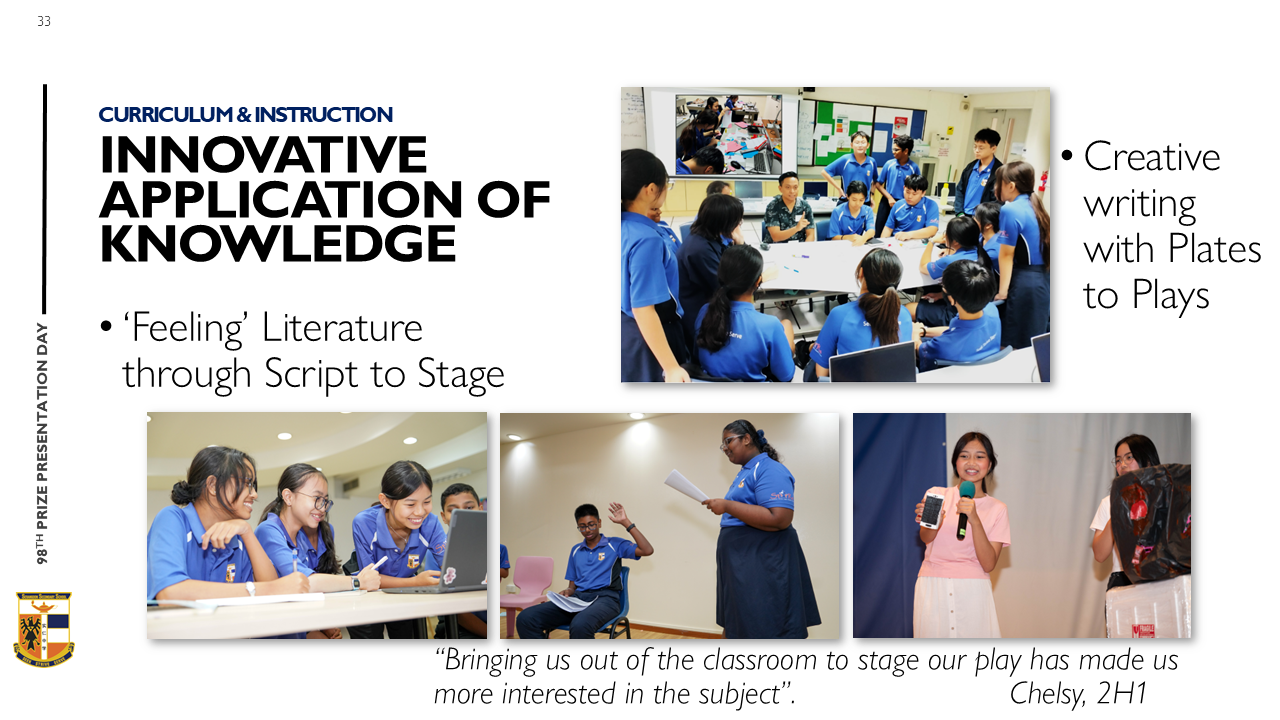
31 - Our English Language and Literature teachers believe that to truly understand a subject, students need to feel it. The ‘Script to Stage’ programme, now in its second year, has students staging their own plays — building adaptive thinking, collaboration, and communication along the way. As student Chelsy from 2H1 put it, “Bringing us out of the classroom to stage our play has made us more interested in the subject.”.
32 - This year, EL department expanded our Talent Development Programme with ‘Plates to Plays’, where students explore creative writing under a professional artiste through the NAC Artist-in-Residence scheme, drawing on the uniquely Singaporean experience of food to find their own voices.
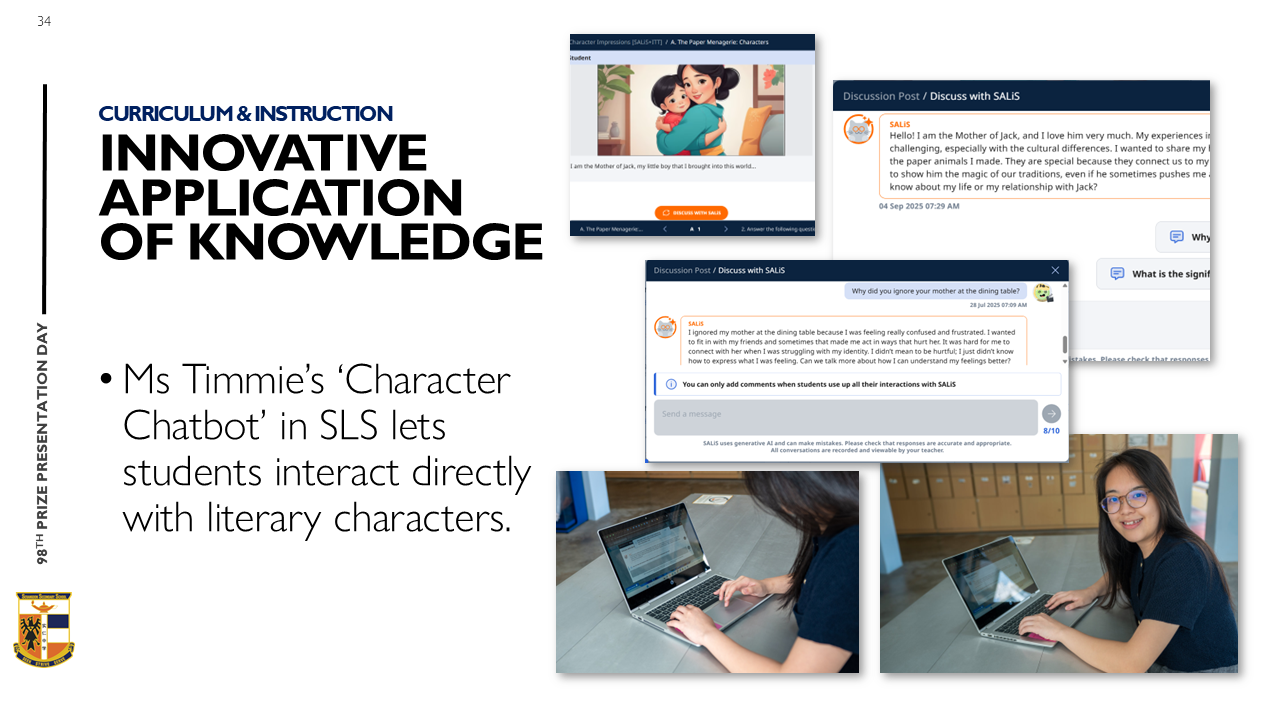
33 - Innovation continues in the classroom too — Ms Timmie Tan’s ‘Character Chatbot’ lets students interact directly with literary characters, an approach so well-received it was shared at the SG Learning Designers’ Circle.
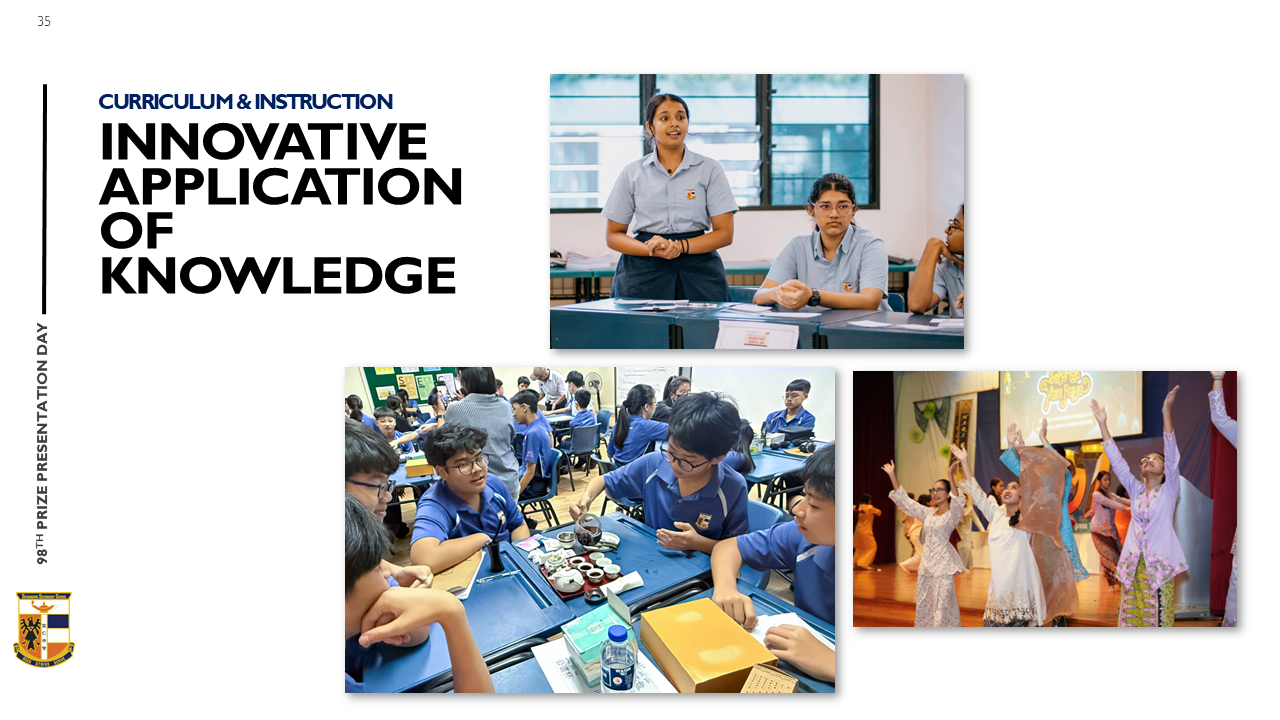
34 - Our Mother Tongue Language Department ignites a joyful learning experience for students through enriching and authentic cultural experiences, deepening their linguistic proficiency while fostering a profound appreciation for their heritage and identity.
35 - Debating continues to be a signature platform shared across all three language streams, with students from the Chinese, Malay, and Tamil units participating in both school-based and national competitions. These experiences sharpen critical thinking, strengthen communication skills, and build the confidence to articulate perspectives with clarity and conviction.
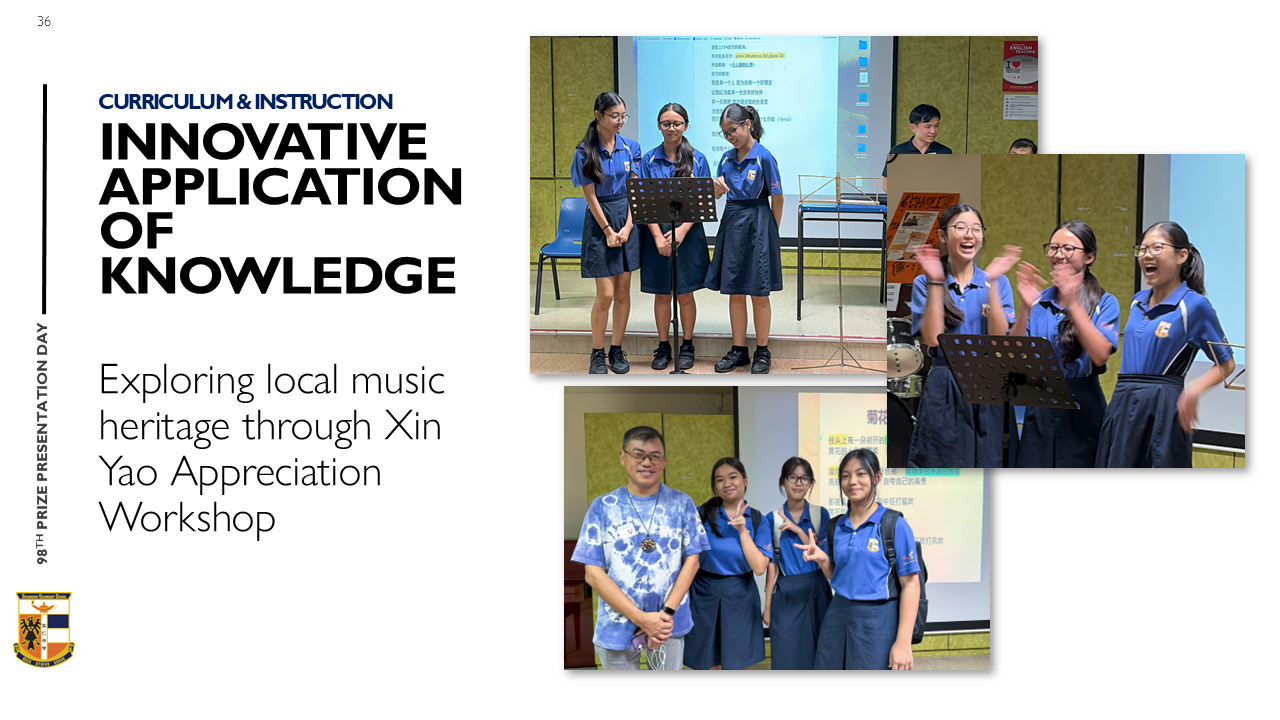
36 - Beyond debating, each unit also offers enrichment programmes that connect students to their cultural roots in meaningful ways. The Chinese Language Unit’s Xin Yao Appreciation Workshop brings students closer to Singapore’s local Chinese music heritage through music, storytelling, and lyric writing.
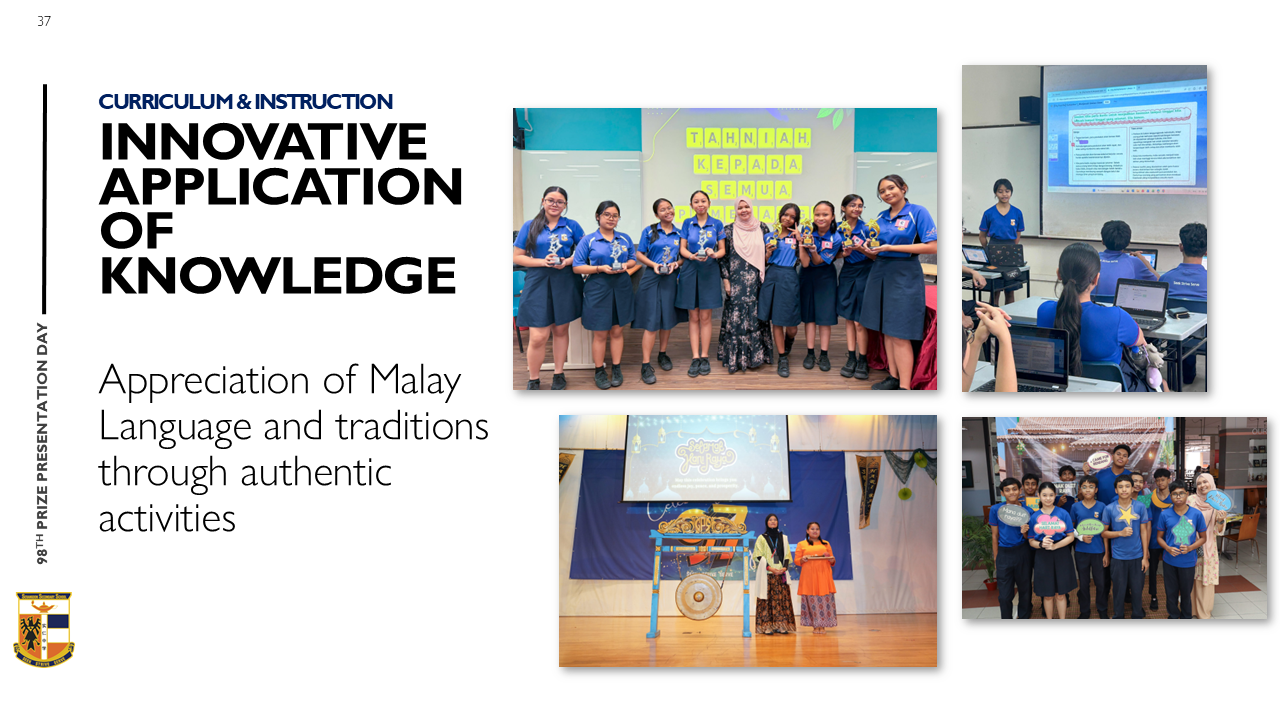
The Malay Language Unit engages students through culturally authentic activities that deepen their appreciation of Malay language and traditions.
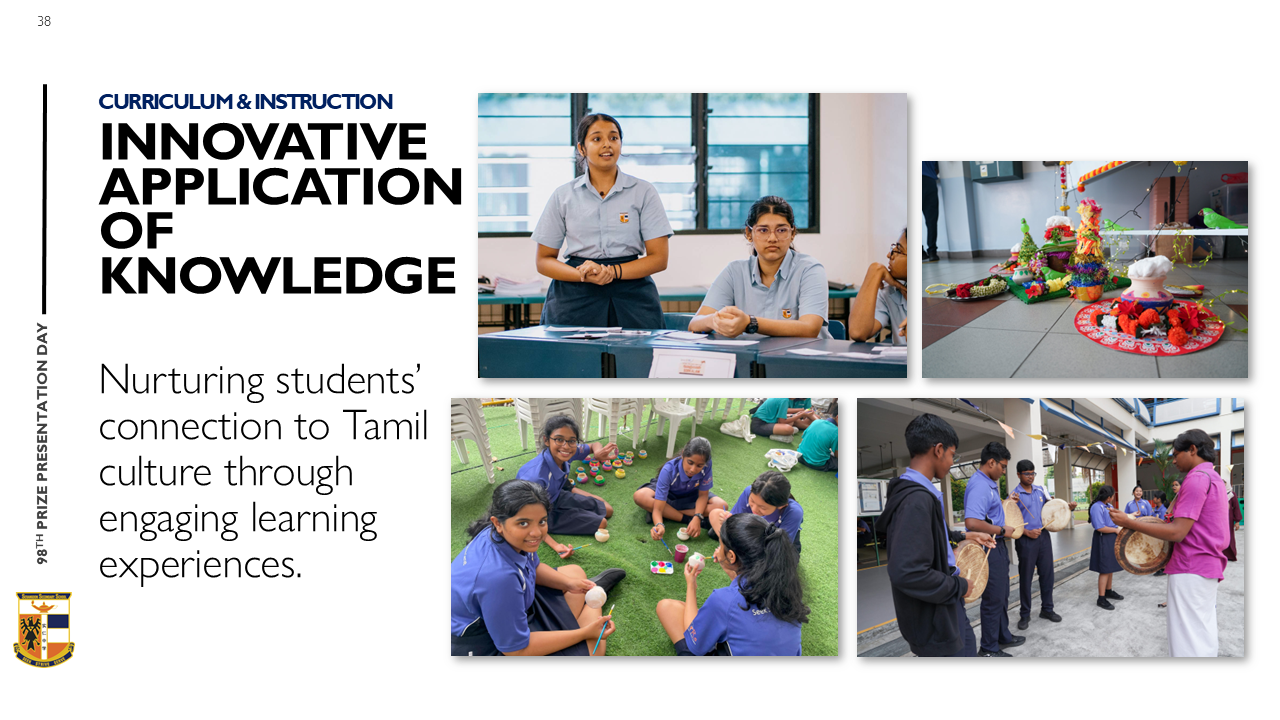
The Tamil Language Unit similarly nurtures students’ connection to Tamil culture and identity through purposeful and engaging learning experiences.
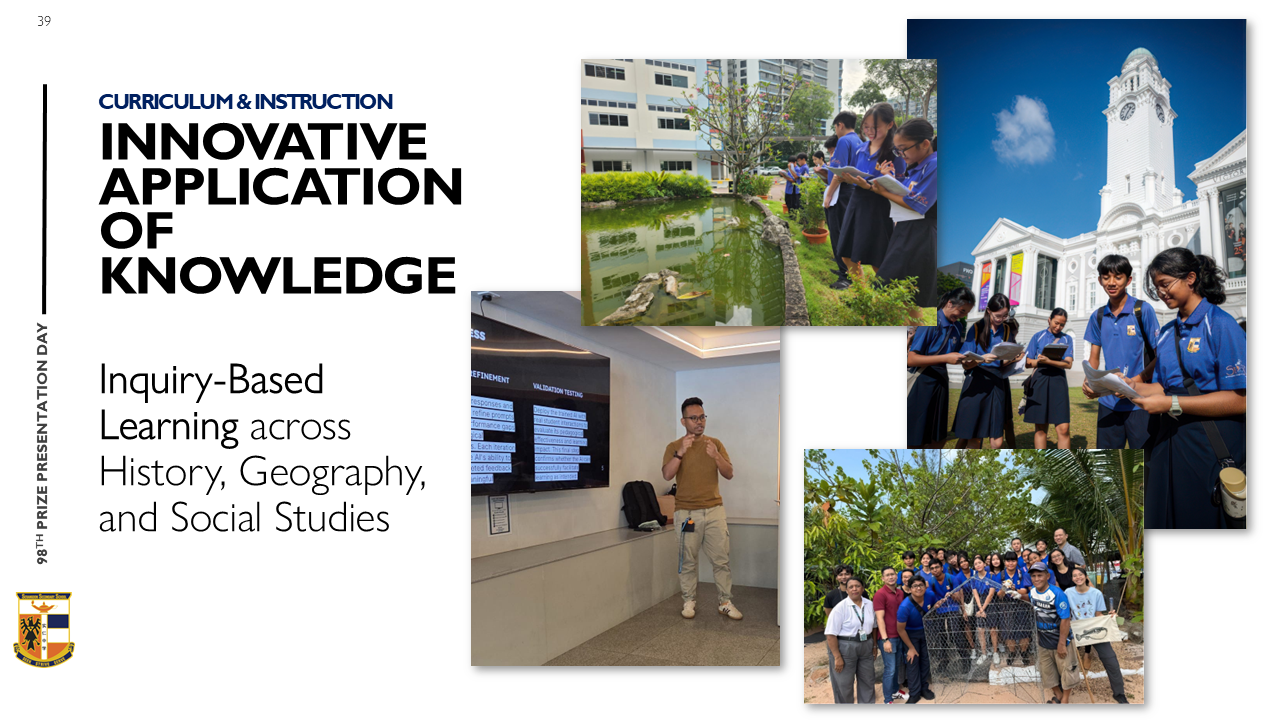
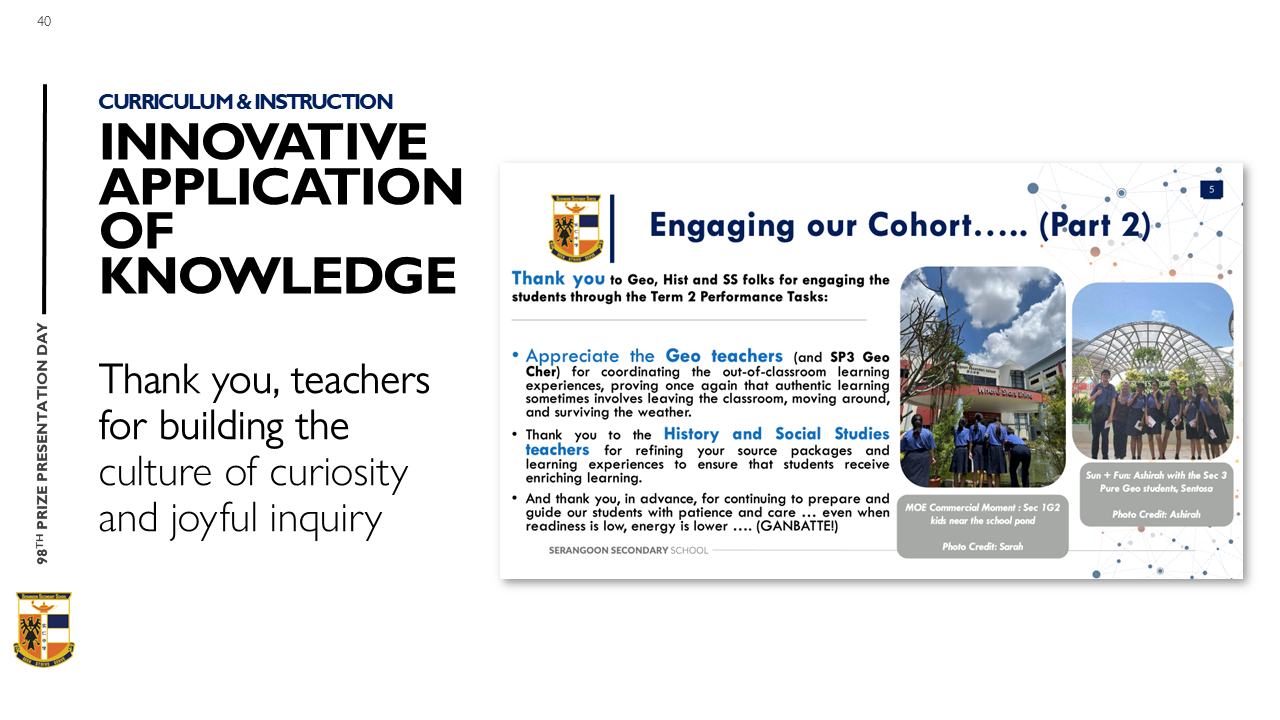
37 - The Humanities Engagement Programme builds knowledge and passion progressively — from investigating water quality at our school pond in Secondary 1, to exploring Singapore’s history at Kranji War Cemetery and Fort Siloso in Secondary 2, to engaging with real-world issues through their electives in Secondary 3.
Our teachers lead the way in innovation — Mr Jeff Mak, Mr Daniel Fung, Mr Hamzah and Mr Matt Yee have transformed feedback and harnessed AI for Socratic questioning and targeted essay, while collaborating with NIE and the Academy of Singapore Teachers, to keep our curriculum at the cutting edge.
Section D2B:CG2
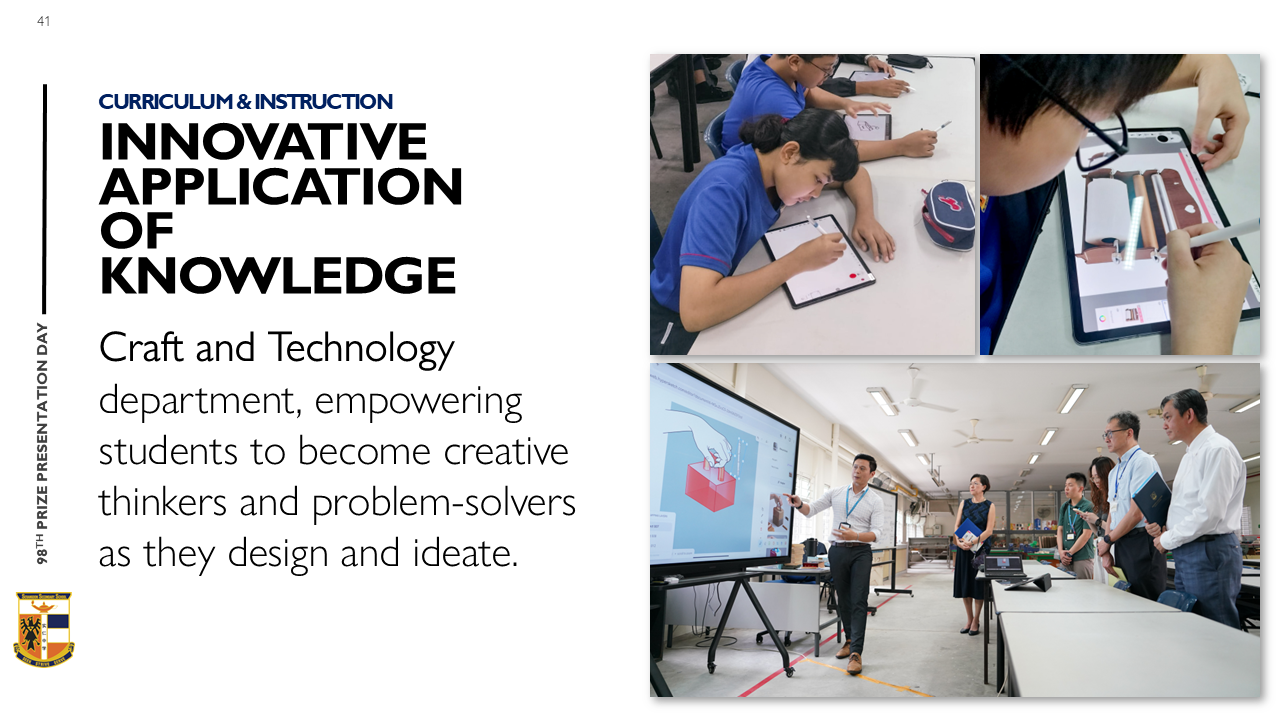
38 - Innovation is at the heart of our Craft and Technology Department, spanning Design and Technology, Nutrition and Food Science, and Art. In Design and Technology, our collaboration with Samsung brings Interactive Flat Displays and tablets into the classroom, while our partnership with STUCK Design’s HYPERSKETCH platform deepens students’ AI literacy and design thinking. Students also showcase their skills at competitions such as the D&T Awards and the Design Innovation Challenge.
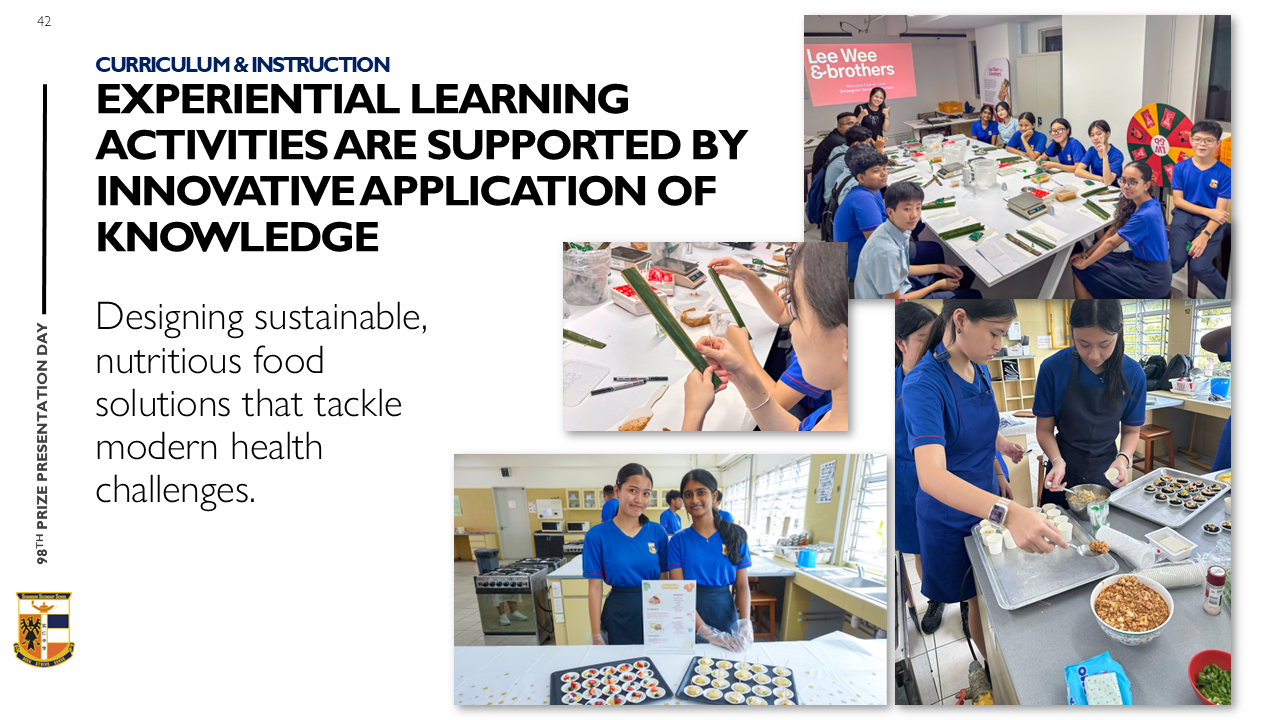
In Nutrition and Food Science, the Connecting Heartily Project empowers students to create nutritious, sustainable food products addressing real-world health challenges. This year, Secondary 3 students visited Lee Wee Brothers for authentic industry exposure, developing not just culinary skills but also critical thinking and a sense of responsibility towards community health.
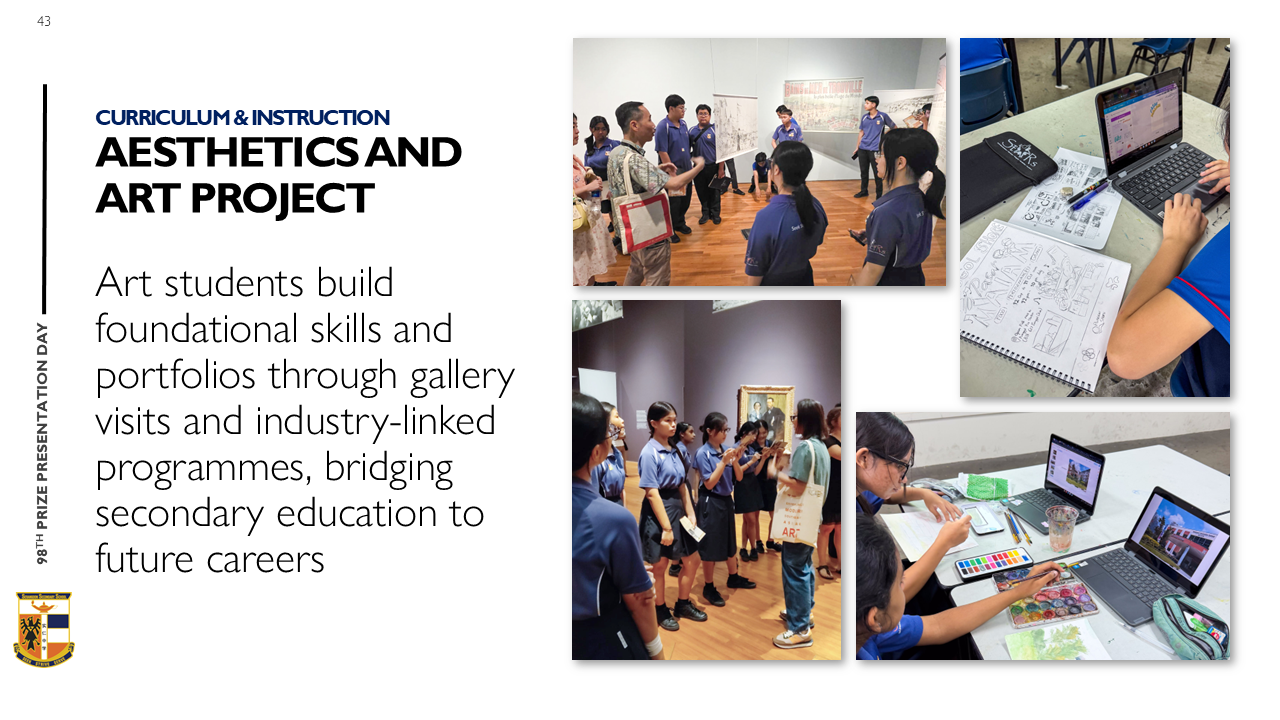
In Art, students progress from foundational visual literacy to advanced portfolio development, enriched by gallery visits and a Design Immersion Programme with tertiary institutions that bridge secondary education to future career pathways. Across all three units, our Craft and Technology Department cultivates creative problem-solving, digital literacy, and social responsibility — preparing students to be creatively confident and future-ready.
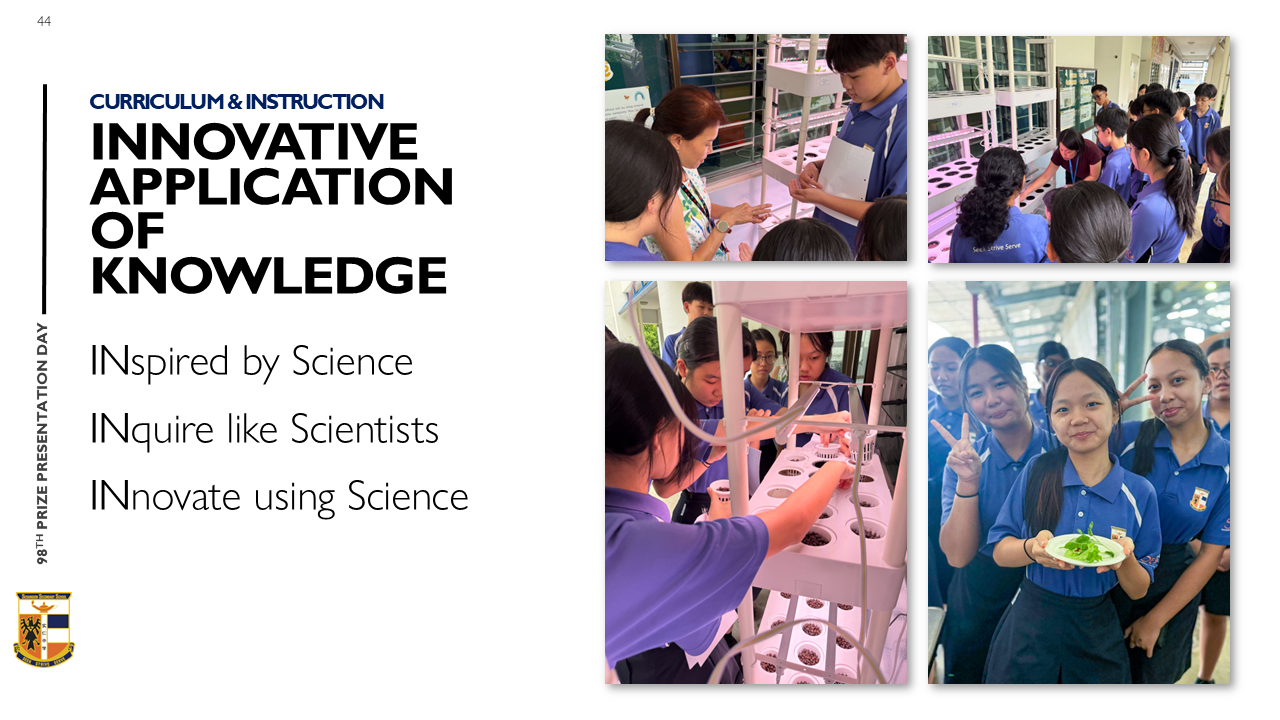
39 - Our Science Department operates on a deliberate 4-year roadmap to ensure every experience is purposeful and progressive — inspiring students to inquire like scientists and innovate using science. This comes to life through initiatives like the Science Garden Project, where students grow their own vegetables to explore food security, and STEM activities such as designing water filtration systems, solar ovens, and marble runs at the Science Centre.
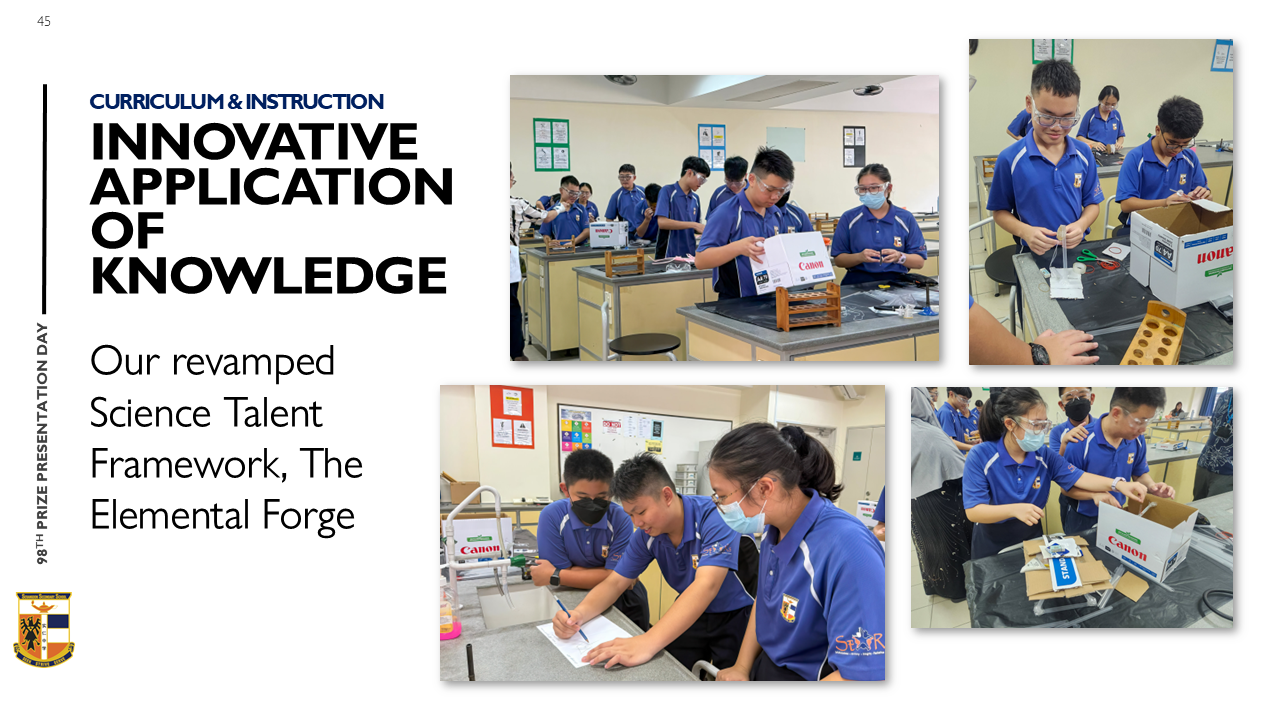
40 - I am also proud to launch The Elemental Forge, our revamped Science Talent Framework, which takes a structured, tiered approach to nurturing scientific talent — from lab and field experiences to design thinking and competitions.
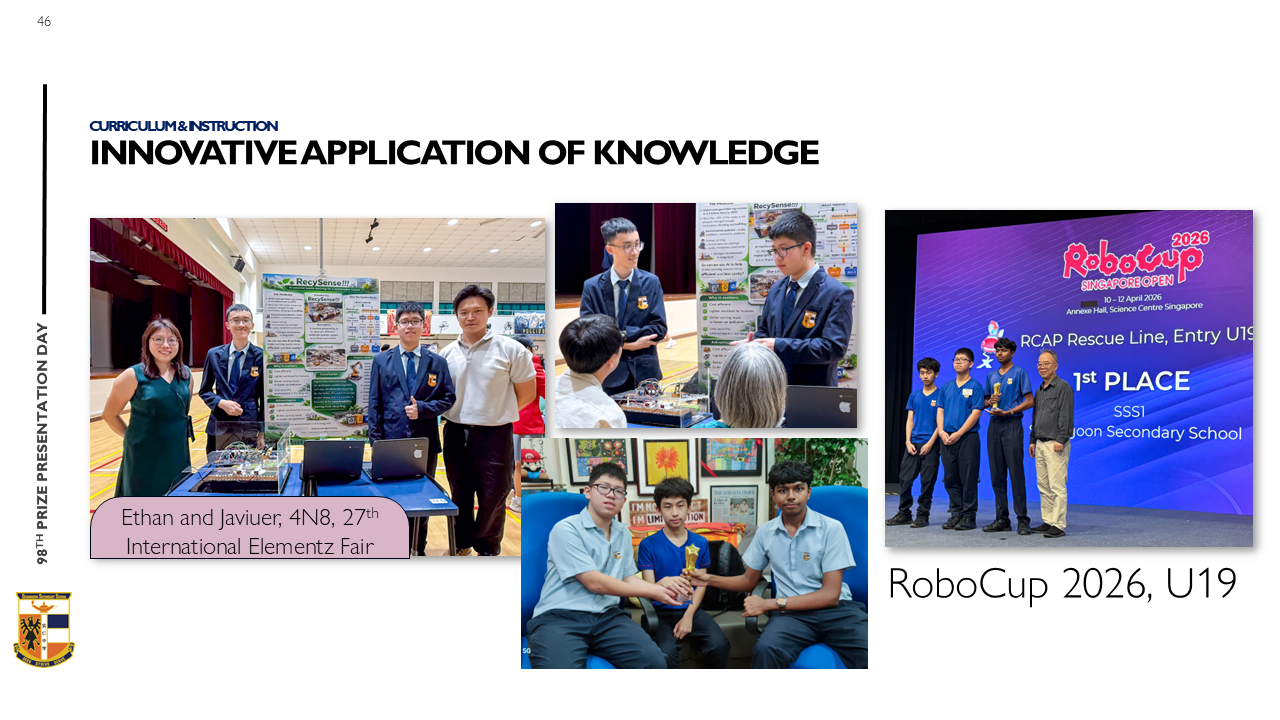
On that note, I would like to celebrate Ethan and Javier from 4N8, who represented our school at the 27th International Elementz Fair. Their AI-powered recycling sorter, RecySense, earned them a well-deserved Silver Award. Please join me in congratulating them. Our students from Infocomm Club have also done us proud, with the team comprising Javier, Fernando from 4N8 and Brandon from 4N7 clinching the first place in the RoboCup 2026, Under 19 category.
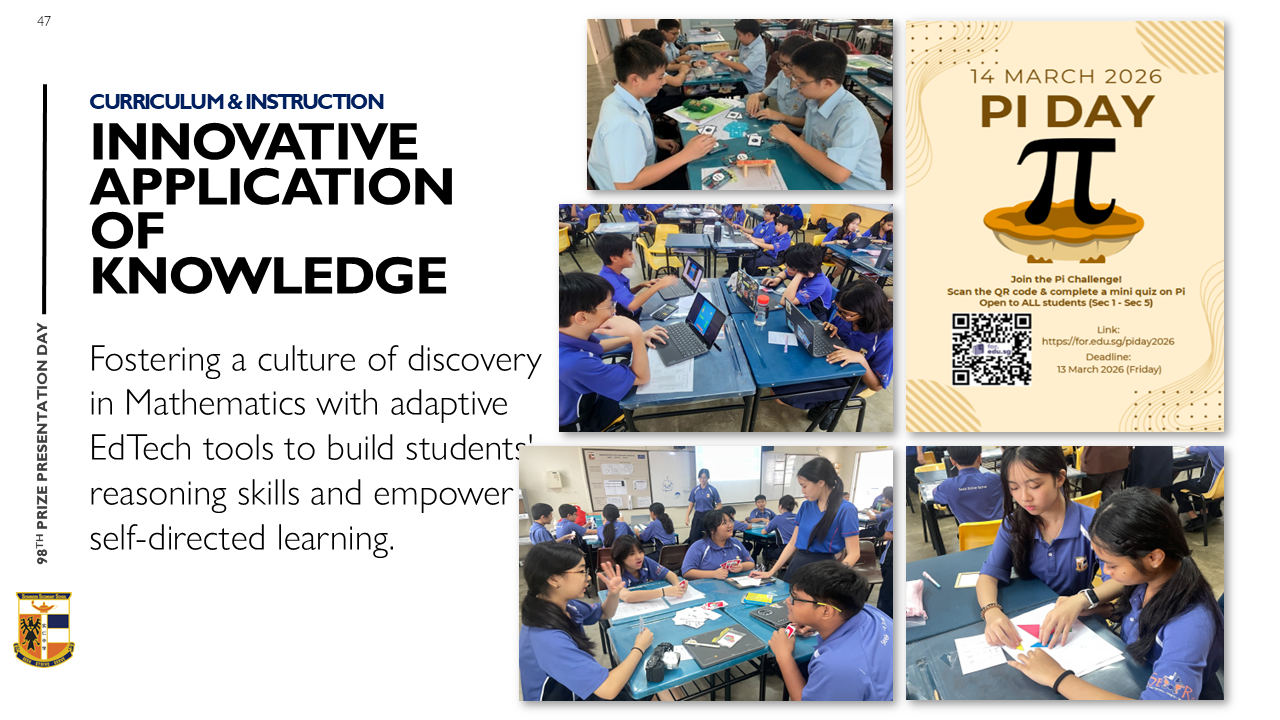
41 - Our Mathematics Department brings the joy of discovery to life through signature programmes that extend learning beyond the classroom. Sec 1 students engage in game-based activities on Mathematics Learning Day to build reasoning and communication skills, while Pi Day sparks curiosity through hands-on exploration. At the upper secondary level, our Financial Literacy Programme connects Mathematics to real-world applications in budgeting, investment, and scam awareness. EdTech tools like SLS FA-Math and the Adaptive Learning System further empower students through personalised feedback and self-directed learning.
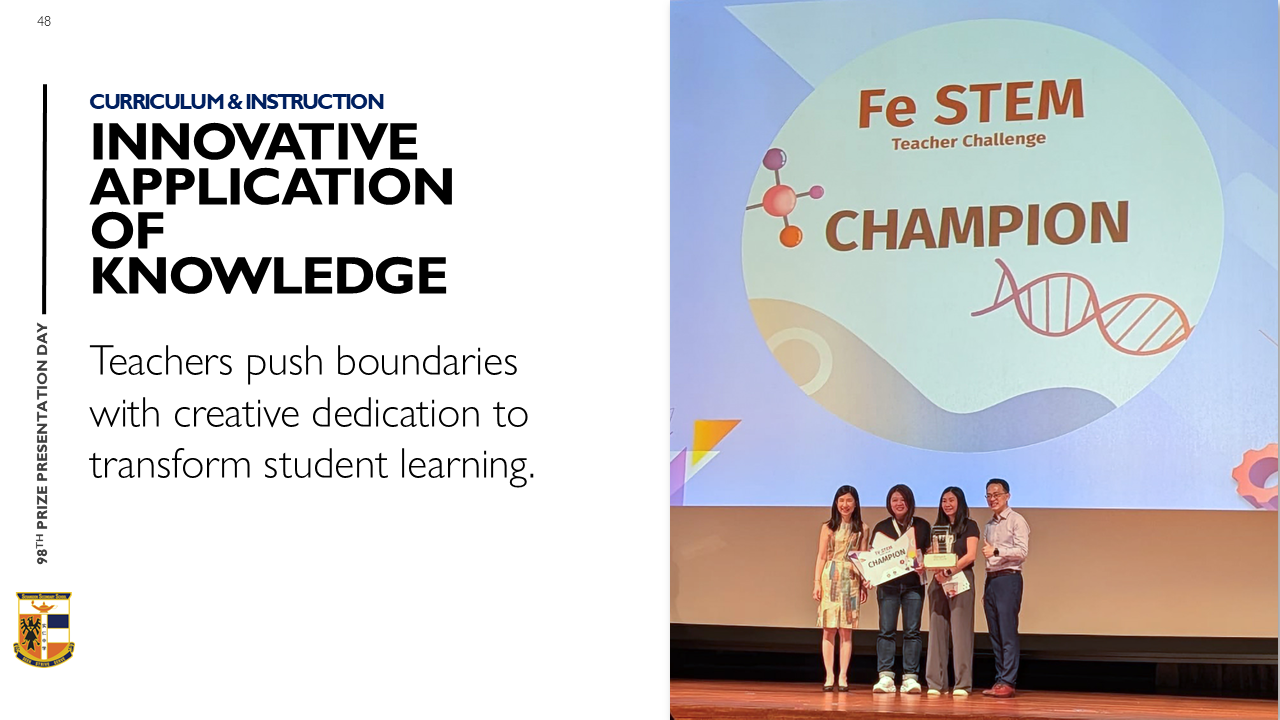
42 - I am also proud to congratulate Ms Eleanor Cheong, together with Science teacher Ms Caelyn Lim, for clinching the People’s Choice Award and emerging as Champion in the STEM Teacher Challenge in 2025 — a wonderful testament to the creativity and dedication of our teachers in pushing the boundaries of teaching and learning.
43 - This culture of collaboration and innovation, championed by every department, does more than create exciting lessons — it actively cultivates the competencies our students need for the future: critical thinking, adaptability, creativity, and effective communication. We are equally committed to how learning takes place. Our curricular approaches — spanning content, pedagogy, and assessment — are designed to ignite a genuine Joy of Learning.
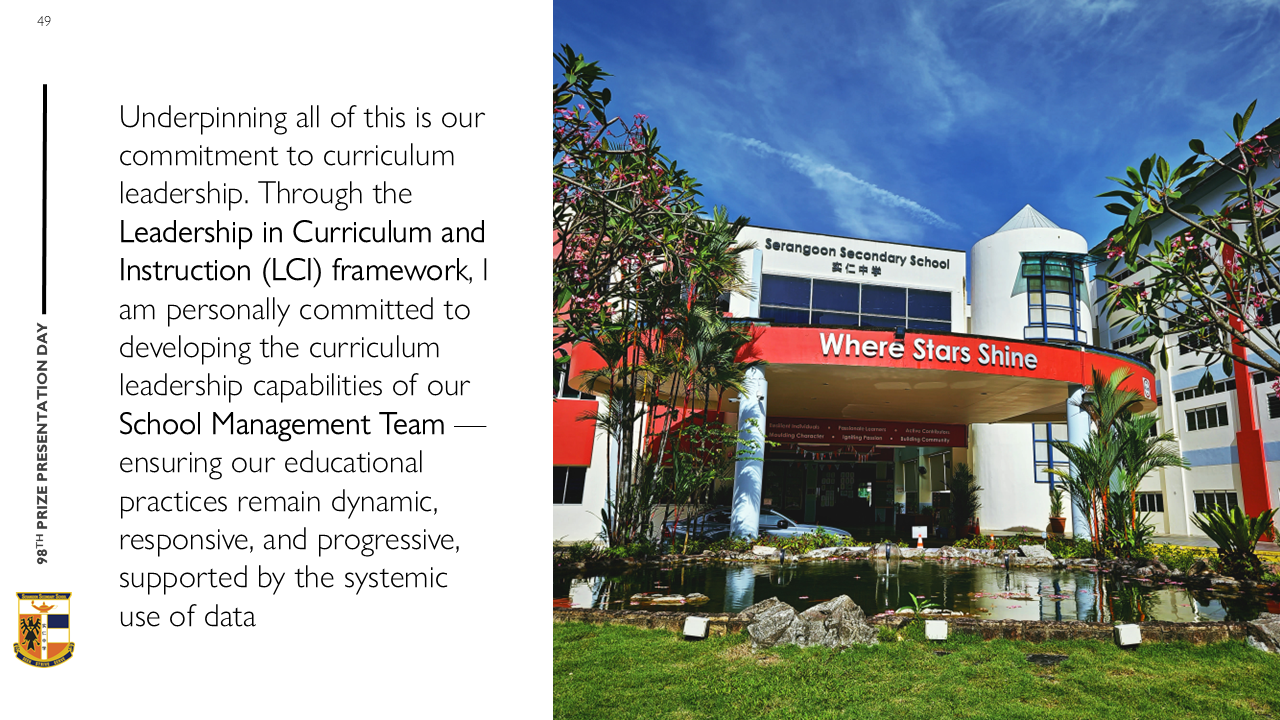
44 - Underpinning all of this is our commitment to curriculum leadership. Through the Leadership in Curriculum and Instruction (LCI) framework, I am personally committed to developing the curriculum leadership capabilities of our School Management Team — ensuring our educational practices remain dynamic, responsive, and progressive, supported by the systemic use of data.
**E. EdTech 2030 Masterplan **
45 - At Serangoon Secondary School, our EdTech journey is guided by the vision that “Teaching and learning can take place anytime, anywhere, with the appropriate digital device.” This vision drives a transformative shift towards a digitally empowered learning experience, where students rely on their Personal Learning Devices to support their educational journey wherever learning is facilitated through EdTech-enabled approaches.
Core Digital Learning Experience
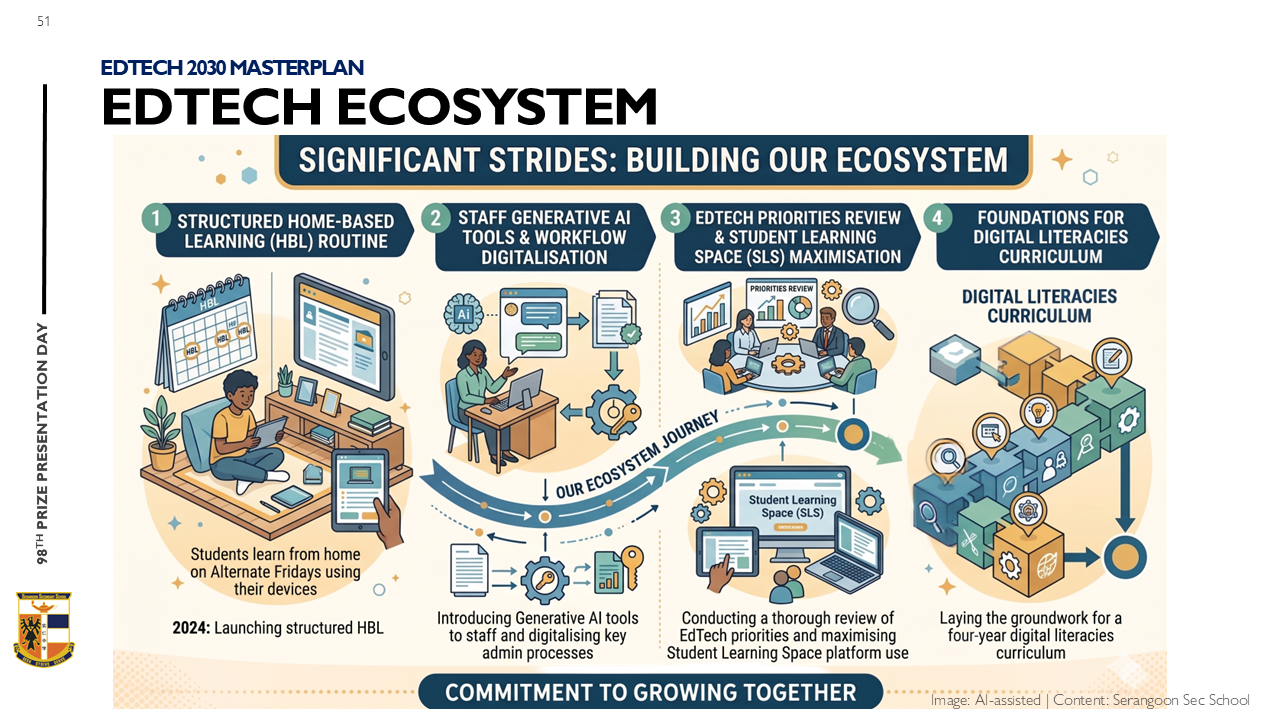
46 - Over the past few years, we have made significant strides in building this ecosystem. In 2024, we launched our structured Home-Based Learning routine, enabling students to learn from home on alternate Fridays using their devices. We also introduced Generative AI tools to our staff, digitalised key administrative workflows, and conducted a thorough review of our EdTech priorities — laying the groundwork for a four-year digital literacies curriculum and maximising the use of the Student Learning Space platform.
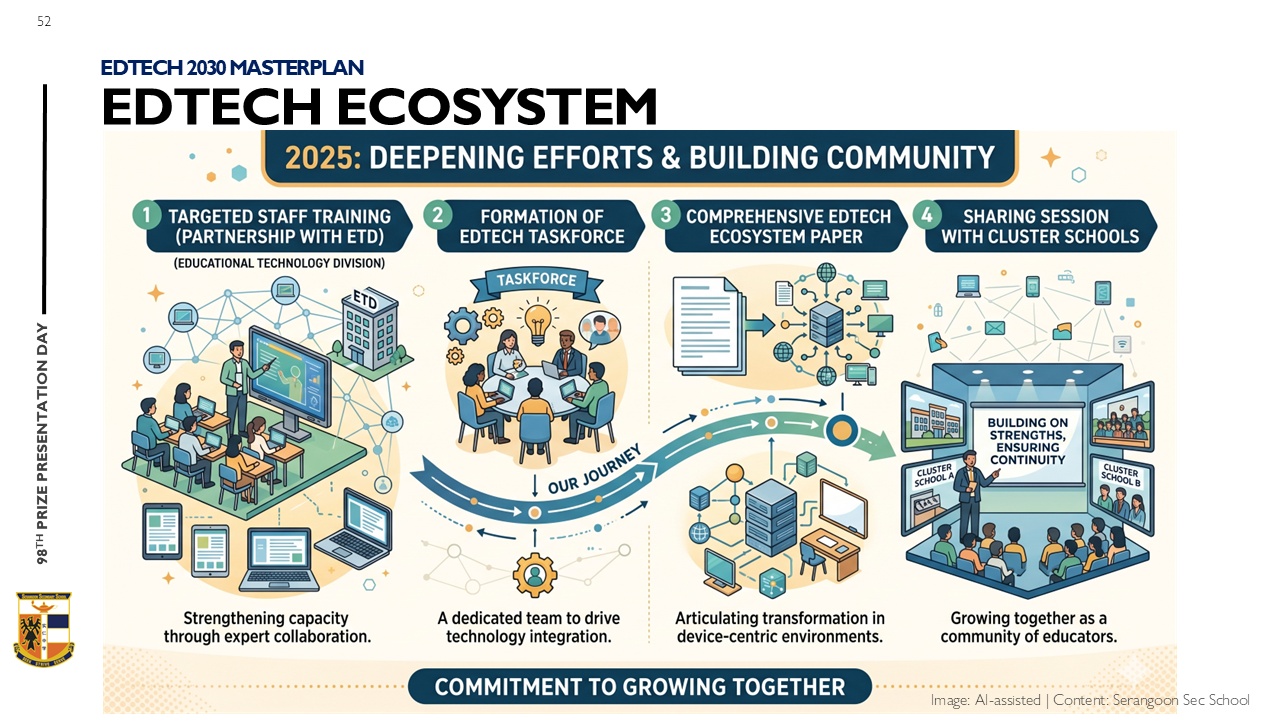
47 - In 2025, we deepened our efforts through targeted staff training in partnership with ETD, the formation of an EdTech Taskforce, and the development of a comprehensive EdTech ecosystem paper that articulates how device-centric environments can transform teaching and learning. We also shared our journey with our cluster schools through a sharing session entitled “Building on Strengths, Ensuring Continuity” — a testament to our commitment to growing together as a community of educators.
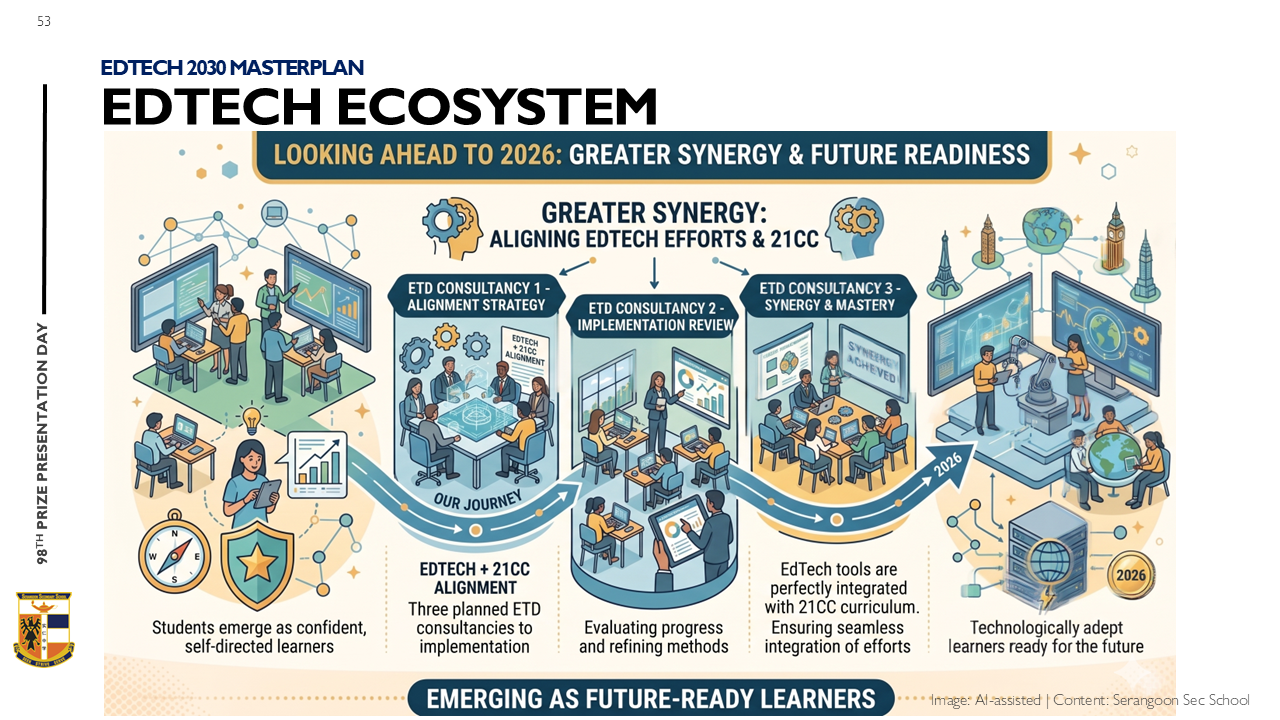
48 - Looking ahead to 2026, we will continue to align our EdTech and 21st Century Competencies efforts for greater synergy, with three planned ETD consultancies to strengthen our implementation and ensure our students emerge as confident, self-directed, and technologically adept learners ready for the future.
F. Strategic Approach for E21CC in SSS
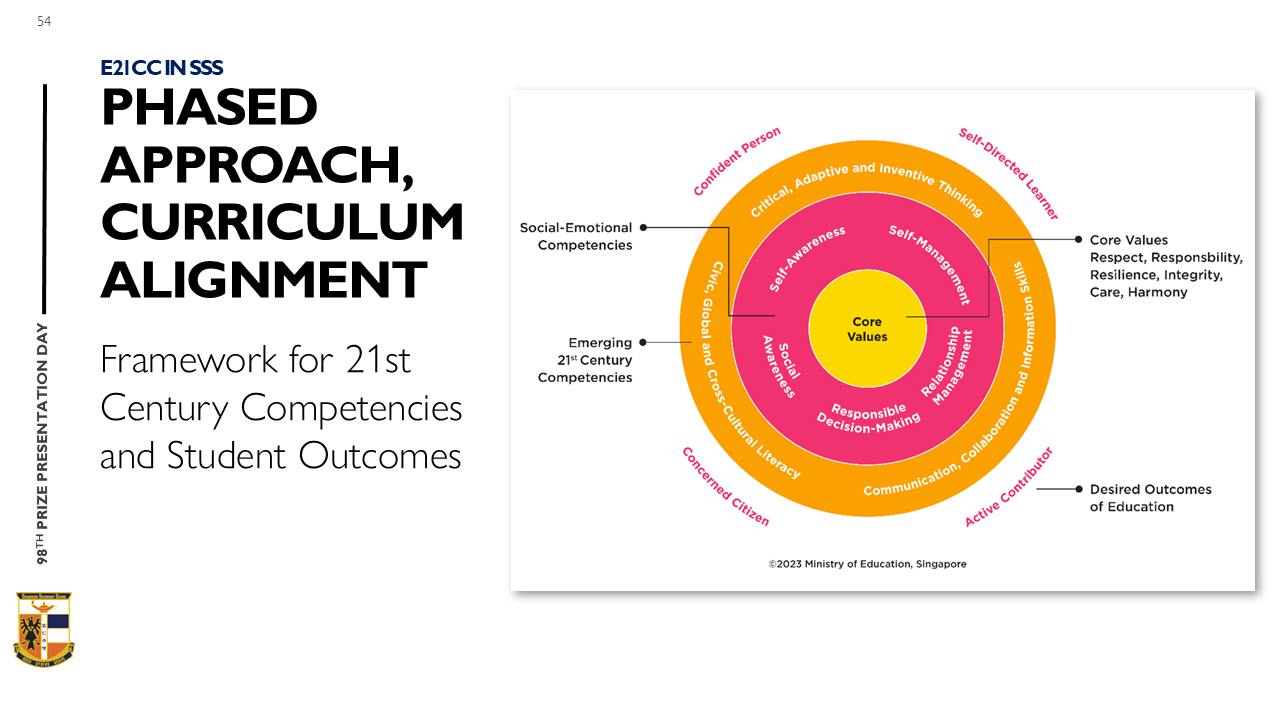
49 - We are guided by the Framework for 21st Century Competencies and Student Outcomes (21CC Framework) which articulates MOE’s vision for holistic student development. Values form the core, supported by Social-Emotional Competencies, and extended through the Emerging 21st Century Competencies (E21CC) domains. At SSS, we are taking on a phased approach to emphasise alignment in our existing programmes and focusing on professional capacity building.
50 - Rather than treating E21CC as a standalone initiative, we have started integrating it within existing curriculum structures from 2024 to 2025, notably the Four-Year Learning Roadmaps. Departments mapped their programmes and syllabi to relevant E21CC domains: Languages and Humanities focused on Communication, Collaboration, and Information Skills; STEM subjects emphasized Critical, Adaptive, and Inventive Thinking; Student Development areas prioritized Social-Emotional Competencies and Civic, Global, and Cross-Cultural Literacy. A stocktaking exercise was done to reveal the extent of E21CC presence and identify areas needing greater intentionality and alignment. This mapping surfaced existing competency development and identified opportunities to strengthen it across levels.
51 - From this year, we take on a professional learning approach, for teachers to have common understanding of the development milestones in the respective domains and strengthen the intentionality to explicitly integrate E21CC into their lesson objectives through appropriate lesson designs and assessment when opportune.
G. Supporting our Staff
52 - To foster a culture of continuous reflection and growth among our teachers, the school has placed strong emphasis on professional learning for our staff.
Section G1: Staff Professional Learning
53 - Since establishing the Teacher Leaders Council in 2023, we have witnessed remarkable growth in our professional development culture. This year, we have expanded the TLC to include associate members, creating a structured pathway for educators to develop within the teaching track and fostering the next generation of teacher leaders.
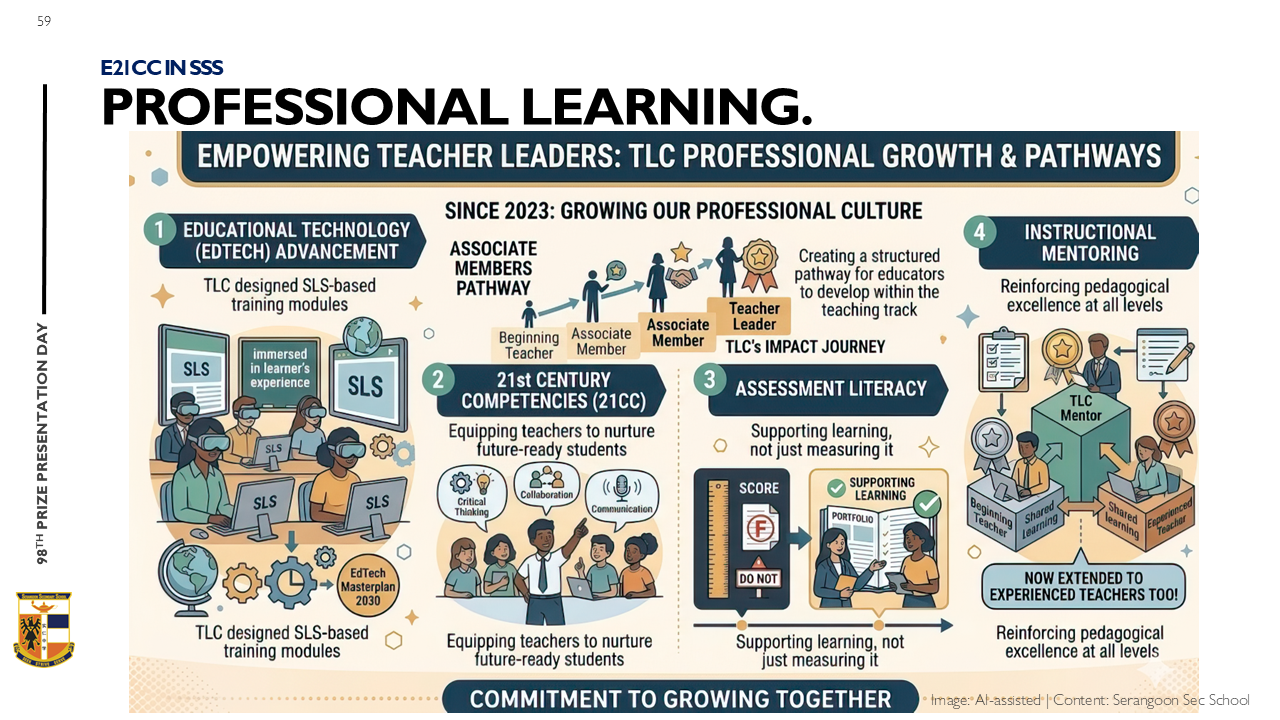
54 - The TLC continues to drive professional growth across four key areas as shown in this image. In Educational Technology, the TLC played an integral role in designing SLS-based training modules that immersed teachers in the learner’s experience, advancing our EdTech Masterplan 2030 initiatives. In 21st Century Competencies, our teachers are equipped to nurture future-ready students who think critically, collaborate effectively, and communicate confidently. In Assessment Literacy, teachers are better equipped to implement assessment methods that support learning rather than merely measure it. Finally, our Instructional Mentoring programme, which has supported beginning teachers, is now being extended to experienced teachers as well — reinforcing our commitment to pedagogical excellence at every level.
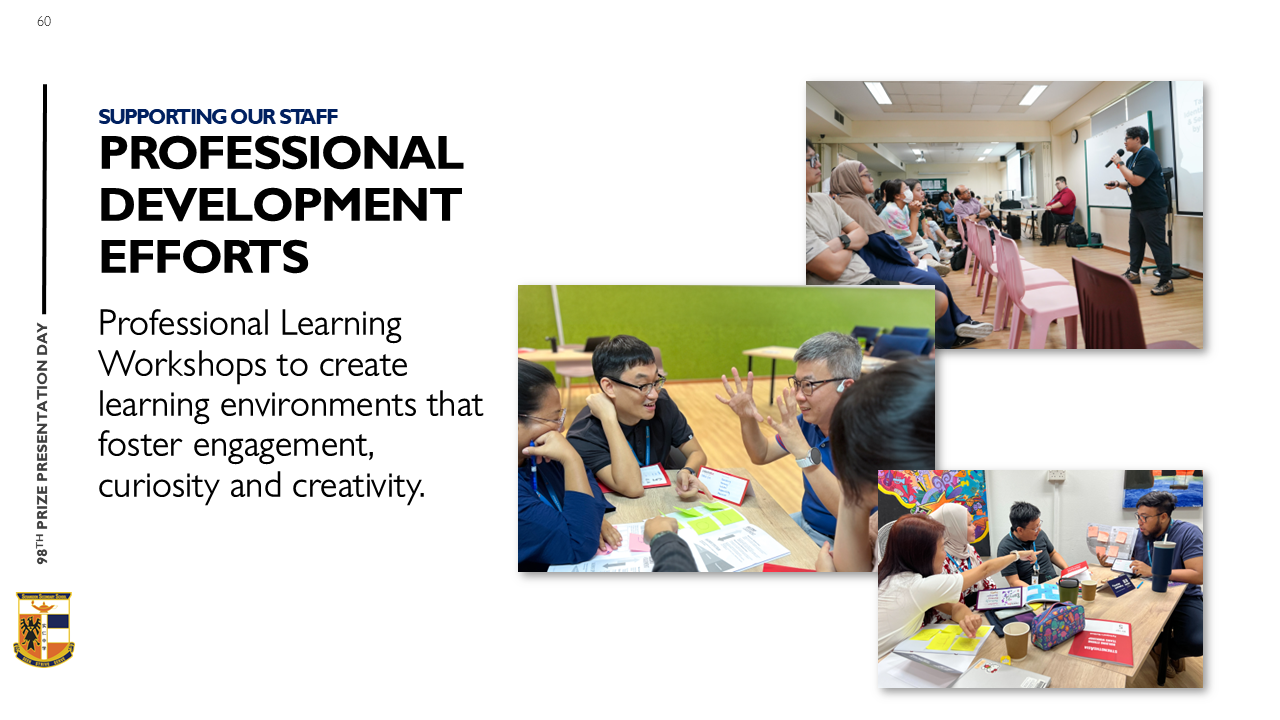
55 - The TLC has also demonstrated outstanding leadership by mounting Professional Learning Workshops on Student Motivation, helping us create learning environments that foster engagement, curiosity, and creativity. I commend the TLC for their dedication and leadership — their work exemplifies our commitment to empowering every educator to bring out the very best in our students.
**Section G2: SWBC **
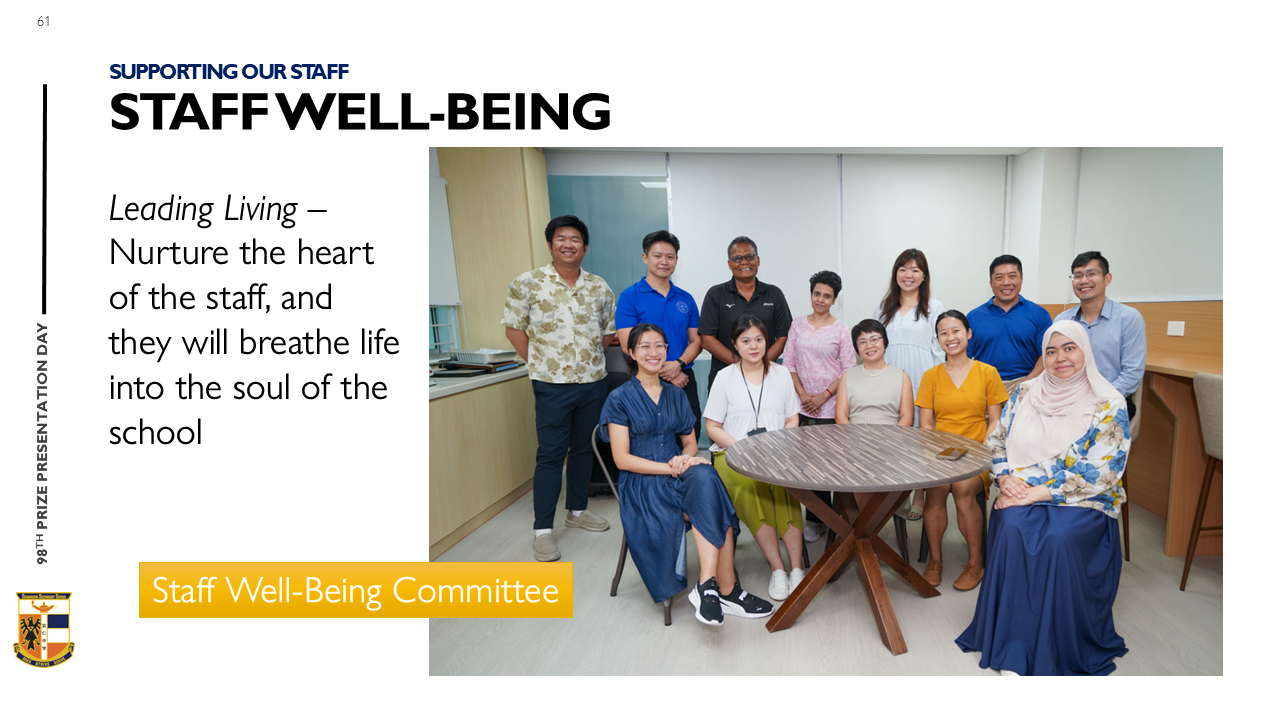
56 - We began in 2023 with the theme Leading Living — my promise to staff that I would take care of them, so they could, in turn, take care of the school. From extended family care leave to time for personal medical needs, these gestures mattered deeply. Staff no longer had to worry about choosing between their responsibilities and their family commitments.
57 - From there, we kept asking: what more can we do? We shifted CCA and meeting days, introduced TGIF afternoons, and gave staff the gift of time. What followed proved something important — when you trust people, they rise to the occasion. Serangoon staff upheld their professionalism even as more was given to them. We are, as I like to say, an uncommon breed.
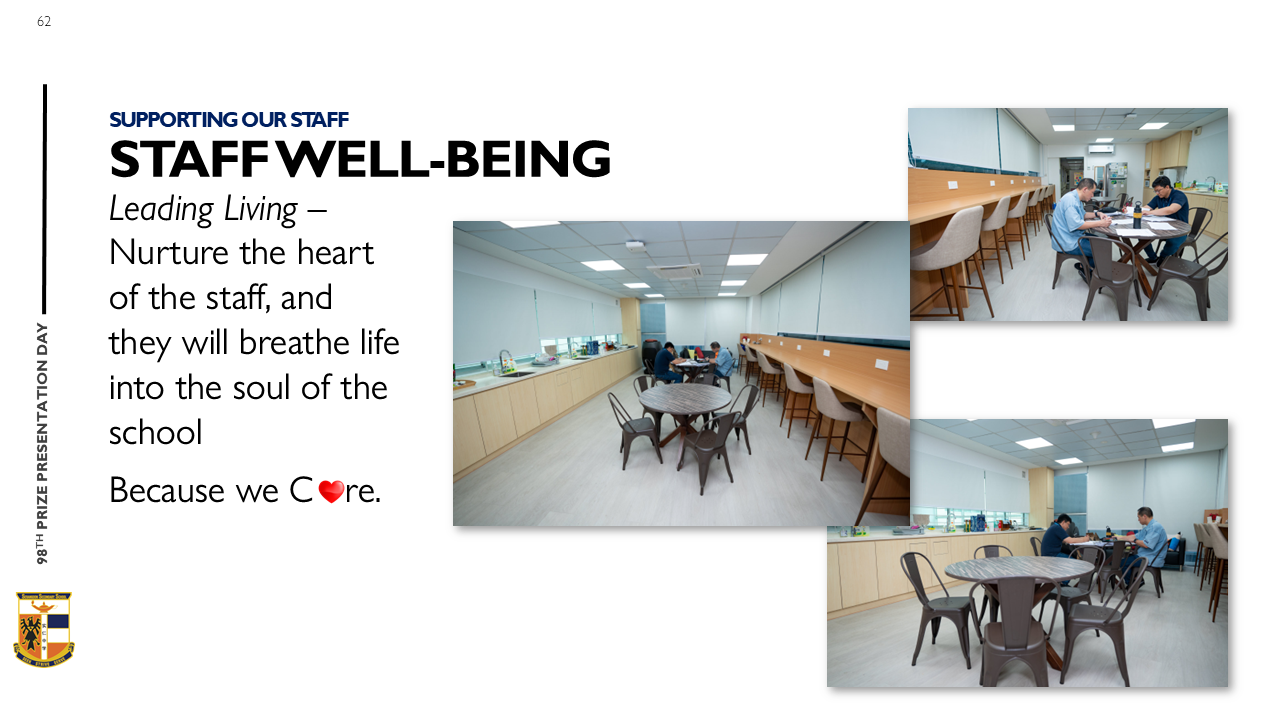
Because we care.
58 - That conviction has only grown stronger. We moved to more online end-of-year meetings and extended the PVT framework. Most recently, we completed renovations to our Staff Pantry, creating a vibrant and welcoming space for our teachers. More Flexible Workplace Arrangements are now on the horizon.
Section G3: FWA
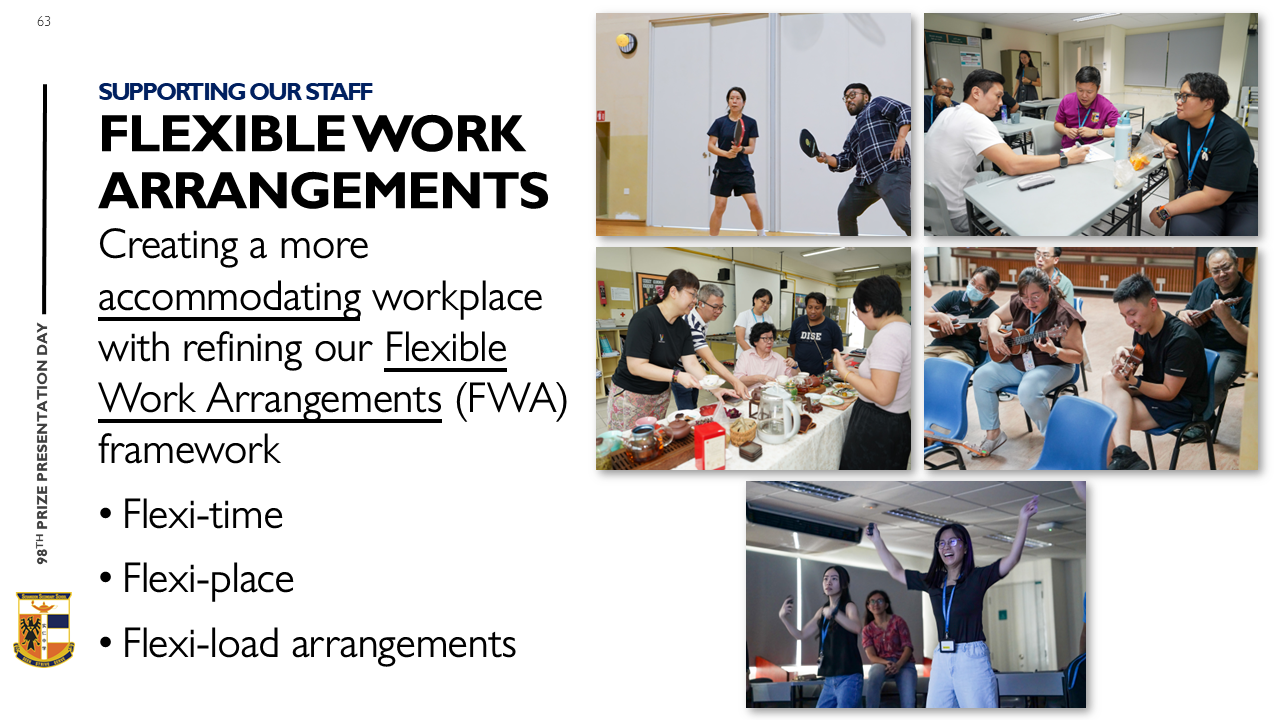
59 - Our commitment to staff well-being goes beyond professional development. Building on our Flexible Work Arrangements framework, we have taken a more systematic approach this year — giving staff greater flexibility in when they work (flexi-time), where they work (flexi-place), and how their workload is structured (flexi-load), all aligned with the Teacher Work Management Framework. Work-from-Home arrangements are now structured around designated days each term, with clear guidelines for all parties.
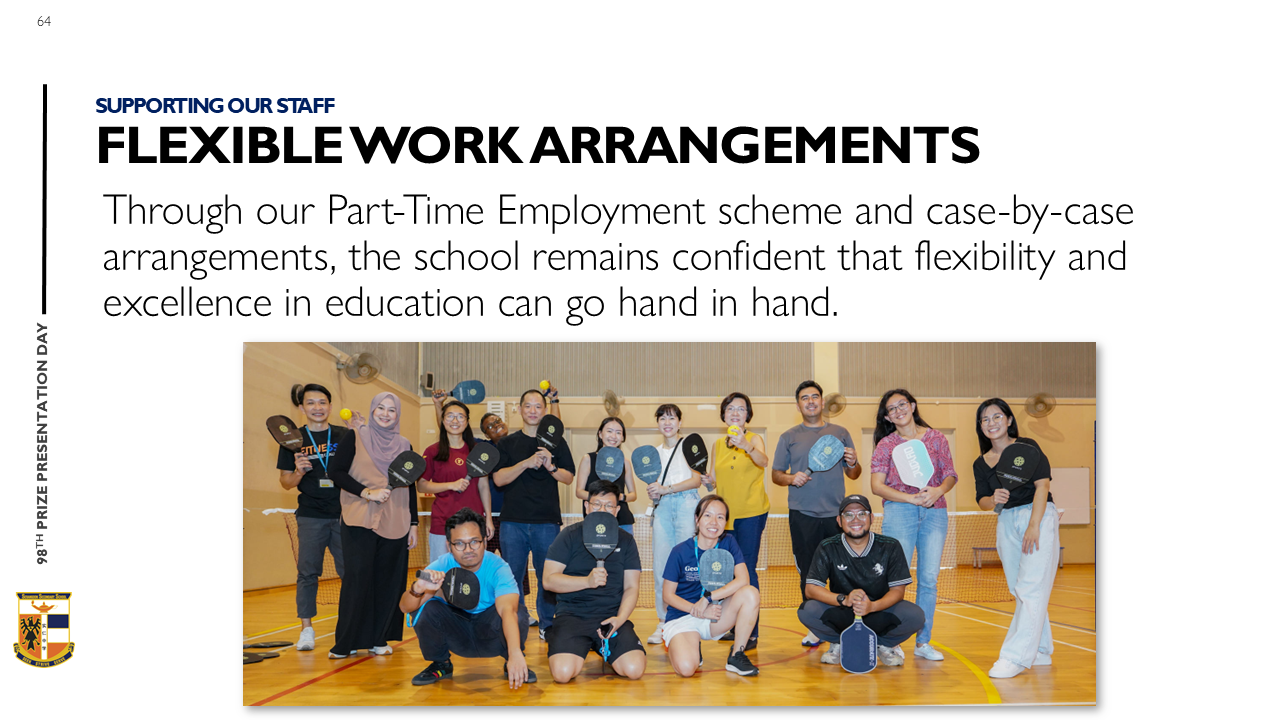
Our Part-Time Employment scheme and individualised arrangements continue to show that flexibility and educational excellence can go hand in hand.
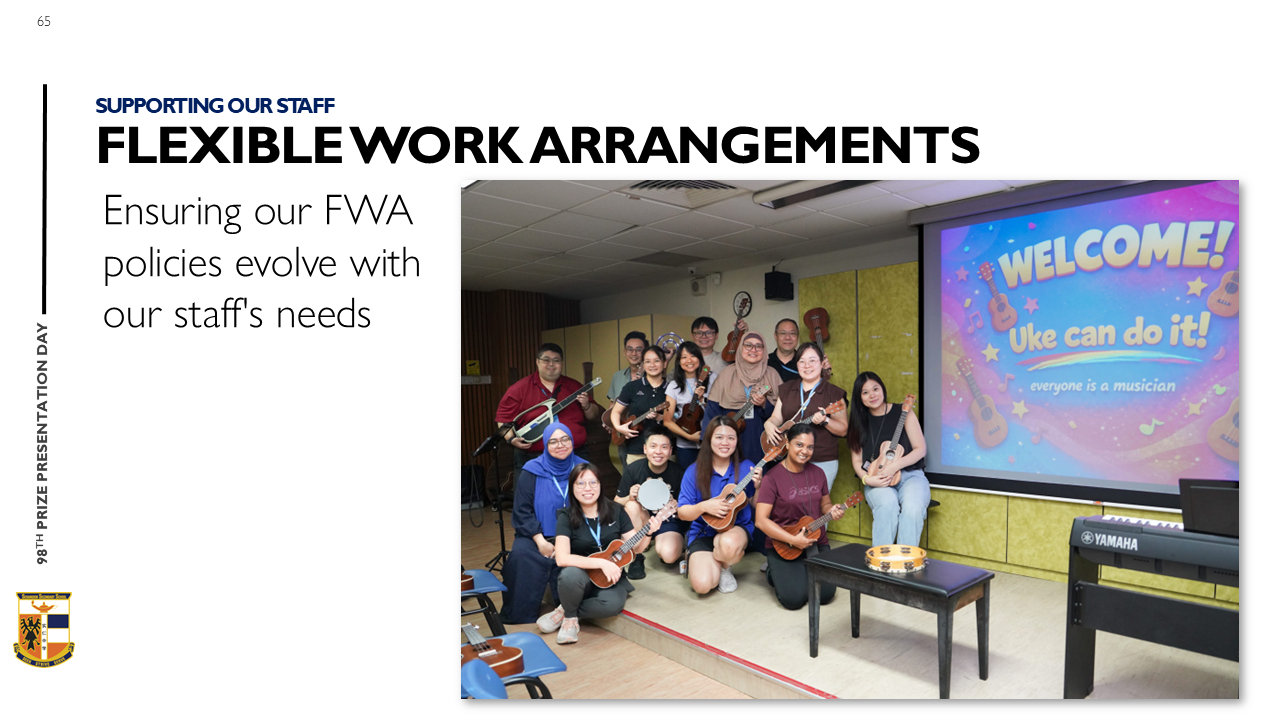
Looking ahead, we are actively exploring early dismissal arrangements for Term 3, 2026, and remain committed to regular reviews to ensure our FWA policies evolve with our staff’s needs.
H. Building and Infrastructure
60 - As part of our ongoing efforts to provide the best possible education for our students,
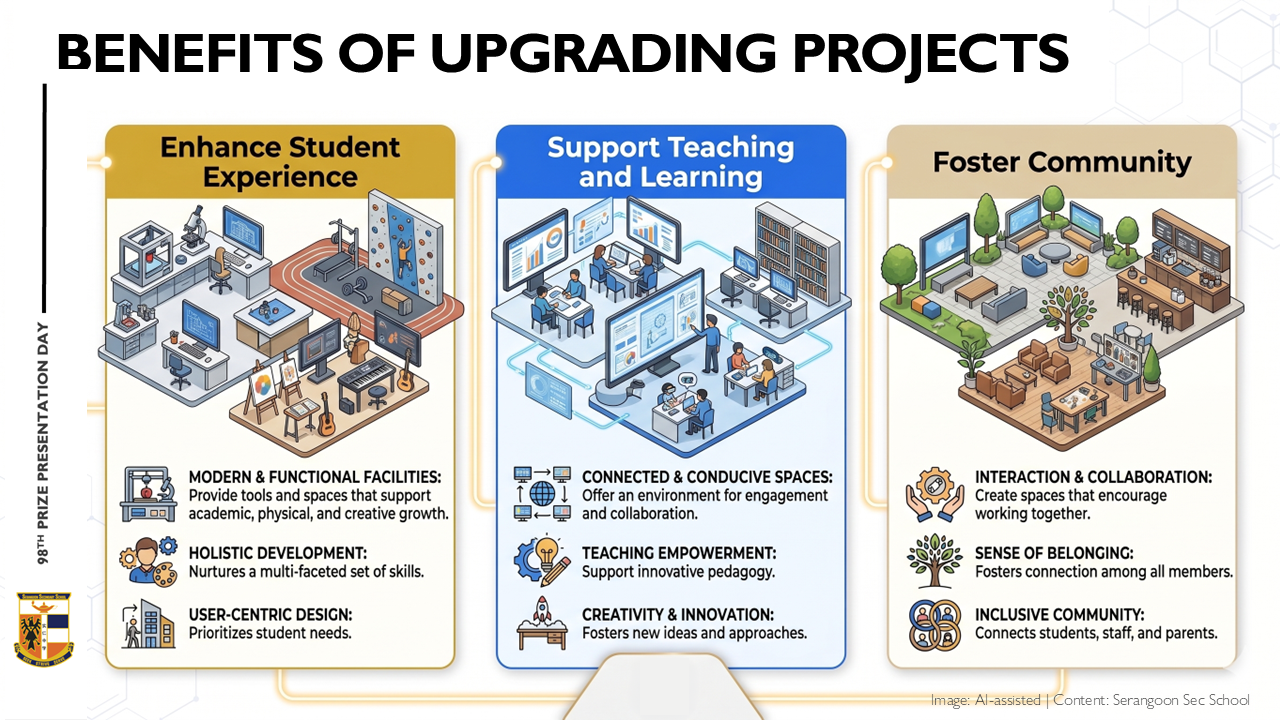
we continue work in infrastructure-upgrading projects. These enhancements will significantly improve the teaching and learning environment for all staff and students.
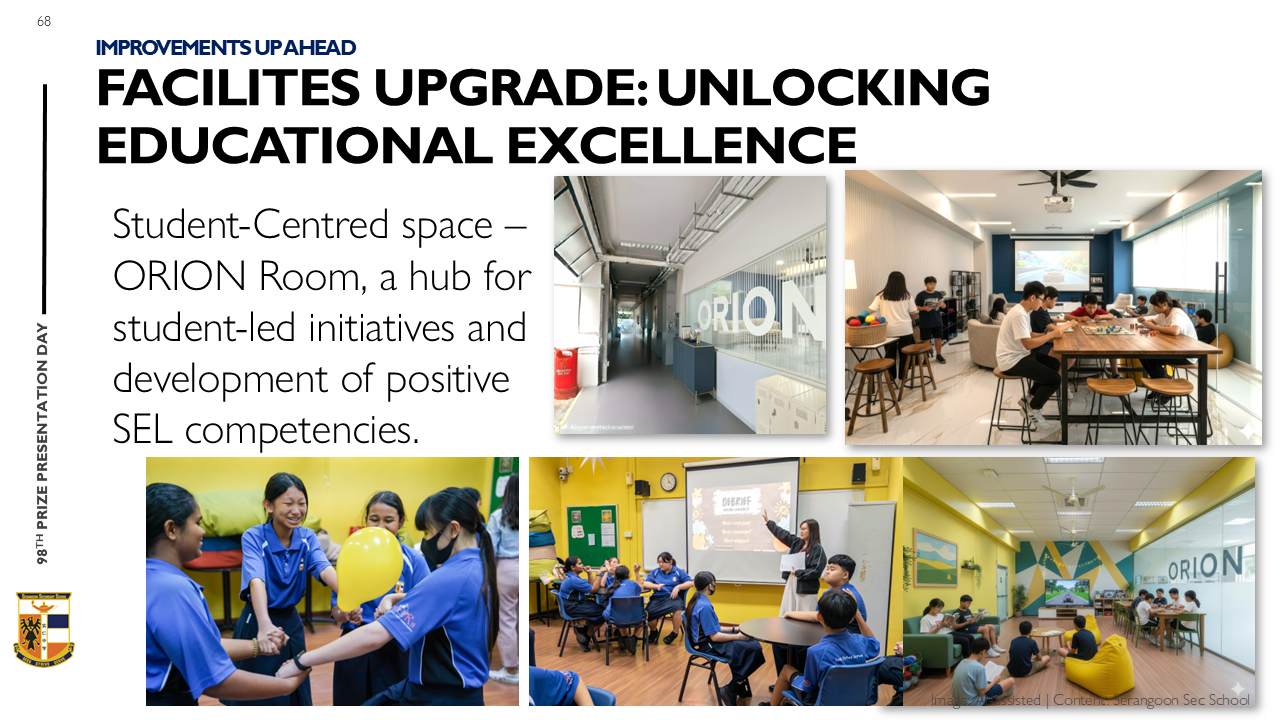
61 - I am pleased to share about the redesign of the Student Activity Centre, the ORION Room to transform it into a safe, welcoming, and student-centred space. We envision the ORION Room as a multi-functional space. Students can seek support through peer conversations and counselling. It will be a hub for student-led initiatives and other bonding activities, encouraging positive peer relationships.
62 - Importantly, student agency is at the heart of this redesign. Student leaders are actively involved in shaping the purpose and functions of the space. We want this space to reflect students’ voices, while also fostering a strong sense of ownership and belonging within the school.
63 - As we embark on our infrastructure enhancement projects, we remain cognizant that these are also powerful platforms for student leadership development. Last year marked significant milestones in our efforts to enhance the school environment for our students.
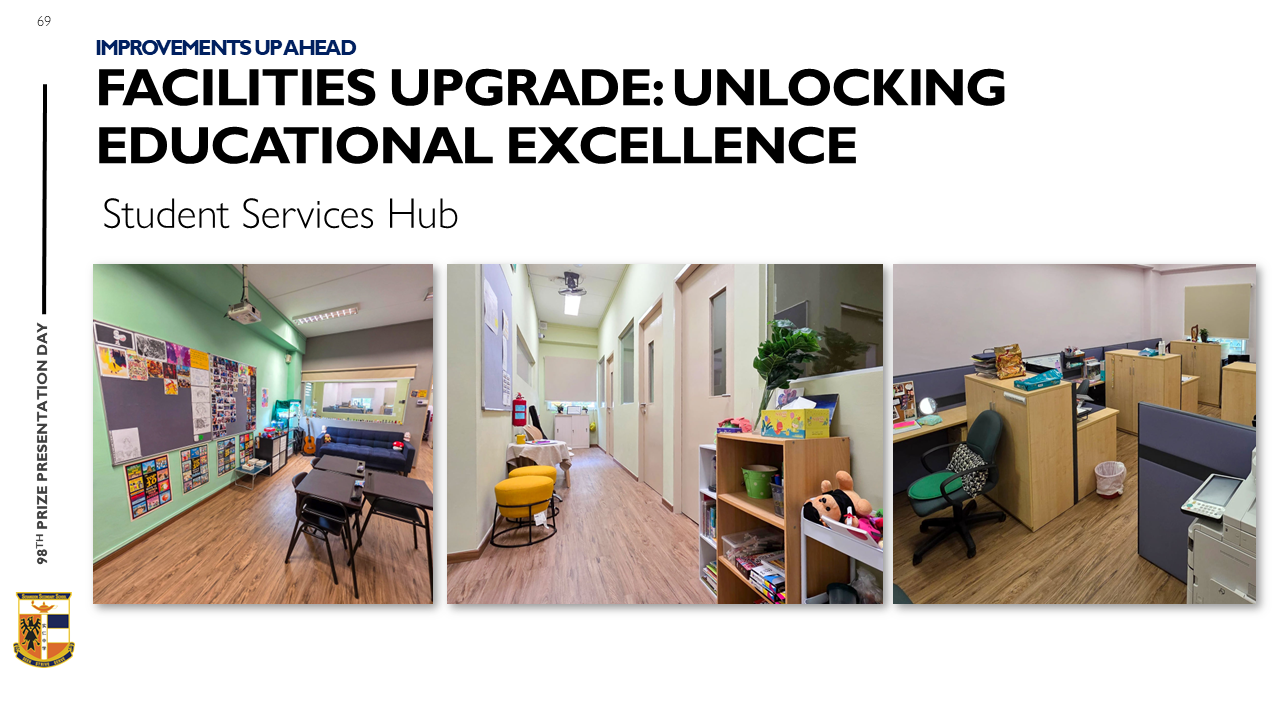
We successfully commissioned the Student Services Hub, a one-stop centre providing critical support services to our students. We also realised the long-awaited
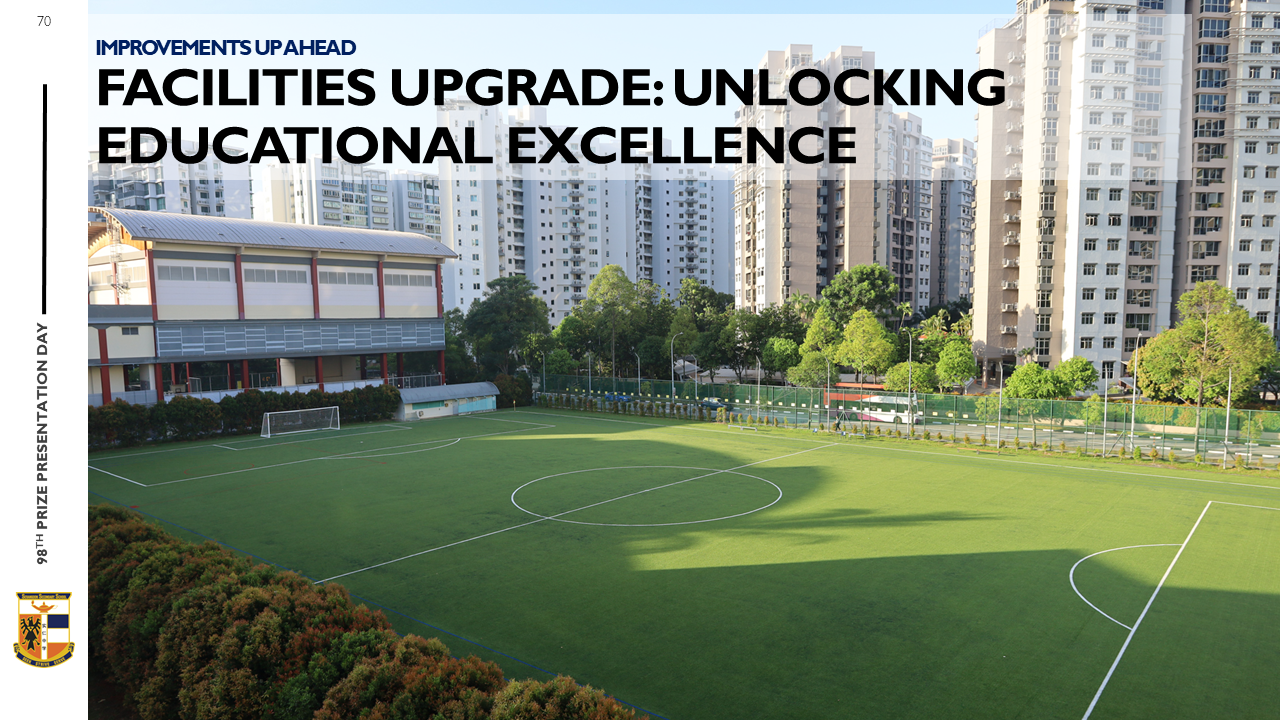
synthetic field, and completed the upgrading of our toilets, giving our students fresh and improved facilities.
64 - Building on this momentum, I am pleased to announce a series of infrastructure upgrading projects that will further transform our school environment. These enhancements reflect our unwavering commitment to providing a conducive and welcoming space where our students and staff can thrive. The upgrading works include:
65 - LED Lights and DC Fans
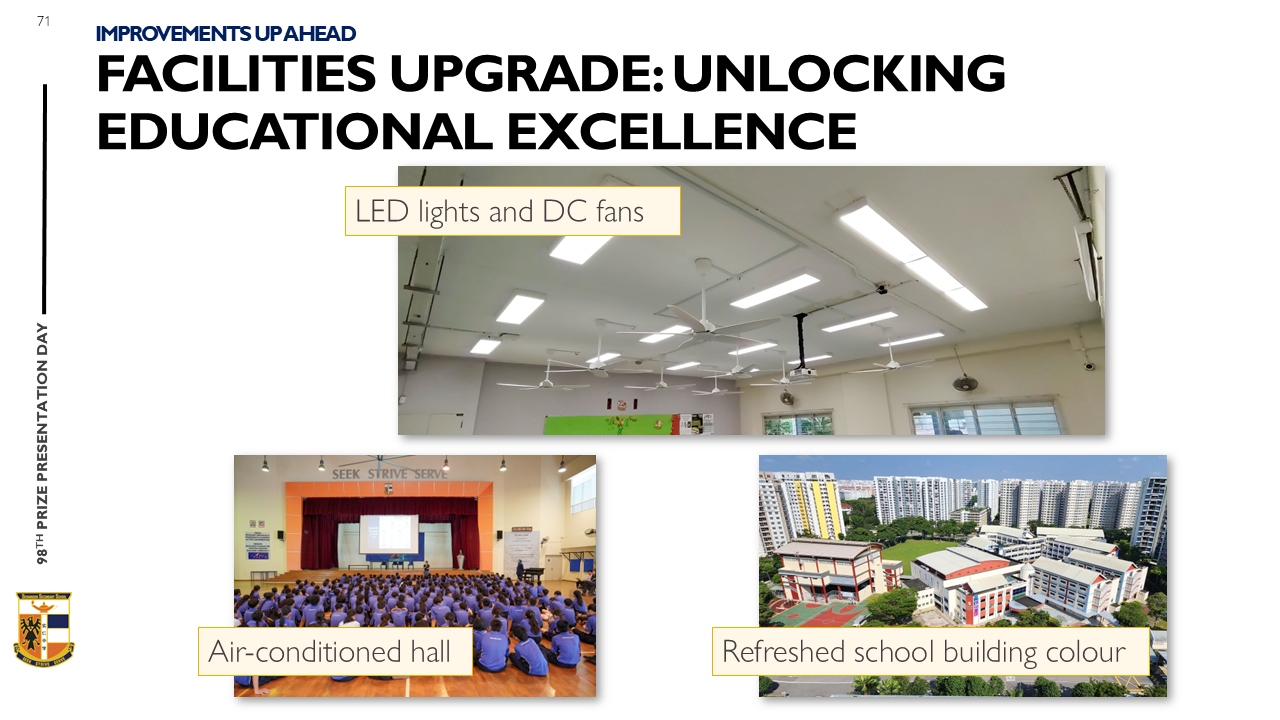
All classrooms will be equipped with LED lights and DC fans, creating a brighter, cooler, and more conducive learning environment for our students.
66 - Air-conditioned School Hall
Our school hall will be air-conditioned, ensuring that students, staff, parents, and guests can fully enjoy significant occasions such as our Prize Presentation Day, Graduation Ceremony, and concerts in comfort and ease.
67 - Repainting of School Buildings and Classrooms
Our school campus will be refreshed and reimagined through a vibrant palette of colours that brings energy and character to our classrooms and buildings. Rather than uniformity, the colour scheme will celebrate our school’s unity in diversity, giving each space a distinct identity.
68 - Reimagined Canteen
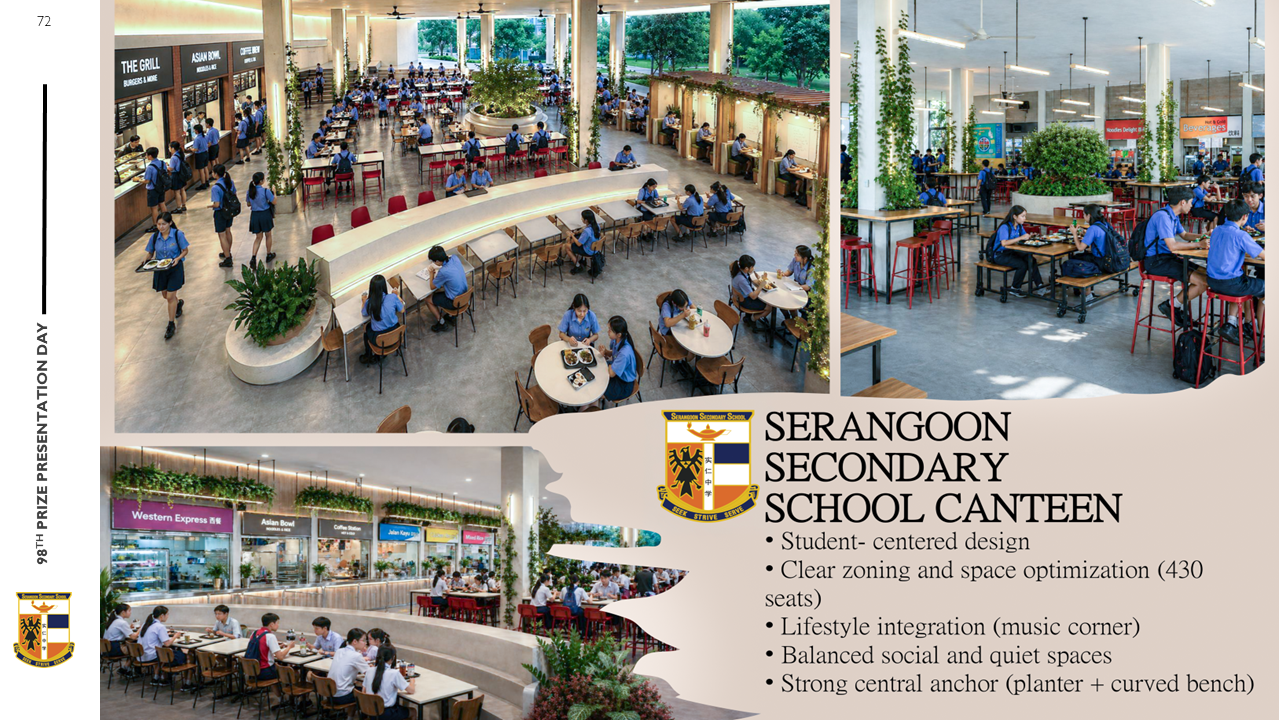
The reimagined canteen will be far more than just a dining space. Thoughtfully designed as a phone-free premier social hub, it will engage and stimulate the senses, foster meaningful connections among students, provide a platform for showcasing individual talents, and support collaborative group work.
69 - Creative Hub
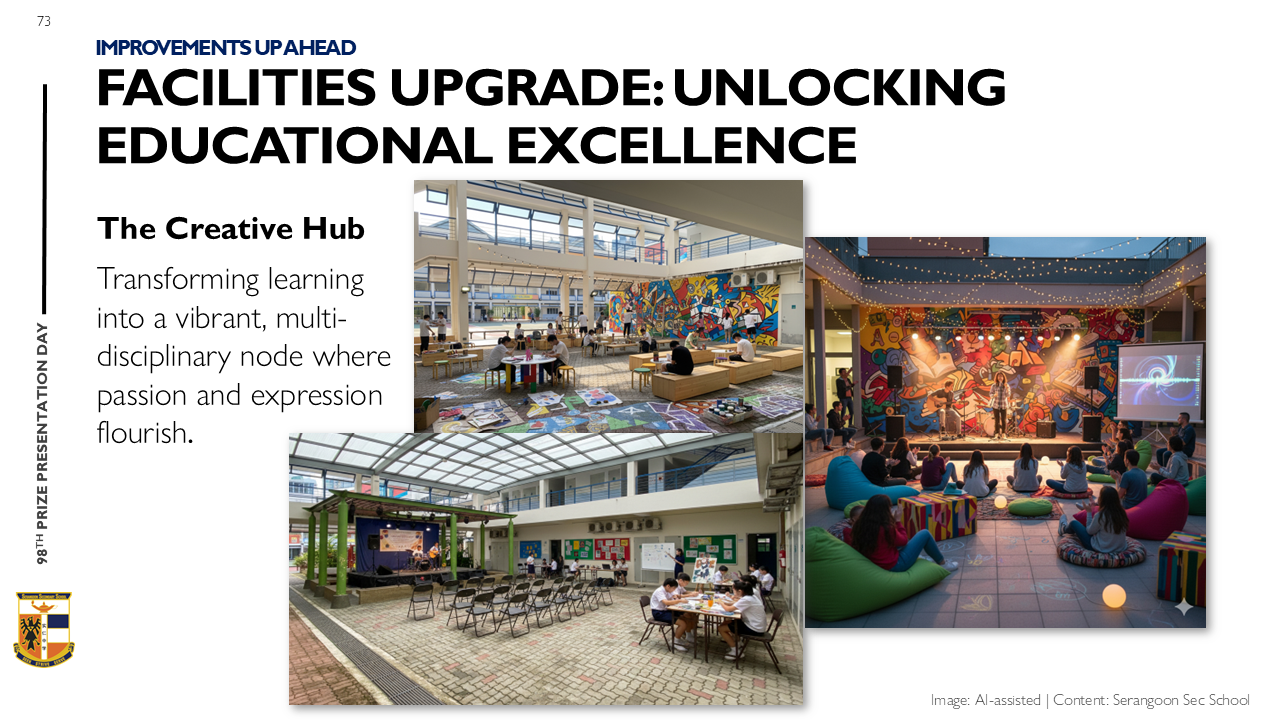
The Creative Hub will serve as a dynamic extension of our learning spaces, seamlessly connecting our arts, science, and language building into a vibrant node of creativity and expression. It will be a space where the arts in all forms flourish, talents are celebrated, and outdoor teaching and learning come alive. Students will be encouraged to experiment freely with arts and crafts, music, and the natural environment, nurturing curiosity, imagination, and a love for learning.
70 - At the heart of all these upgrading projects is the spirit of student agency and staff participation. By involving our school community in shaping these spaces, we foster a deep sense of ownership, pride, and belonging — ensuring that these are not merely physical upgrades, but meaningful investments in the soul of our school.
I. Our Partnerships
71 - No school thrives in isolation. Our partnerships with external stakeholders — be it industry partners, community organisations, or institutions of higher learning — are integral to enriching the schooling experience we provide.
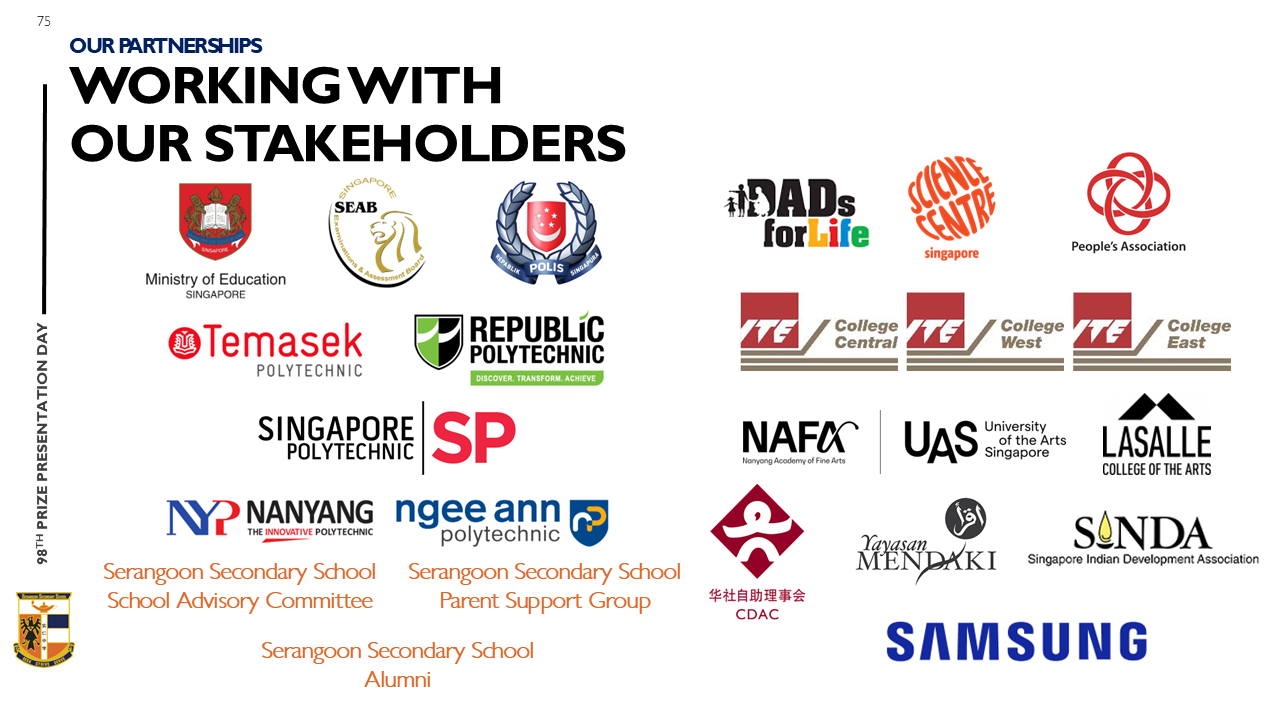
These collaborations allow us to tap into a wider pool of expertise, resources, and real-world perspectives that would be difficult to replicate within the school alone. By building a strong community of support around our students, we are able to create opportunities that are more diverse, meaningful, and relevant — preparing them not just for examinations, but for life beyond school.
72 - In our partnerships with Self-help groups, we continue our vital partnerships with CDAC, SINDA, and MENDAKI to support students through their diverse programmes. Beyond academic support, our students also contribute actively to the community.
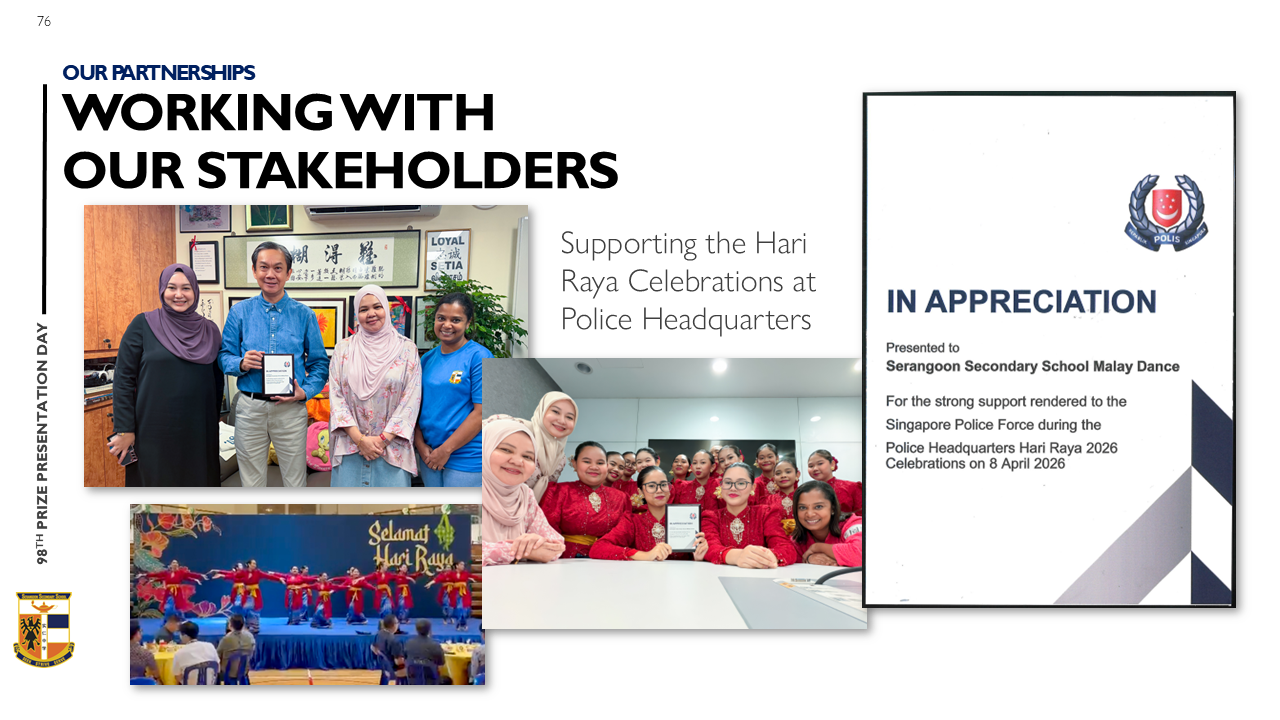
A prime example is our Malay Dance group, which recently partnered with the Police Headquarters to support and perform for their Hari Raya Celebrations, fostering strong ties with our uniformed partners.
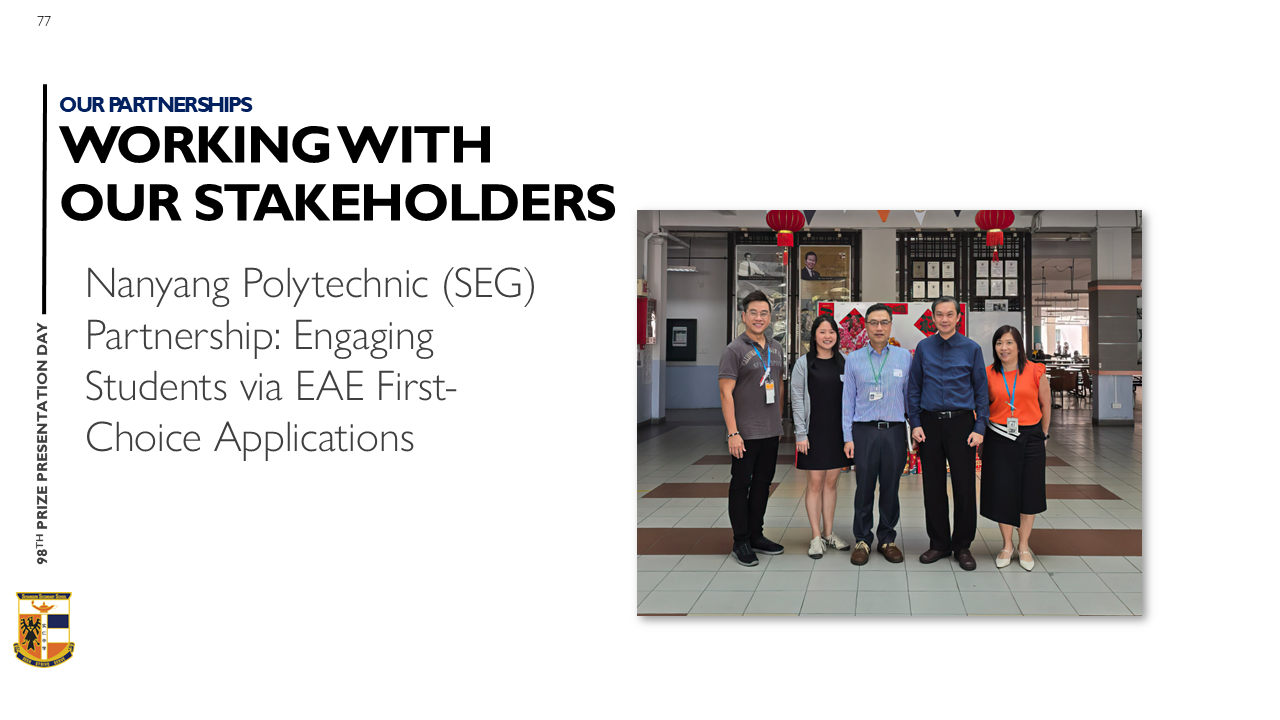
Last year, our school embarked on its first year of partnership with Nanyang Polytechnic (NYP) School of Engineering (SEG), centred on an opportunity for students who had applied to NYP SEG courses as their first choice through the EAE. To date, we are also exploring possible ECG collaborations with Republic Polytechnic, NAFA-University of the Arts Singapore and LASALLE College of the Arts.
Section I1: PSG
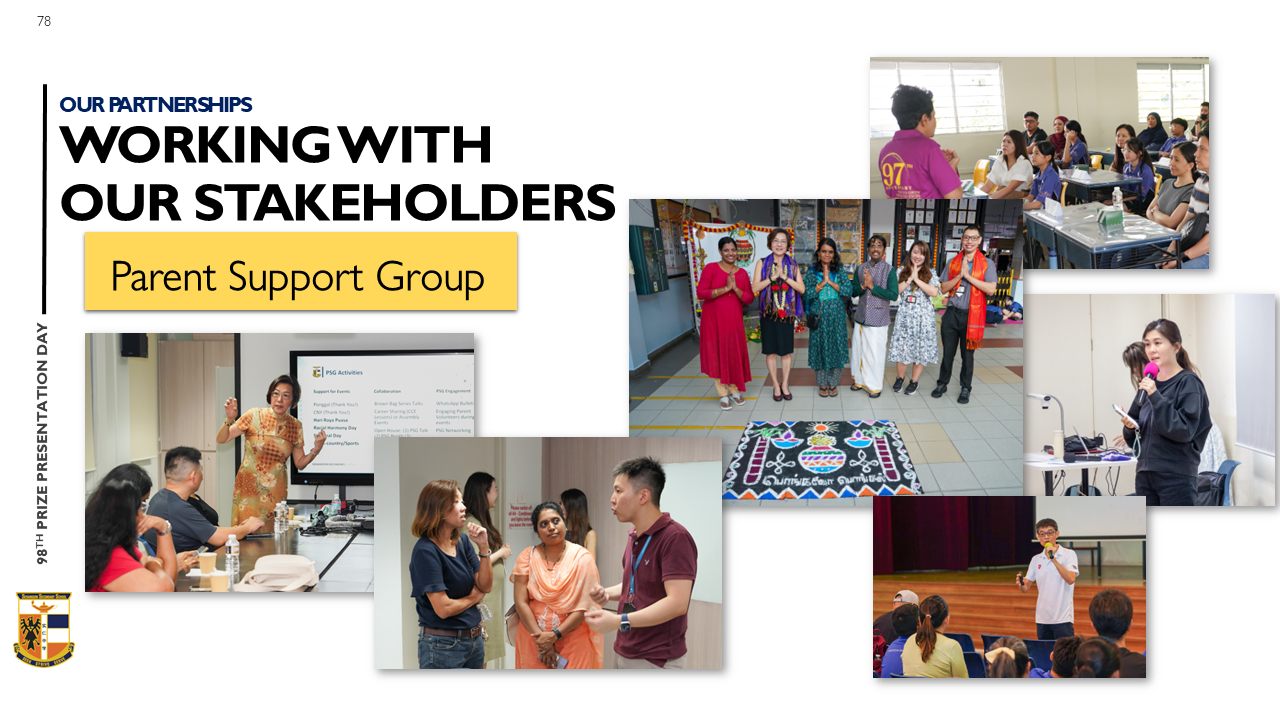
73 - Our school takes a multi-channel approach to parent engagement, ensuring parents are active partners in their child’s education. Parent Engagement Sessions are held twice a year for one-to-one conversations with form teachers, complemented by level-specific touchpoints aligned to key student milestones — from the Sec 1 Parent Engagement and CCA Orientation to the Sec 4 and 5 Post-Secondary Pathways Talk.
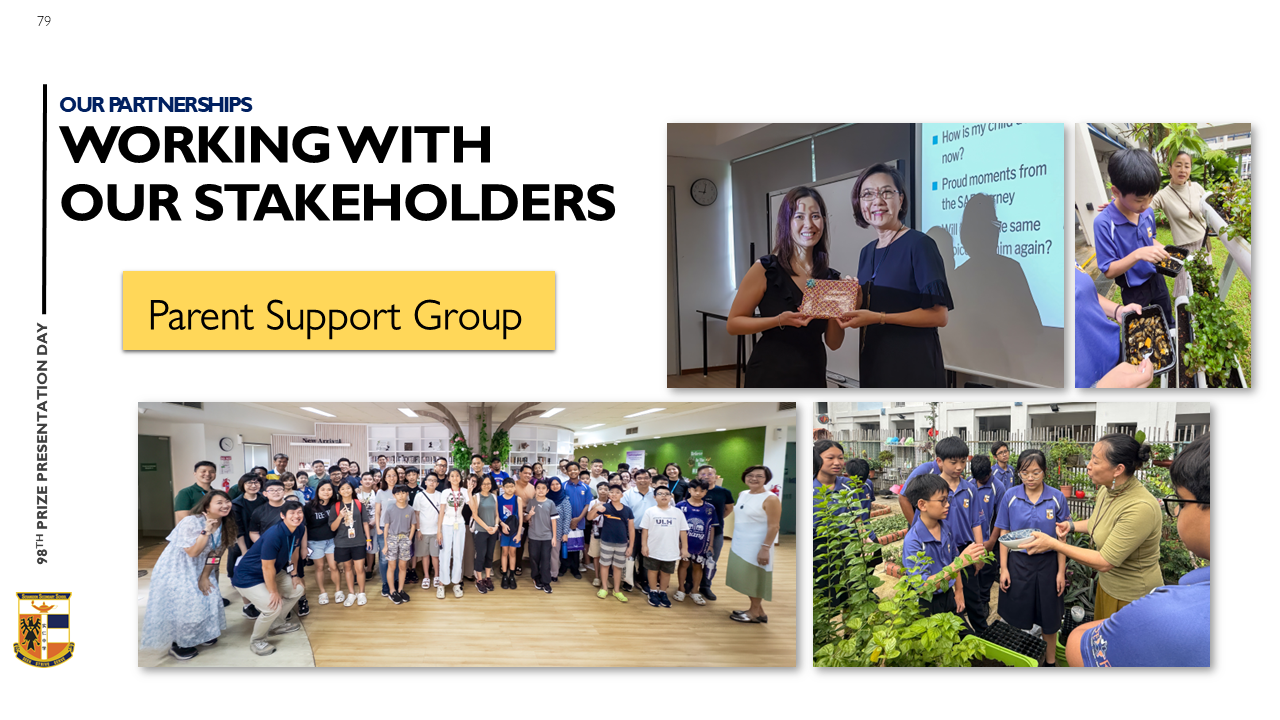
74 - Since 2025, we have deepened this partnership through two key efforts. The first is our parent-for-parent engagement model, where parents share insights and strategies with fellow parents — particularly in supporting students with Special Educational Needs.
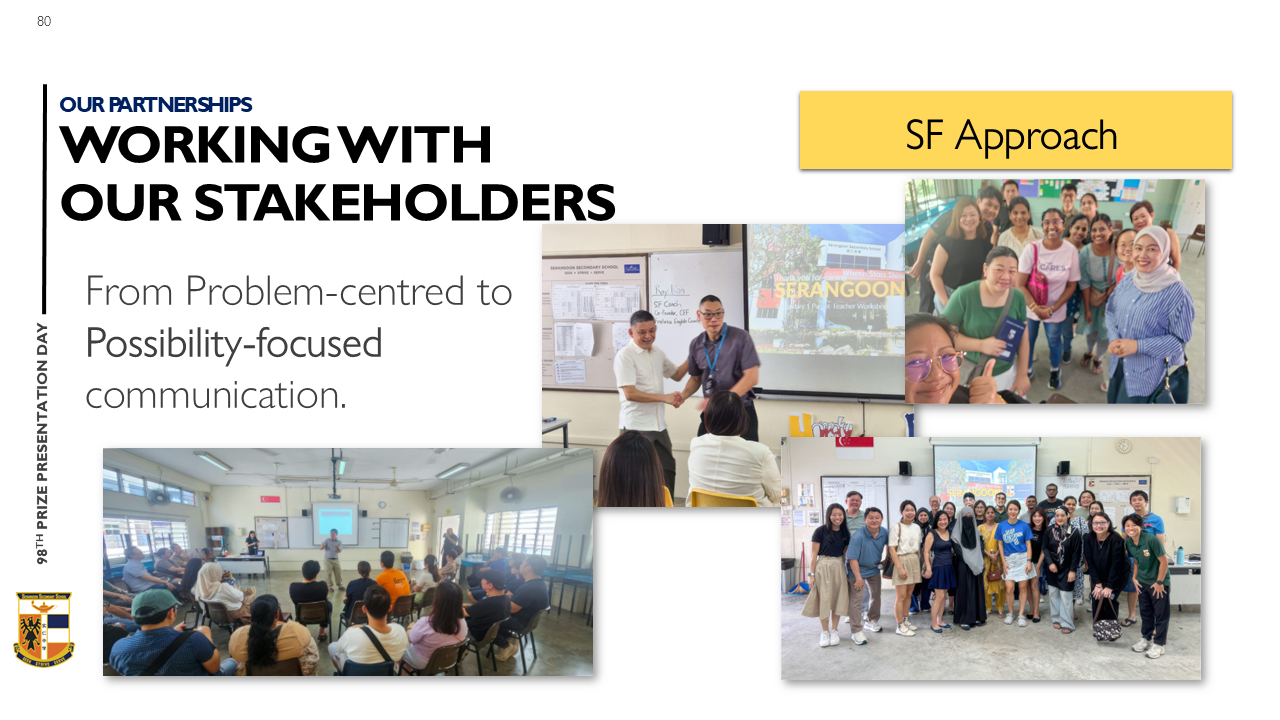
75 - The second is our Solution-Focused approach, introduced with last year’s Sec 1 cohort. This represents a deliberate shift from problem-centred to possibility-focused communication — emphasising strengths, collaborative problem-solving, and co-creating success narratives with families.
Section I2: Alumni
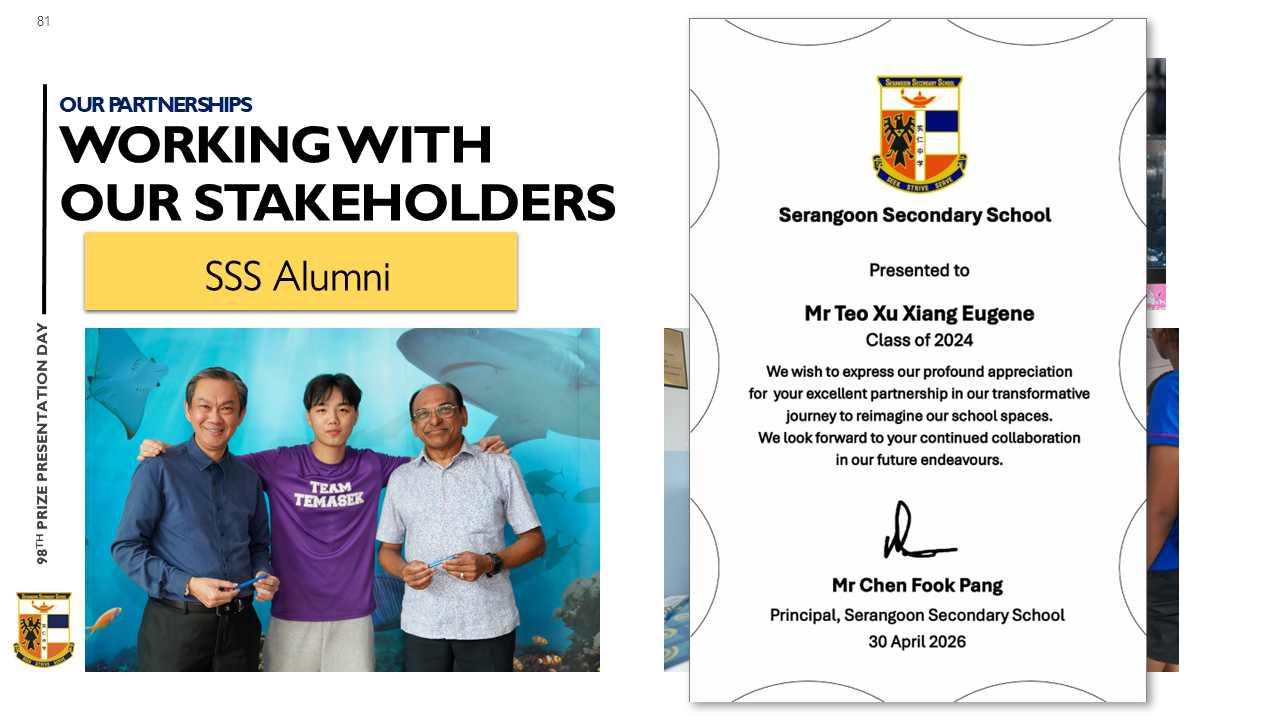
76 - We are also taking deliberate steps to build a vibrant youth alumni community that stays connected to Serangoon Secondary and gives back meaningfully. Through existing initiatives like Learning from the StaRs, our alumni are returning to share their post-secondary experiences and insights with our graduating cohorts.
We envision our youth alumni as partners and mentors who can inspire, guide, and contribute their growing expertise to enrich the school community. A wonderful example of this is Eugene, who is currently reading Architecture at Temasek Polytechnic and has gone above and beyond by actively collaborating with us on the redesign of our school canteen — bringing his emerging skills and fresh perspectives to a space that every Serangoon StaR calls their own. Eugene’s involvement exemplifies the kind of meaningful, reciprocal relationship we hope to cultivate with our alumni — one where their growth and our school’s growth go hand in hand. Let us welcome Eugene up on stage!
Section I4: School Advisory Committee
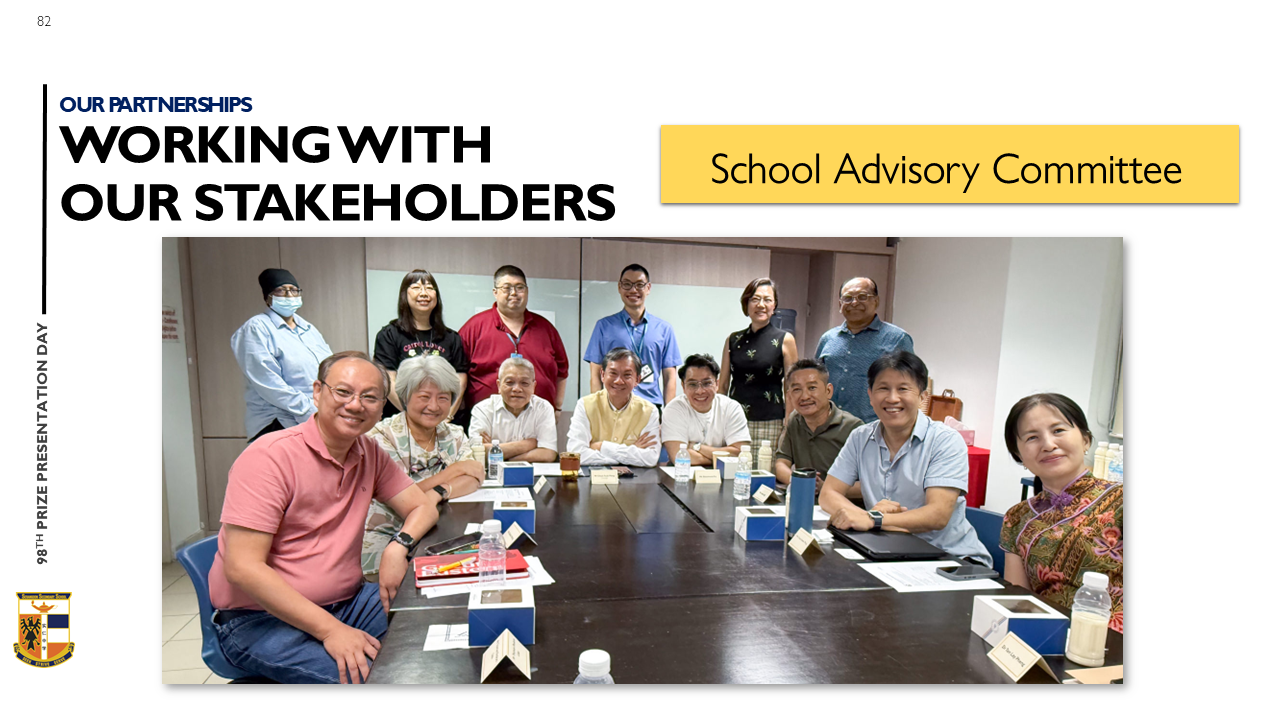
77 - Our School Advisory Committee remains an invaluable partner in enriching our students’ learning beyond the classroom. Through Brown Bag Series sessions, Prize Presentation Day addresses, and programme engagements, our SAC members bring authentic stories of resilience, adaptability, and success that resonate deeply with our students. Their contributions have been wide-ranging and meaningful. Mr Desmond Fu, our SAC Chairman, has championed the unity and resilience that define our school community. Mr Roger Foong opened students’ eyes to the value of non-linear career journeys, while Mr Andy Ng powerfully demonstrated that success extends beyond academic grades. Ms Gladys Wong’s participation in our Connecting Heartily programme further deepened students’ understanding of real-world applications of their learning.
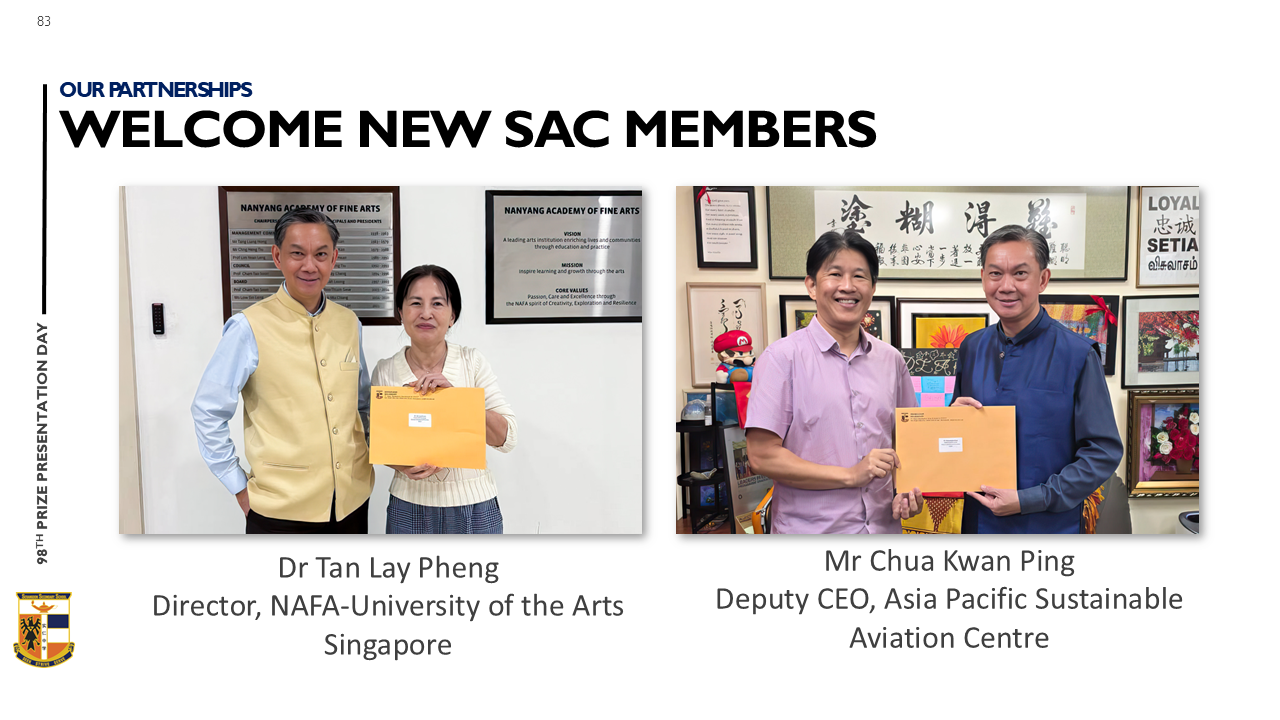
78 - We are also pleased to welcome two new members to our SAC — Dr Tan Lay Pheng, Director at NAFA-University of The Arts Singapore, and Mr Chua Kwan Ping, Deputy CEO, Asia Pacific Sustainable Aviation Centre (APSAC).. We look forward to the perspectives and expertise they will bring to our school community. Through their continued commitment, our SAC strengthens the bridge between school and community — ensuring our students are prepared not just academically, but as confident, adaptable individuals ready to make their mark on the world.
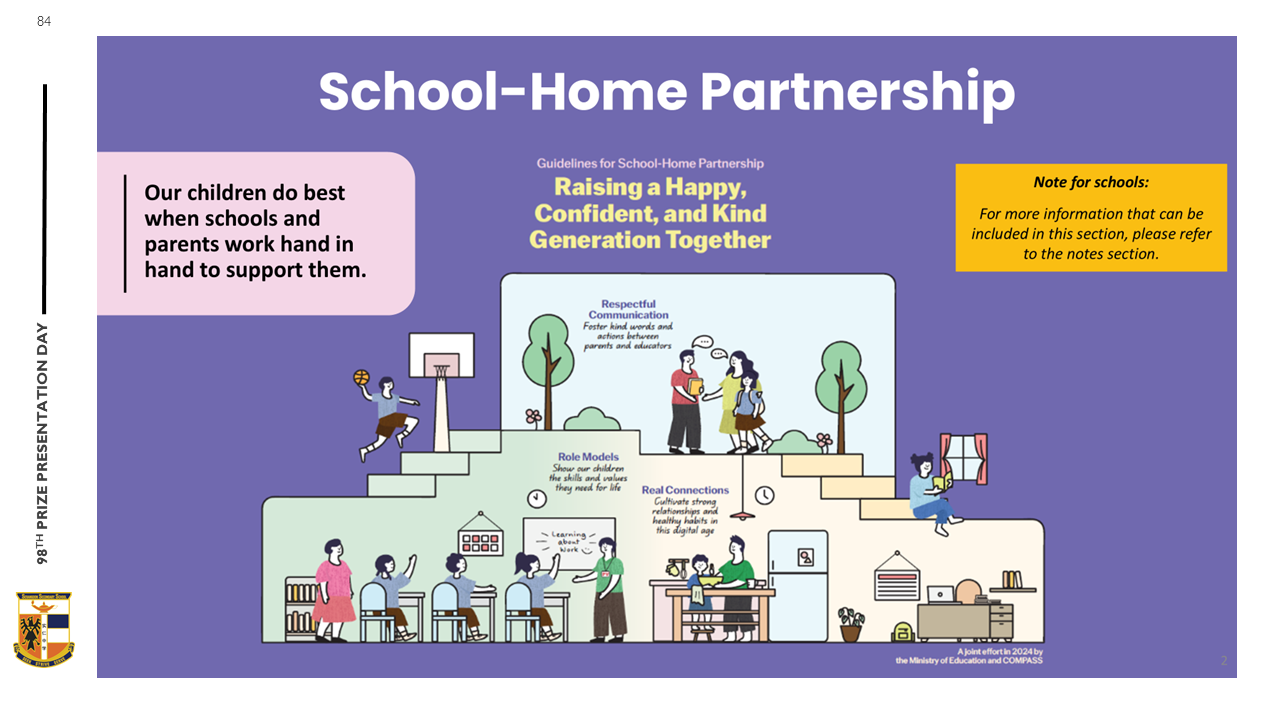
79 - Our partnership with parents is built on three foundations — Respectful Communication, Being Role Models, and Building Real Connections. Guided by the MOE Engagement Charter, we foster meaningful dialogue through open conversations and established channels, while respecting everyone’s work-life harmony.
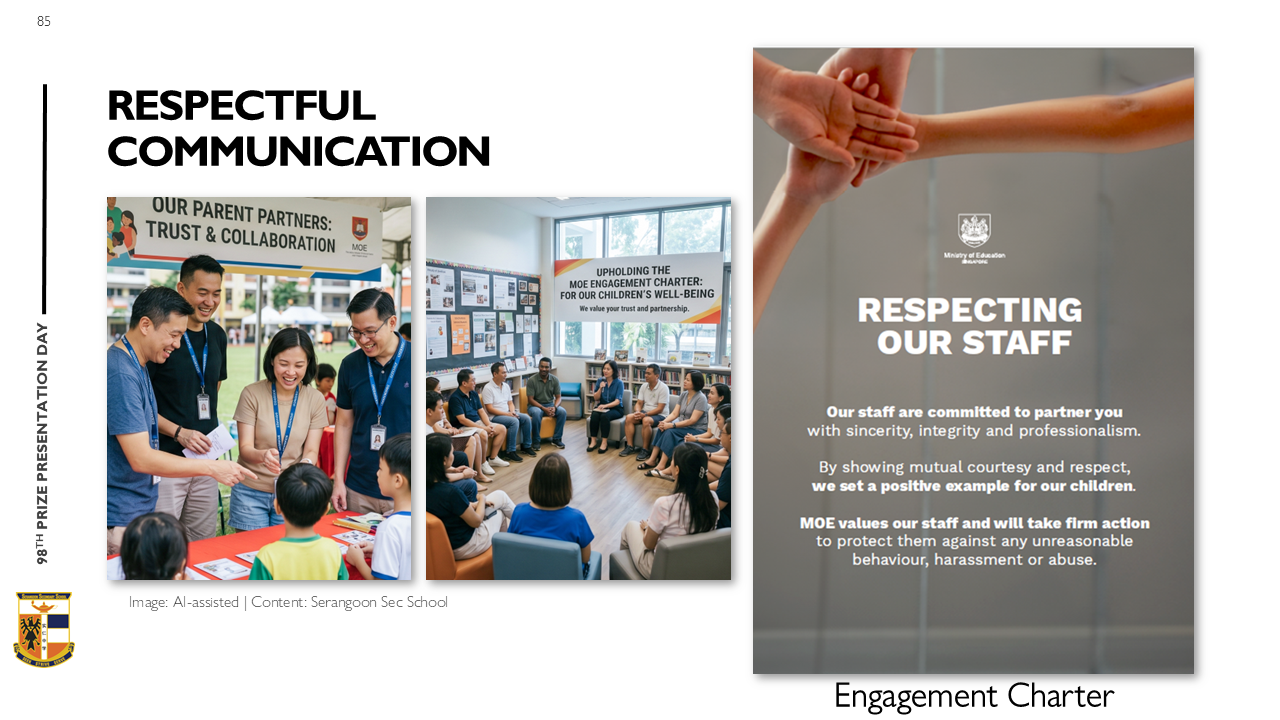
80 - I would like to sincerely thank all our parents for upholding the MOE Engagement Charter — your commitment to respectful and constructive communication makes a real difference to our school community and, most importantly, to your children. We are truly grateful for your trust and partnership.
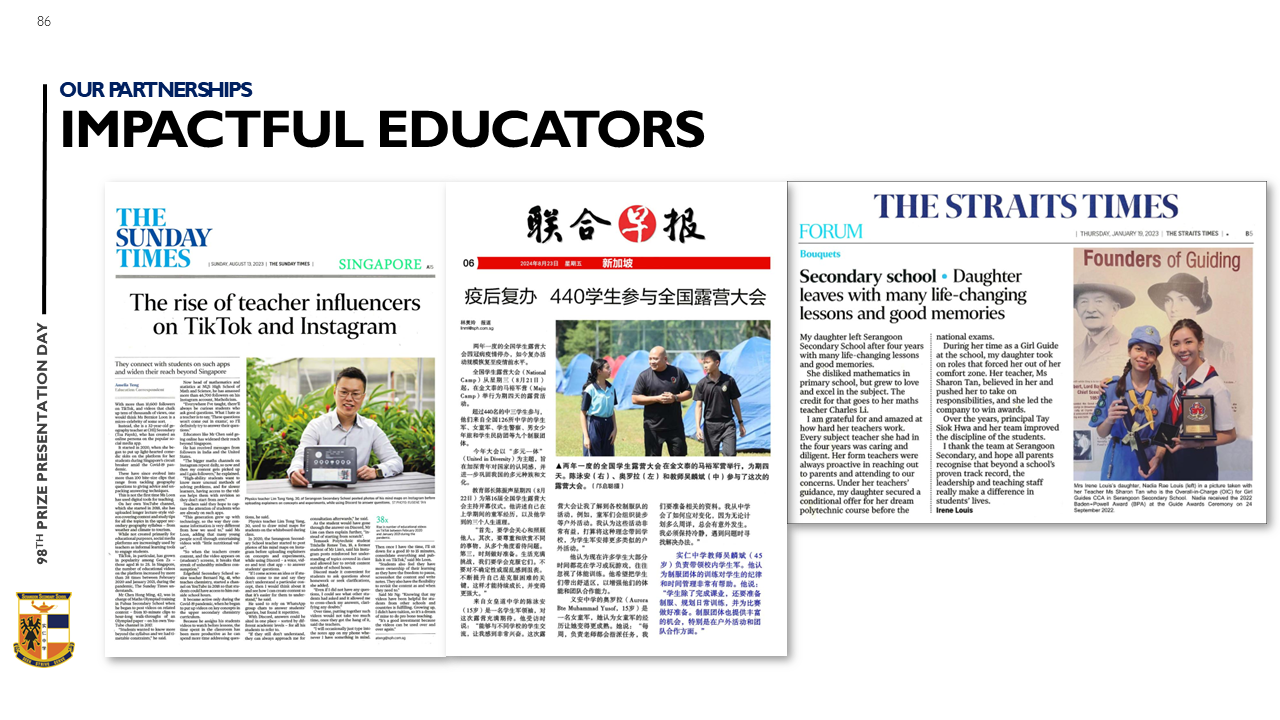
81 - Looking ahead, we’re committed to strengthening these partnerships further. Recent parent feedback highlights how our collaborative approach - from arranging bridging programmes for transitioning students to facilitating school transfers for students with medical needs - demonstrates our commitment to supporting each family’s unique circumstances. To our parents, your partnership remains invaluable. When we work together with shared understanding and purpose, we create an environment where every StaR can truly shine.
J. Close
82 - In closing, it is my hope that today’s Prize Presentation Day be a celebration of all that our StaRs have accomplished and all that they aspire to become.
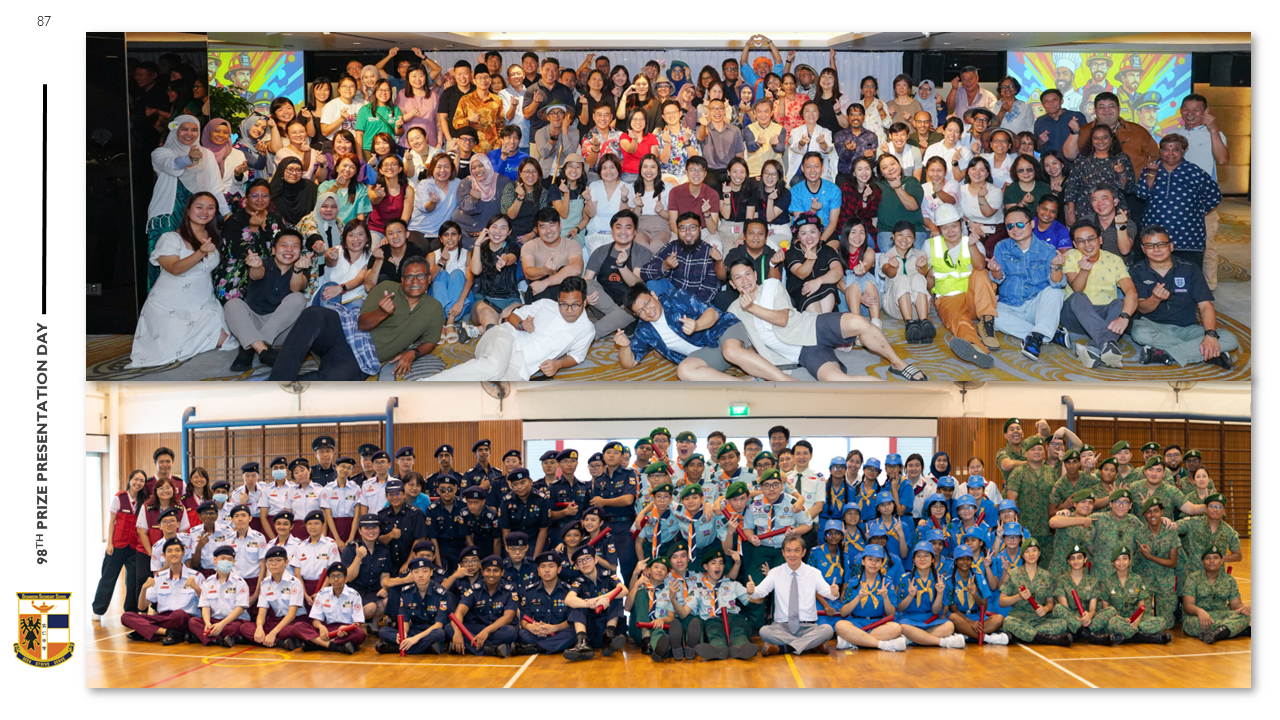
83 - At the heart of our school community is our One StaR Family. As a One StaR Family, we work hard together to make Serangoon Secondary a whole greater than the sum of its parts. The bonds we share are not just valuable; they are the very essence of who we are and what we strive to achieve together as a school.
84 - From this nucleus, we have our 2 Core Teams. These are our Education Officers, and our School Admin Team. Together, our school’s 2 Core Teams serve as the backbone of our school.
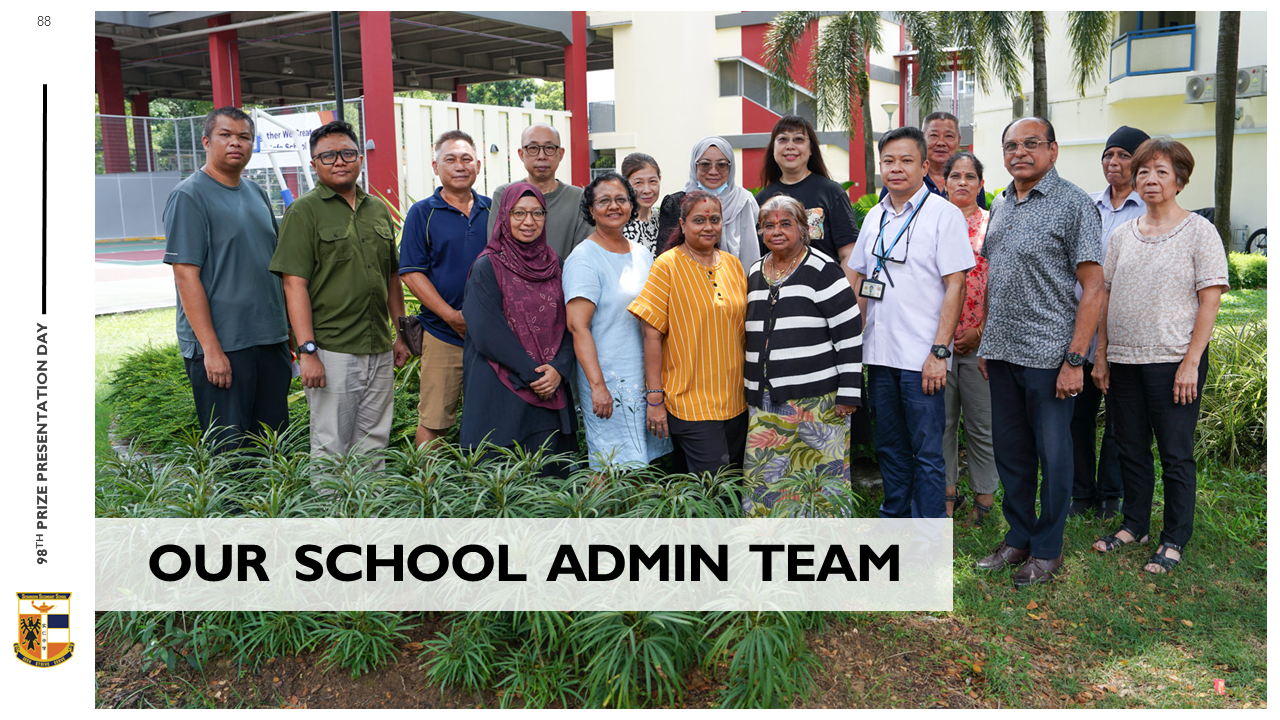
85 - Our School Admin Team is the heartbeat of our administrative operations, providing essential support, guidance, and expertise that keep our school running smoothly day in and day out.
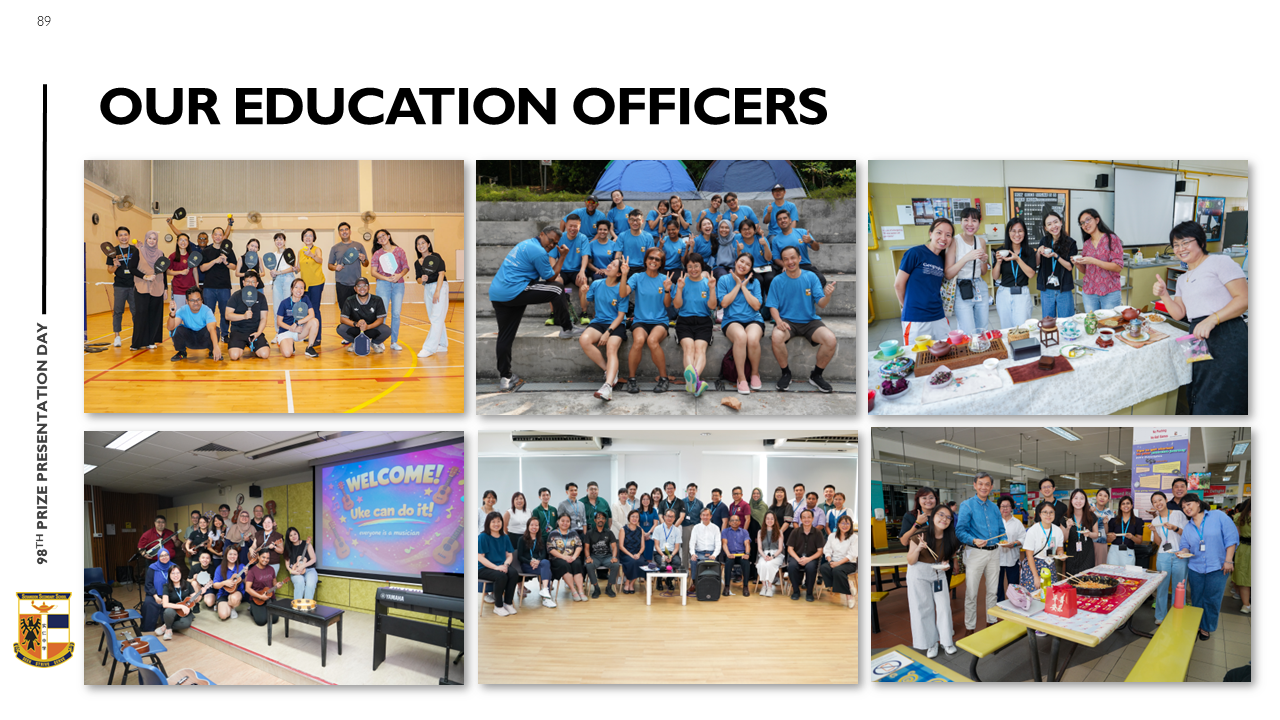
86 - Our Education Officers are our unsung heroes who work hard behind the scenes and in the forefront every day to enable us to fulfil our core business as a school, that is to deliver a high-quality education to every student.
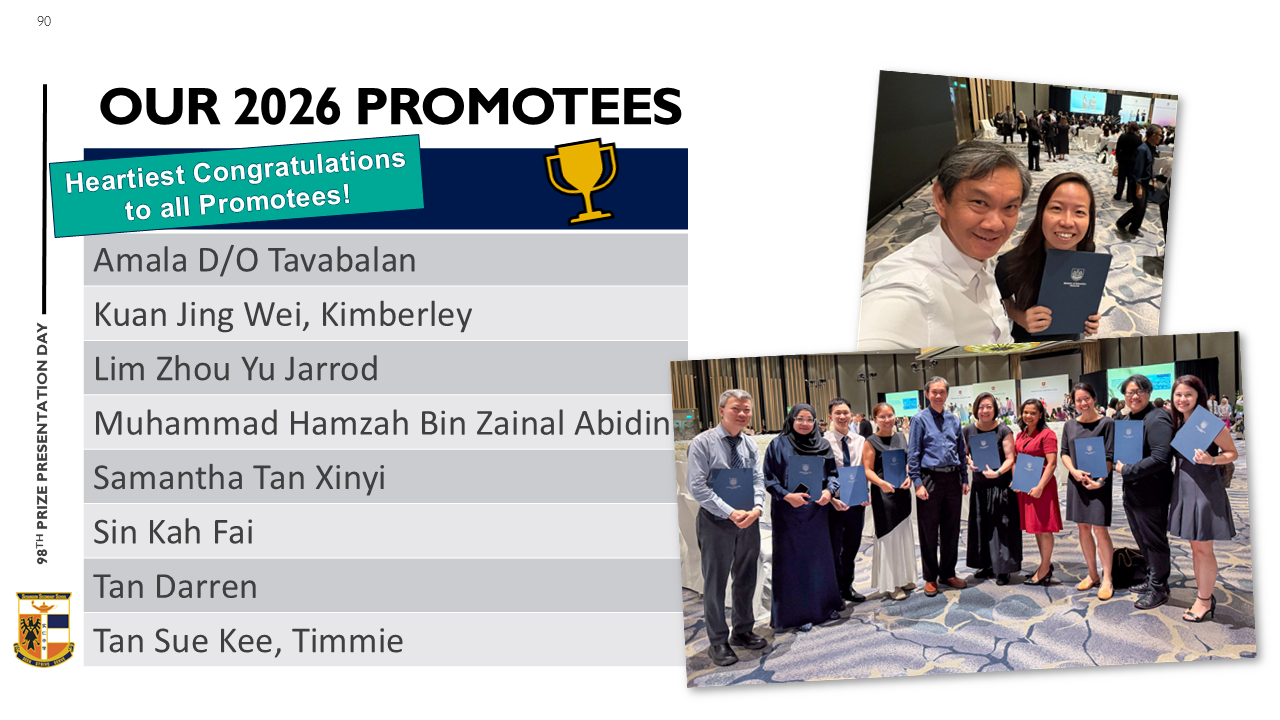
87 - On this note, I would like to extend my heartiest congratulations to all the staff who are promoted in April 2026.
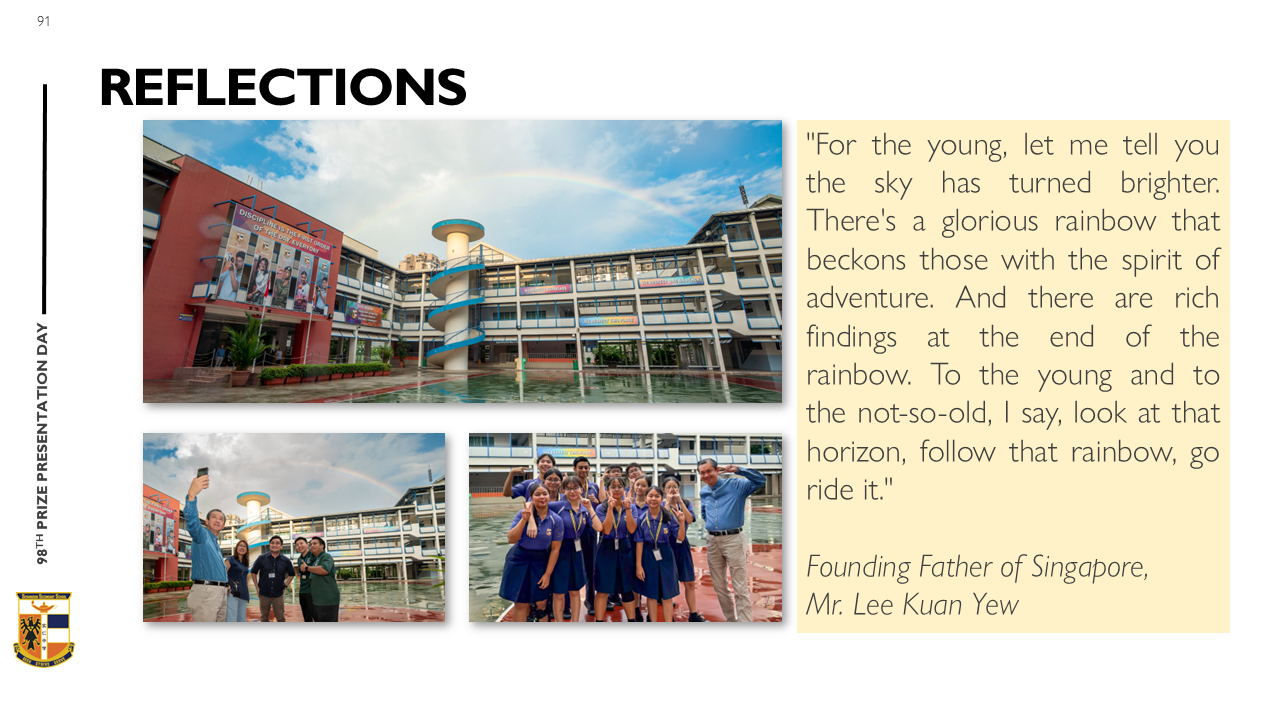
88 - Reflecting on my years at Serangoon Secondary School, Staff Welfare has been one of the most important domains driving us forward. I have always believed that taking care of the school means taking care of our people first. To lift a quote from our founding father, our late PM LKY “For the young, let me tell you the sky has turned brighter. There’s a glorious rainbow that beckons those with the spirit of adventure. And there are rich findings at the end of the rainbow. To the young and to the not-so-old, I say, look at that horizon, follow that rainbow, go ride it.” Diving deeper into the text, he meant to say that This signals hope and optimism after a difficult period. “Sky has turned brighter” suggests clouds/trouble have passed. For students, it frames the future as full of possibility, not fear..The “rainbow” = new opportunities, dreams, goals. But it only “beckons” — calls out to — people willing to take risks and explore. No adventure, no rainbow…“Rich findings” = growth, skills, friendships, purpose, character. It’s about what you become on the journey…“Young and not-so-old” = Inclusive. This isn’t just for Sec 1s — staff, alumni, parents can all still chase dreams…Have vision. Lift your eyes beyond the daily grind…“Follow that rainbow” = Commit to the journey. It takes Self-directedness and Resilience….“Go ride it” = Don’t just watch — act. Be bold. This is the call to agency and leadership.
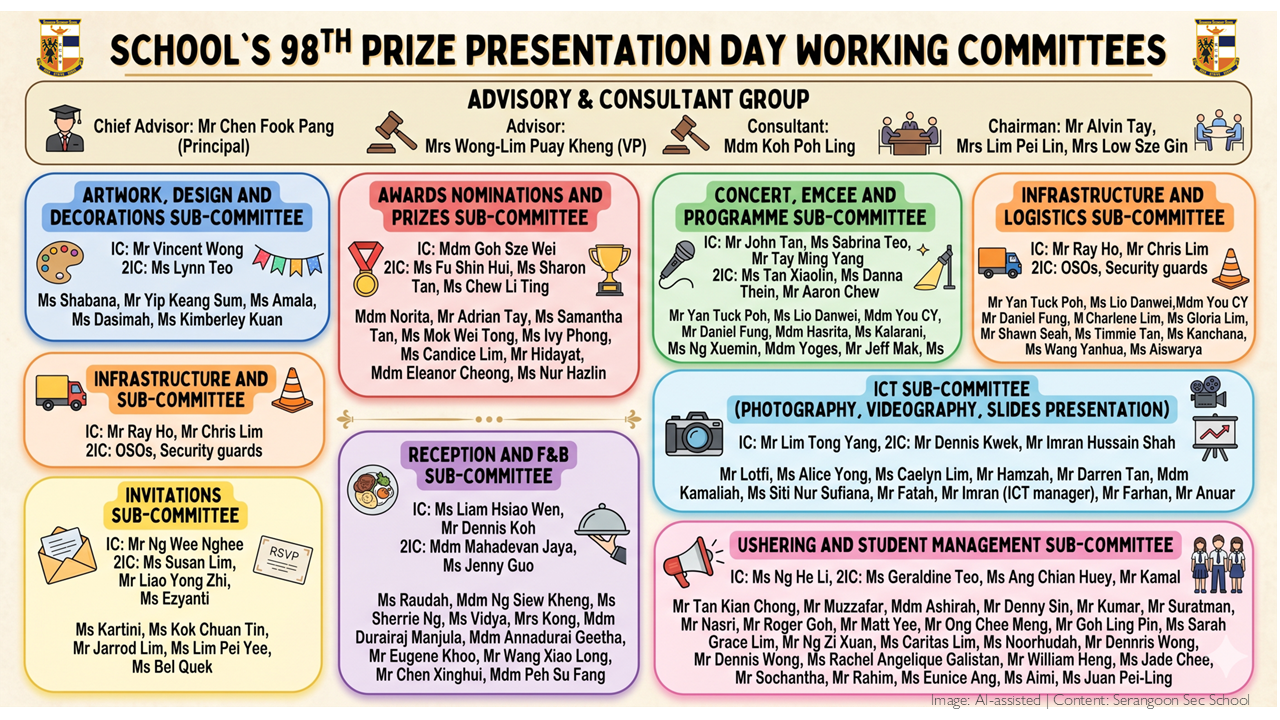
89 - I would like to thank the core planning committee led by VP/ Mrs Wong, VP/ Mr Marc, VPA/ Mr Raja, HOD C&T/ Alvin, HOD Data Management/ Pei Lin and HOD Science/ Sze Gin and the entire school team for their hard work and perseverance, without which this 98th Prize Presentation Day would not have been possible.
90 - Thank you for your presence today.
Good morning,
School Advisory Committee Members,
Principal, Mr Remington Chen,
Vice-Principals, teachers, parents,
and most importantly, students of Serangoon Secondary School.
2 - It is such a privilege for me to be here today at the 98th Prize Presentation Day. Today is not just about awards or grades. It is about celebrating effort, growth, and the journey each of you has taken to get here.
3 - First, my heartiest congratulations to all prize recipients. Your hard work and perseverance have brought you here. But remember, it is not just about the awards. The late nights, the challenges you overcame, and the small steps you have taken to improve yourselves are just as important. They form the foundation of your future success.
4 - I would like to recognise a few individuals who have gone above and beyond. Alumni Lum Yip Hon, Derren, will receive the 2nd Tier Friends of SSS Award for his ongoing contributions. As Senior Cadet Inspector, he has led the NPCC drill team, mentored new cadets, and volunteered regularly. His dedication shows that leadership and giving back can continue long after you leave school.
5 - This year’s valedictorian, Richelle Lim Jia Rui, has excelled in academics, conduct, and CCA while holding top leadership roles. She has been nominated for the Lee Kuan Yew All Round Excellence Award and received the Red Cross Youth Director’s Award in 2025. Richelle proves that hard work, discipline, and passion can take you far in every area of life.
6 - Their stories remind us that success is not just about grades. It is about character, contribution, leadership, and the impact you have on others.
7 - Today, I want to share three points with you. First, the value of school partnerships. Second, my personal education journey in this school. Third, why life skills and soft skills matter as much as academic achievements.
8 - One-way schools prepare you for life is through partnerships with our Institutes of Higher Learning.
9 - These collaborations give you opportunities to experience learning in real-life contexts, beyond the classroom.
10 - Partnering with Institutes of Higher Learning (IHLs), like ITEs, polytechnics or universities, is important for secondary schools for several key reasons, especially in preparing students for life beyond the classroom:
11 - IHLs allow students to try out subjects, projects, or disciplines they might not have at school. These help them discover interests, strengths, and potential career paths early, reducing uncertainty when choosing post-secondary education.
12 - Familiarity with the teaching styles at IHLs, project-based work, and collaborative learning platforms prepare students for the demands of polytechnics or universities. They develop confidence and skills that make the transition smoother and less intimidating.
13 - In short, partnering with IHLs allows students like you, experience learning in “real world” contexts, develop essential life skills and soft skills, explore future pathways, and build confidence for life after school. It transforms education from just preparing for exams to preparing for life.
14 - On that note, the partnership between Serangoon Secondary School and Republic Polytechnic aligns perfectly with the recent 2026 Minister of Education Committee of Supply debate. During the session, Minister Desmond Lee highlighted the importance of Education and Career Guidance, real-world learning, and career fairs under the theme: “We Learn for Life Together: Building a ‘We First’ Society through Education.”
15 - You will be happy to learn that more than 700 Serangoon Secondary students have already benefited from our mass learning journeys and talks from 2024 to date. This sustained collaboration ensures that students like you, gain the clarity and confidence they need to navigate future pathways as they work toward their #GreaterMe.
16 - Next, I’d like to share a bit about my personal journey in this school. I’m a proud alumnus of SSS, but the truth is, my time here wasn’t always smooth. During my years here from 1984 to 1990, I focused heavily on my CCA, and as a result, my academic performance suffered.
17 - In my first year, I failed almost all my subjects and had to move from the Express stream to the Normal stream. Later, my first attempt at the O Levels didn’t go well either. It was a tough period—my options seemed limited, and I felt disheartened.
18 - But these setbacks taught me something important. They are part of the journey, a start on growth and progress. I learned to refocus and persevere. I also learned the importance of taking chances. My principal then, offered me the chance to retake my O Levels. While hesitant, the “yes”, helped me to discover possibilities I never would have known otherwise. Slowly, things began to turn around through support and trust from teachers, and new friends.
20 - Taking a quote from my student at a conference. “You miss 100 percent of the chances you do not take”. Life rarely offers second invitations. Growth happens when you grab the opportunities in front of you. Remember, a stumble does not define you. How you respond, pick yourself up and keep moving forward is what truly defines you.
21 - Finally, let’s talk about skills beyond academics. Grades are important and they measure knowledge, but academics alone cannot prepare you for the real world.
22 - Life skills such as resilience, adaptability, problem-solving, and self-awareness teaches you how to respond when life does not go as planned. They help you recover from setbacks, make decisions, and keep moving forward even when things get tough.
23 - Soft skills such as communication, teamwork, empathy, and leadership allow you to connect with people, collaborate effectively, and influence others positively.
24 - Think of it this way. Academics open doors, but life and soft skills determine how far you go once you are inside. Your grades may get you into university or a job, but your ability to adapt, communicate, and work with others is what helps you thrive and make a real impact.
25 - In summary, academics give you knowledge. Life skills give you resilience. Soft skills give you influence. Together, they prepare you not just to succeed in tests, but to succeed in life.
26 - To all teachers of Serangoon Secondary School, thank you for all your selfless efforts in guiding these students, not just academically but in the lives, you are shaping in this school.
27 - To all parents gathered here, you are a pillar of strength for your children. Your continuous support and encouragement for your child may go unnoticed, but it is essential and greatly appreciated. Today, put your anxieties aside and be proud of your child for what they have achieved.
28 - And finally, to the students, remember - success is not just about grades or awards. It is about the person you are becoming. No matter your post-secondary pathway – Junior College, Polytechnic, ITE or other institutions, keep learning, keep growing, take chances, fail sometimes, pick yourself up, and keep moving forward. Your journey is your story. Make it one worth telling.
29 - Once again - CONGRATULATIONS!!
Mr. Fu Chuan Chong
Director, School of Hospitality, Republic Polytechnic
Former student of SSS